

2.5 Visco-Elastic Damage Model
51
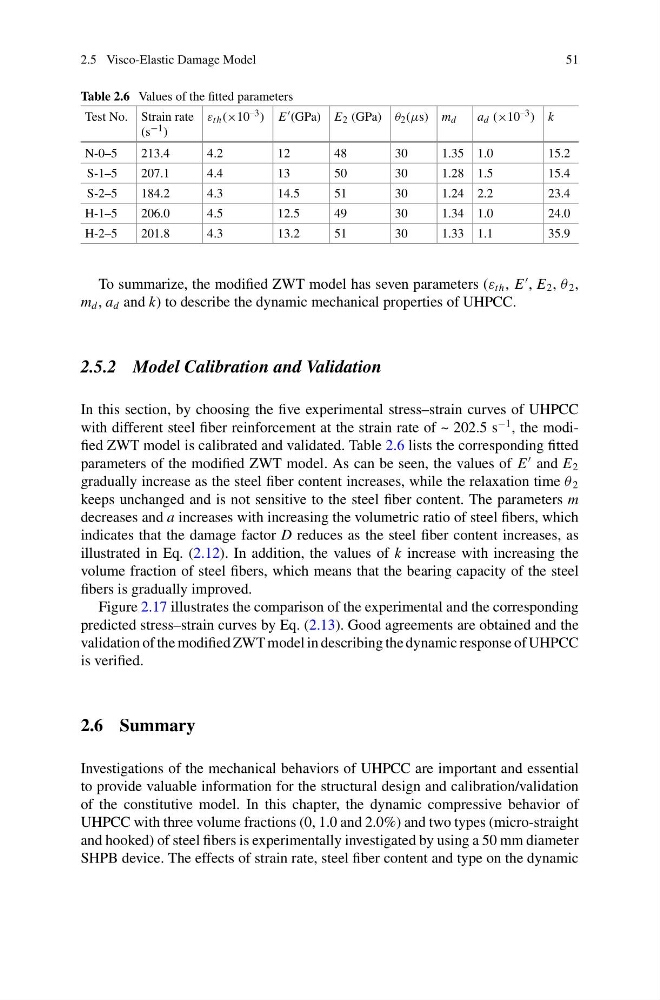
Table 2.6 Values of the fitted parameters
Test No. Strain rate
(s −1 )
ε th (×10 –3 ) E (GPa) E 2 (GPa) θ 2 (μs) m d
a d (×10 –3 ) k
N-0–5
213.4
4.2
12
48
30
1.35 1.0
15.2
S-1–5
207.1
4.4
13
50
30
1.28 1.5
15.4
S-2–5
184.2
4.3
14.5
51
30
1.24 2.2
23.4
H-1–5
206.0
4.5
12.5
49
30
1.34 1.0
24.0
H-2–5
201.8
4.3
13.2
51
30
1.33 1.1
35.9
To summarize, the modified ZWT model has seven parameters (ε th , E
, E 2 , θ 2 ,
m d , a d and k) to describe the dynamic mechanical properties of UHPCC.
2.5.2 Model Calibration and Validation
In this section, by choosing the five experimental stress–strain curves of UHPCC
with different steel fiber reinforcement at the strain rate of ~ 202.5 s
−1 , the modified ZWT model is calibrated and validated. Table 2.6 lists the corresponding fitted
parameters of the modified ZWT model. As can be seen, the values of E
and E 2
gradually increase as the steel fiber content increases, while the relaxation time θ 2
keeps unchanged and is not sensitive to the steel fiber content. The parameters m
decreases and a increases with increasing the volumetric ratio of steel fibers, which
indicates that the damage factor D reduces as the steel fiber content increases, as
illustrated in Eq. (2.12). In addition, the values of k increase with increasing the
volume fraction of steel fibers, which means that the bearing capacity of the steel
fibers is gradually improved.
Figure 2.17 illustrates the comparison of the experimental and the corresponding
predicted stress–strain curves by Eq. (2.13). Good agreements are obtained and the
validation of the modified ZWT model in describing the dynamic response of UHPCC
is verified.
2.6 Summary
Investigations of the mechanical behaviors of UHPCC are important and essential
to provide valuable information for the structural design and calibration/validation
of the constitutive model. In this chapter, the dynamic compressive behavior of
UHPCC with three volume fractions (0, 1.0 and 2.0%) and two types (micro-straight
and hooked) of steel fibers is experimentally investigated by using a 50 mm diameter
SHPB device. The effects of strain rate, steel fiber content and type on the dynamic
51
Table 2.6 Values of the fitted parameters
Test No. Strain rate
(s −1 )
ε th (×10 –3 ) E (GPa) E 2 (GPa) θ 2 (μs) m d
a d (×10 –3 ) k
N-0–5
213.4
4.2
12
48
30
1.35 1.0
15.2
S-1–5
207.1
4.4
13
50
30
1.28 1.5
15.4
S-2–5
184.2
4.3
14.5
51
30
1.24 2.2
23.4
H-1–5
206.0
4.5
12.5
49
30
1.34 1.0
24.0
H-2–5
201.8
4.3
13.2
51
30
1.33 1.1
35.9
To summarize, the modified ZWT model has seven parameters (ε th , E
, E 2 , θ 2 ,
m d , a d and k) to describe the dynamic mechanical properties of UHPCC.
2.5.2 Model Calibration and Validation
In this section, by choosing the five experimental stress–strain curves of UHPCC
with different steel fiber reinforcement at the strain rate of ~ 202.5 s
−1 , the modified ZWT model is calibrated and validated. Table 2.6 lists the corresponding fitted
parameters of the modified ZWT model. As can be seen, the values of E
and E 2
gradually increase as the steel fiber content increases, while the relaxation time θ 2
keeps unchanged and is not sensitive to the steel fiber content. The parameters m
decreases and a increases with increasing the volumetric ratio of steel fibers, which
indicates that the damage factor D reduces as the steel fiber content increases, as
illustrated in Eq. (2.12). In addition, the values of k increase with increasing the
volume fraction of steel fibers, which means that the bearing capacity of the steel
fibers is gradually improved.
Figure 2.17 illustrates the comparison of the experimental and the corresponding
predicted stress–strain curves by Eq. (2.13). Good agreements are obtained and the
validation of the modified ZWT model in describing the dynamic response of UHPCC
is verified.
2.6 Summary
Investigations of the mechanical behaviors of UHPCC are important and essential
to provide valuable information for the structural design and calibration/validation
of the constitutive model. In this chapter, the dynamic compressive behavior of
UHPCC with three volume fractions (0, 1.0 and 2.0%) and two types (micro-straight
and hooked) of steel fibers is experimentally investigated by using a 50 mm diameter
SHPB device. The effects of strain rate, steel fiber content and type on the dynamic