

2.4 Test Results and Discussions
49
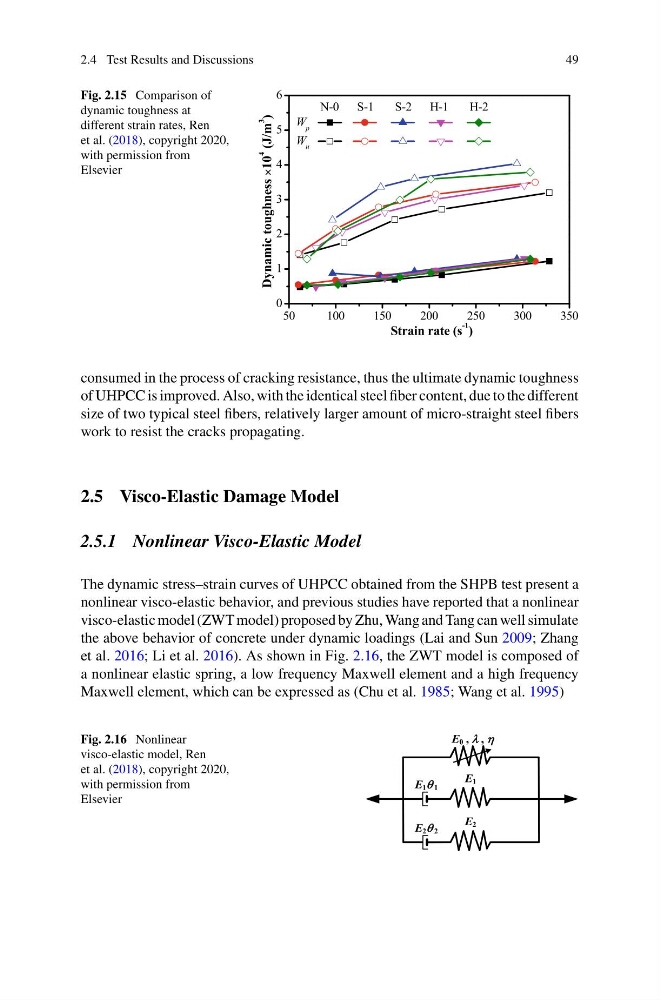
Fig. 2.15 Comparison of
dynamic toughness at
different strain rates, Ren
et al. (2018), copyright 2020,
with permission from
Elsevier
consumed in the process of cracking resistance, thus the ultimate dynamic toughness
of UHPCC is improved. Also, with the identical steel fiber content, due to the different
size of two typical steel fibers, relatively larger amount of micro-straight steel fibers
work to resist the cracks propagating.
2.5 Visco-Elastic Damage Model
2.5.1 Nonlinear Visco-Elastic Model
The dynamic stress–strain curves of UHPCC obtained from the SHPB test present a
nonlinear visco-elastic behavior, and previous studies have reported that a nonlinear
visco-elastic model (ZWT model) proposed by Zhu, Wang and Tang can well simulate
the above behavior of concrete under dynamic loadings (Lai and Sun 2009; Zhang
et al. 2016; Li et al. 2016). As shown in Fig. 2.16, the ZWT model is composed of
a nonlinear elastic spring, a low frequency Maxwell element and a high frequency
Maxwell element, which can be expressed as (Chu et al. 1985; Wang et al. 1995)
Fig. 2.16 Nonlinear
visco-elastic model, Ren
et al. (2018), copyright 2020,
with permission from
Elsevier
49
Fig. 2.15 Comparison of
dynamic toughness at
different strain rates, Ren
et al. (2018), copyright 2020,
with permission from
Elsevier
consumed in the process of cracking resistance, thus the ultimate dynamic toughness
of UHPCC is improved. Also, with the identical steel fiber content, due to the different
size of two typical steel fibers, relatively larger amount of micro-straight steel fibers
work to resist the cracks propagating.
2.5 Visco-Elastic Damage Model
2.5.1 Nonlinear Visco-Elastic Model
The dynamic stress–strain curves of UHPCC obtained from the SHPB test present a
nonlinear visco-elastic behavior, and previous studies have reported that a nonlinear
visco-elastic model (ZWT model) proposed by Zhu, Wang and Tang can well simulate
the above behavior of concrete under dynamic loadings (Lai and Sun 2009; Zhang
et al. 2016; Li et al. 2016). As shown in Fig. 2.16, the ZWT model is composed of
a nonlinear elastic spring, a low frequency Maxwell element and a high frequency
Maxwell element, which can be expressed as (Chu et al. 1985; Wang et al. 1995)
Fig. 2.16 Nonlinear
visco-elastic model, Ren
et al. (2018), copyright 2020,
with permission from
Elsevier