

38
2 Dynamic Compressive Mechanical Properties of UHPCC
Fig. 2.8 Stress equilibrium
check, Ren et al. (2018),
copyright 2020, with
permission from Elsevier
2.4.2 Strain Rate Determination
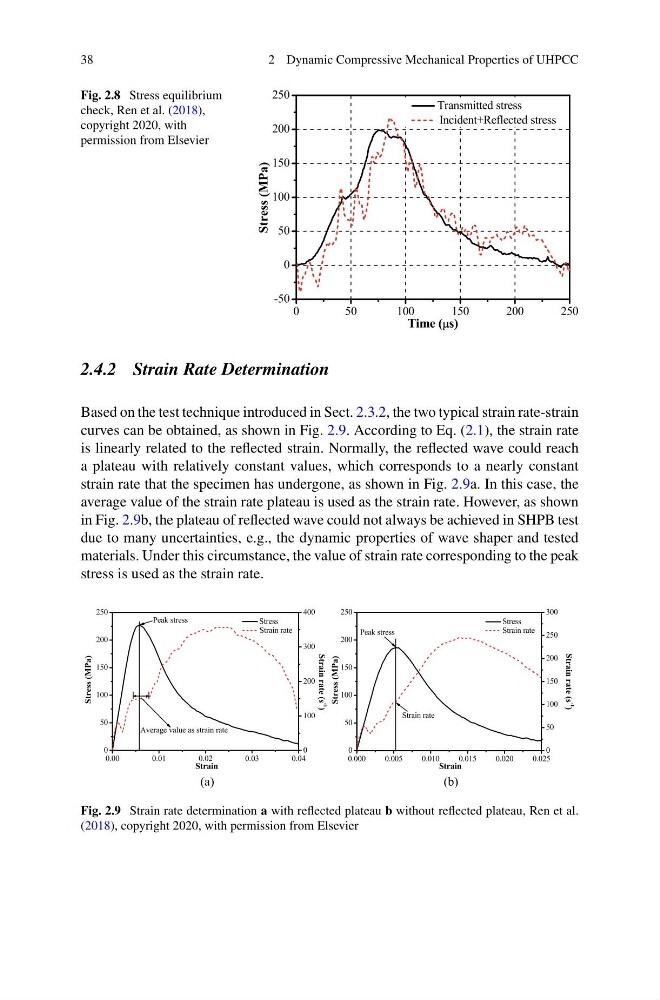
Based on the test technique introduced in Sect. 2.3.2, the two typical strain rate-strain
curves can be obtained, as shown in Fig. 2.9. According to Eq. (2.1), the strain rate
is linearly related to the reflected strain. Normally, the reflected wave could reach
a plateau with relatively constant values, which corresponds to a nearly constant
strain rate that the specimen has undergone, as shown in Fig. 2.9a. In this case, the
average value of the strain rate plateau is used as the strain rate. However, as shown
in Fig. 2.9b, the plateau of reflected wave could not always be achieved in SHPB test
due to many uncertainties, e.g., the dynamic properties of wave shaper and tested
materials. Under this circumstance, the value of strain rate corresponding to the peak
stress is used as the strain rate.
Fig. 2.9 Strain rate determination a with reflected plateau b without reflected plateau, Ren et al.
(2018), copyright 2020, with permission from Elsevier
2 Dynamic Compressive Mechanical Properties of UHPCC
Fig. 2.8 Stress equilibrium
check, Ren et al. (2018),
copyright 2020, with
permission from Elsevier
2.4.2 Strain Rate Determination
Based on the test technique introduced in Sect. 2.3.2, the two typical strain rate-strain
curves can be obtained, as shown in Fig. 2.9. According to Eq. (2.1), the strain rate
is linearly related to the reflected strain. Normally, the reflected wave could reach
a plateau with relatively constant values, which corresponds to a nearly constant
strain rate that the specimen has undergone, as shown in Fig. 2.9a. In this case, the
average value of the strain rate plateau is used as the strain rate. However, as shown
in Fig. 2.9b, the plateau of reflected wave could not always be achieved in SHPB test
due to many uncertainties, e.g., the dynamic properties of wave shaper and tested
materials. Under this circumstance, the value of strain rate corresponding to the peak
stress is used as the strain rate.
Fig. 2.9 Strain rate determination a with reflected plateau b without reflected plateau, Ren et al.
(2018), copyright 2020, with permission from Elsevier