

492
14 Constitutive Modelling of UHPCC Material Under Impact …
0.000 0.005 0.010 0.015 0.020 0.025 0.030 0.035 0.040
0
25
50
75
100
125
150
175
200
Stress(MPa)
Strain
Experimental data
Original Kong-Fang model
Modified Kong-Fang model
0.000 0.005 0.010 0.015 0.020 0.025 0.030 0.035 0.040
0
25
50
75
100
125
150
175
200
225
250
Stress(MPa)
Strain
Experimental data
Original Kong-Fang model
Modified Kong-Fang model
0.000 0.005 0.010 0.015 0.020 0.025 0.030 0.035 0.040
0
50
100
150
200
250
300
Stress(MPa)
Strain
Experimental data
Original Kong-Fang model
Modified Kong-Fang model
0.000 0.005 0.010 0.015 0.020 0.025 0.030 0.035 0.040
0
50
100
150
200
250
300
350
Stress(MPa)
Strain
Experimental data
Original Kong-Fang model
Modified Kong-Fang model
(a)
(b)
(c)
(d)
0.000 0.005 0.010 0.015 0.020 0.025 0.030 0.035 0.040
0
100
200
300
400
Stress(MPa)
Strain
Experimental data
Original Kong-Fang model
Modified Kong-Fang model
0.000 0.005 0.010 0.015 0.020 0.025 0.030 0.035 0.040
0
100
200
300
400
500
Stress(MPa)
Strain
Experimental data
Original Kong-Fang model
Modified Kong-Fang model
(e)
(f)
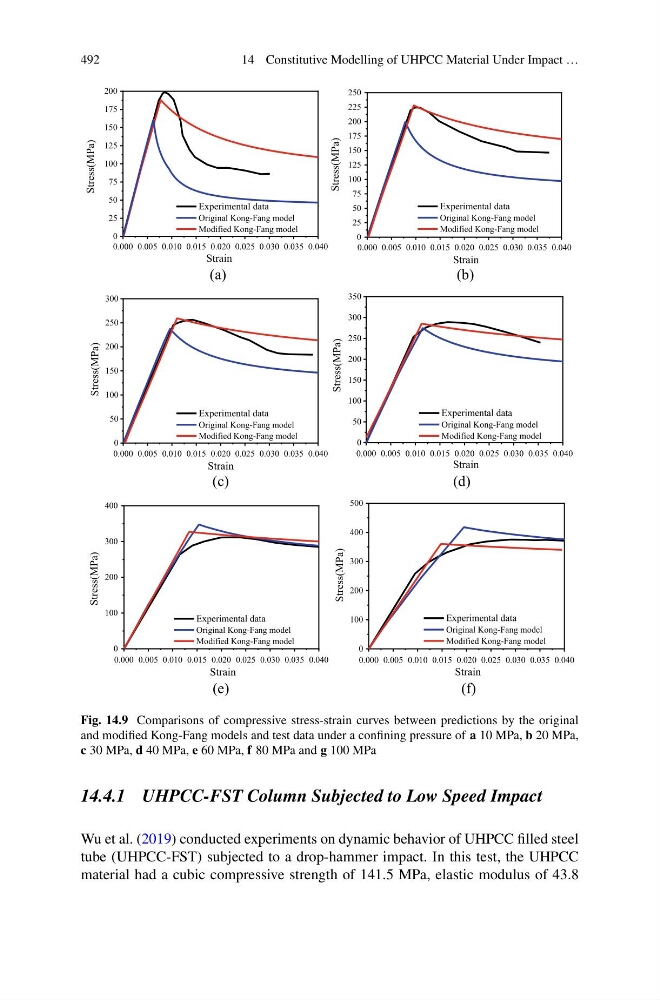
Fig. 14.9 Comparisons of compressive stress-strain curves between predictions by the original
and modified Kong-Fang models and test data under a confining pressure of a 10 MPa, b 20 MPa,
c 30 MPa, d 40 MPa, e 60 MPa, f 80 MPa and g 100 MPa
14.4.1 UHPCC-FST Column Subjected to Low Speed Impact
Wu et al. (2019) conducted experiments on dynamic behavior of UHPCC filled steel
tube (UHPCC-FST) subjected to a drop-hammer impact. In this test, the UHPCC
material had a cubic compressive strength of 141.5 MPa, elastic modulus of 43.8
14 Constitutive Modelling of UHPCC Material Under Impact …
0.000 0.005 0.010 0.015 0.020 0.025 0.030 0.035 0.040
0
25
50
75
100
125
150
175
200
Stress(MPa)
Strain
Experimental data
Original Kong-Fang model
Modified Kong-Fang model
0.000 0.005 0.010 0.015 0.020 0.025 0.030 0.035 0.040
0
25
50
75
100
125
150
175
200
225
250
Stress(MPa)
Strain
Experimental data
Original Kong-Fang model
Modified Kong-Fang model
0.000 0.005 0.010 0.015 0.020 0.025 0.030 0.035 0.040
0
50
100
150
200
250
300
Stress(MPa)
Strain
Experimental data
Original Kong-Fang model
Modified Kong-Fang model
0.000 0.005 0.010 0.015 0.020 0.025 0.030 0.035 0.040
0
50
100
150
200
250
300
350
Stress(MPa)
Strain
Experimental data
Original Kong-Fang model
Modified Kong-Fang model
(a)
(b)
(c)
(d)
0.000 0.005 0.010 0.015 0.020 0.025 0.030 0.035 0.040
0
100
200
300
400
Stress(MPa)
Strain
Experimental data
Original Kong-Fang model
Modified Kong-Fang model
0.000 0.005 0.010 0.015 0.020 0.025 0.030 0.035 0.040
0
100
200
300
400
500
Stress(MPa)
Strain
Experimental data
Original Kong-Fang model
Modified Kong-Fang model
(e)
(f)
Fig. 14.9 Comparisons of compressive stress-strain curves between predictions by the original
and modified Kong-Fang models and test data under a confining pressure of a 10 MPa, b 20 MPa,
c 30 MPa, d 40 MPa, e 60 MPa, f 80 MPa and g 100 MPa
14.4.1 UHPCC-FST Column Subjected to Low Speed Impact
Wu et al. (2019) conducted experiments on dynamic behavior of UHPCC filled steel
tube (UHPCC-FST) subjected to a drop-hammer impact. In this test, the UHPCC
material had a cubic compressive strength of 141.5 MPa, elastic modulus of 43.8