

488
14 Constitutive Modelling of UHPCC Material Under Impact …
0.00
0.05
0.10
0.15
0.20
0.25
0
2
4
6
8
10
12
Erzar et al. (hydrostatic pressure)(2016)
Erzar et al. (2016)
Pontiroli (2019)
Riedel et al. (2008)
Original Kong-Fang model
Modified Kong-Fang model
Pressure (GPa)
Volumetric strain
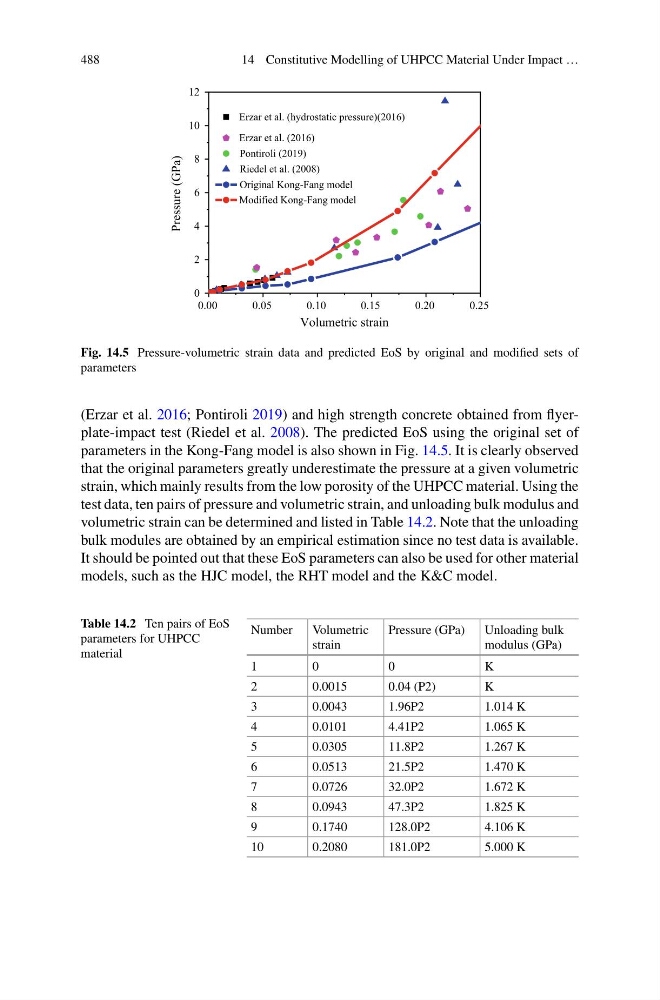
Fig. 14.5 Pressure-volumetric strain data and predicted EoS by original and modified sets of
parameters
(Erzar et al. 2016; Pontiroli 2019) and high strength concrete obtained from flyerplate-impact test (Riedel et al. 2008). The predicted EoS using the original set of
parameters in the Kong-Fang model is also shown in Fig. 14.5. It is clearly observed
that the original parameters greatly underestimate the pressure at a given volumetric
strain, which mainly results from the low porosity of the UHPCC material. Using the
test data, ten pairs of pressure and volumetric strain, and unloading bulk modulus and
volumetric strain can be determined and listed in Table 14.2. Note that the unloading
bulk modules are obtained by an empirical estimation since no test data is available.
It should be pointed out that these EoS parameters can also be used for other material
models, such as the HJC model, the RHT model and the K&C model.
Table 14.2 Ten pairs of EoS
parameters for UHPCC
material
Number
Volumetric
strain
Pressure (GPa)
Unloading bulk
modulus (GPa)
1
0
0
K
2
0.0015
0.04 (P2)
K
3
0.0043
1.96P2
1.014 K
4
0.0101
4.41P2
1.065 K
5
0.0305
11.8P2
1.267 K
6
0.0513
21.5P2
1.470 K
7
0.0726
32.0P2
1.672 K
8
0.0943
47.3P2
1.825 K
9
0.1740
128.0P2
4.106 K
10
0.2080
181.0P2
5.000 K
14 Constitutive Modelling of UHPCC Material Under Impact …
0.00
0.05
0.10
0.15
0.20
0.25
0
2
4
6
8
10
12
Erzar et al. (hydrostatic pressure)(2016)
Erzar et al. (2016)
Pontiroli (2019)
Riedel et al. (2008)
Original Kong-Fang model
Modified Kong-Fang model
Pressure (GPa)
Volumetric strain
Fig. 14.5 Pressure-volumetric strain data and predicted EoS by original and modified sets of
parameters
(Erzar et al. 2016; Pontiroli 2019) and high strength concrete obtained from flyerplate-impact test (Riedel et al. 2008). The predicted EoS using the original set of
parameters in the Kong-Fang model is also shown in Fig. 14.5. It is clearly observed
that the original parameters greatly underestimate the pressure at a given volumetric
strain, which mainly results from the low porosity of the UHPCC material. Using the
test data, ten pairs of pressure and volumetric strain, and unloading bulk modulus and
volumetric strain can be determined and listed in Table 14.2. Note that the unloading
bulk modules are obtained by an empirical estimation since no test data is available.
It should be pointed out that these EoS parameters can also be used for other material
models, such as the HJC model, the RHT model and the K&C model.
Table 14.2 Ten pairs of EoS
parameters for UHPCC
material
Number
Volumetric
strain
Pressure (GPa)
Unloading bulk
modulus (GPa)
1
0
0
K
2
0.0015
0.04 (P2)
K
3
0.0043
1.96P2
1.014 K
4
0.0101
4.41P2
1.065 K
5
0.0305
11.8P2
1.267 K
6
0.0513
21.5P2
1.470 K
7
0.0726
32.0P2
1.672 K
8
0.0943
47.3P2
1.825 K
9
0.1740
128.0P2
4.106 K
10
0.2080
181.0P2
5.000 K