

14.2 UHPCC Material Model
487
Table 14.1 Parameters of the
modified Kong-Fang model
Failure surface
Damage
fc
–
T 1 (MPa) 5.45 + 72 × V f
T (MPa) 80 × V f + 6.5
ε 1
9e −4
E (MPa)
1 − 100V f
E m +
V f E s
ε 2
0.002 −
6e −2 ×
V f
K (MPa) E/3(1 − 2ν)
ε frac
0.0125 +
V f − 0.01
× 0.5
G (MPa) E/2(1 + ν)
α
1
υ
0.23
d1
0.03
a1
0.40189
d2
1.5
a2
0.17867/ f c
d3
0.1
parameters are calibrated based on our previous test data in Sect. 14.2.4 and not
repeated here.
The compressive-softening parameters are determined by trial-and-error method
until the predicted uniaxial stress-strain curve agrees well with the experimentally
obtained uniaxial stress-strain relations. α = 1, d 1 =0.03 and d 2 =1.5 are suggested.
It should be pointed out that the introduce of strain-softening, especially the
tensile strain-softening in a material model unavoidably results in the mesh size
dependency (Kong et al. 2018b). To mitigate the mesh size dependency, the smeared
crack approach is frequently used in previous studies (Guo et al. 2017; Othman
and Marzouk 2018), in which the area under the tensile strain-stress curve is hold
as G f /h c with G f and h c being the fracture energy and characteristic length of an
element. This approach is appropriate for static loadings, but is inappropriate for
dynamic loadings, which mainly results from the change of failure pattern from a
major single crack under static loadings to multiple parallel cracks under dynamic
loadings (Kong et al. 2018b). A new damage-based nonlocal model was recently
proposed by Kong et al. (2019) to resolve this issue, which is, however, beyond the
scope of the present study. The smeared crack approach is not used but mesh sensitive
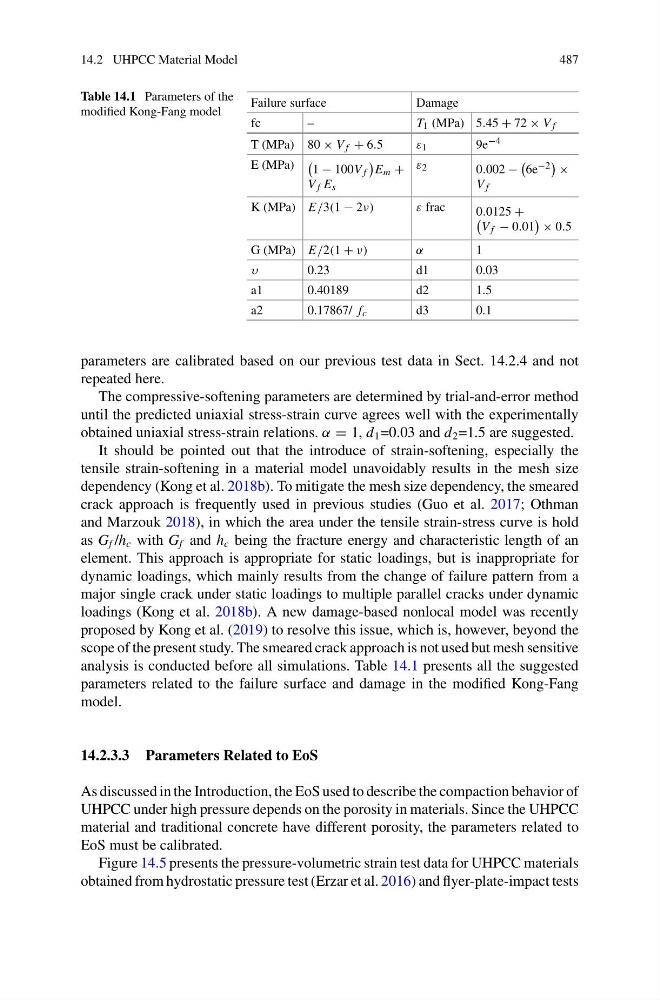
analysis is conducted before all simulations. Table 14.1 presents all the suggested
parameters related to the failure surface and damage in the modified Kong-Fang
model.
14.2.3.3 Parameters Related to EoS
As discussed in the Introduction, the EoS used to describe the compaction behavior of
UHPCC under high pressure depends on the porosity in materials. Since the UHPCC
material and traditional concrete have different porosity, the parameters related to
EoS must be calibrated.
Figure 14.5 presents the pressure-volumetric strain test data for UHPCC materials
obtained from hydrostatic pressure test (Erzar et al. 2016) and flyer-plate-impact tests
487
Table 14.1 Parameters of the
modified Kong-Fang model
Failure surface
Damage
fc
–
T 1 (MPa) 5.45 + 72 × V f
T (MPa) 80 × V f + 6.5
ε 1
9e −4
E (MPa)
1 − 100V f
E m +
V f E s
ε 2
0.002 −
6e −2 ×
V f
K (MPa) E/3(1 − 2ν)
ε frac
0.0125 +
V f − 0.01
× 0.5
G (MPa) E/2(1 + ν)
α
1
υ
0.23
d1
0.03
a1
0.40189
d2
1.5
a2
0.17867/ f c
d3
0.1
parameters are calibrated based on our previous test data in Sect. 14.2.4 and not
repeated here.
The compressive-softening parameters are determined by trial-and-error method
until the predicted uniaxial stress-strain curve agrees well with the experimentally
obtained uniaxial stress-strain relations. α = 1, d 1 =0.03 and d 2 =1.5 are suggested.
It should be pointed out that the introduce of strain-softening, especially the
tensile strain-softening in a material model unavoidably results in the mesh size
dependency (Kong et al. 2018b). To mitigate the mesh size dependency, the smeared
crack approach is frequently used in previous studies (Guo et al. 2017; Othman
and Marzouk 2018), in which the area under the tensile strain-stress curve is hold
as G f /h c with G f and h c being the fracture energy and characteristic length of an
element. This approach is appropriate for static loadings, but is inappropriate for
dynamic loadings, which mainly results from the change of failure pattern from a
major single crack under static loadings to multiple parallel cracks under dynamic
loadings (Kong et al. 2018b). A new damage-based nonlocal model was recently
proposed by Kong et al. (2019) to resolve this issue, which is, however, beyond the
scope of the present study. The smeared crack approach is not used but mesh sensitive
analysis is conducted before all simulations. Table 14.1 presents all the suggested
parameters related to the failure surface and damage in the modified Kong-Fang
model.
14.2.3.3 Parameters Related to EoS
As discussed in the Introduction, the EoS used to describe the compaction behavior of
UHPCC under high pressure depends on the porosity in materials. Since the UHPCC
material and traditional concrete have different porosity, the parameters related to
EoS must be calibrated.
Figure 14.5 presents the pressure-volumetric strain test data for UHPCC materials
obtained from hydrostatic pressure test (Erzar et al. 2016) and flyer-plate-impact tests