

14.2 UHPCC Material Model
481
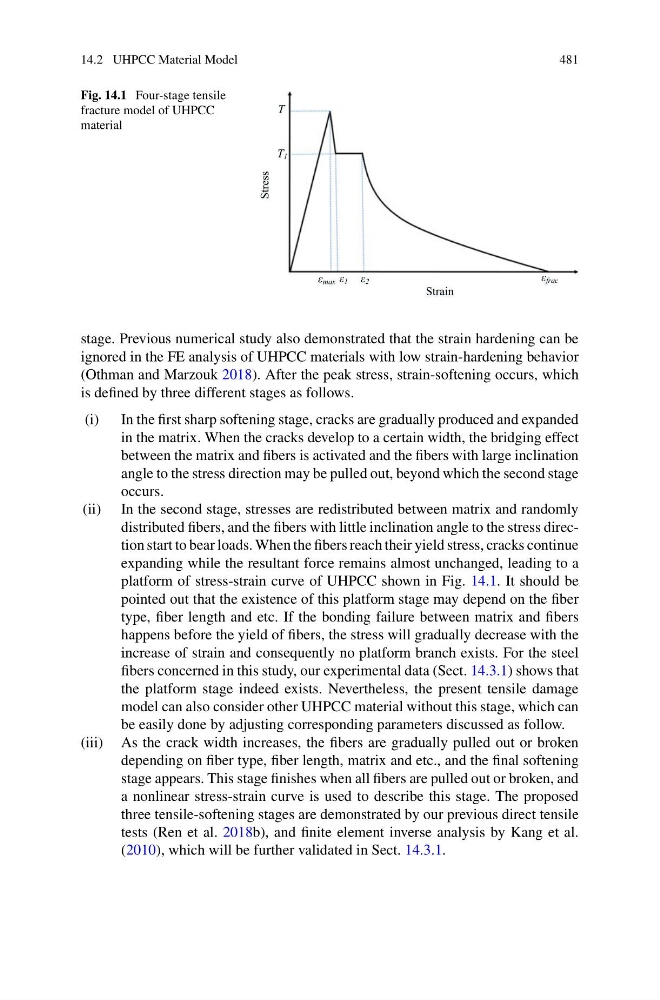
Fig. 14.1 Four-stage tensile
fracture model of UHPCC
material
Stress
T
T 1
Strain
ε max ε 1 ε 2
ε frac
stage. Previous numerical study also demonstrated that the strain hardening can be
ignored in the FE analysis of UHPCC materials with low strain-hardening behavior
(Othman and Marzouk 2018). After the peak stress, strain-softening occurs, which
is defined by three different stages as follows.
(i) In the first sharp softening stage, cracks are gradually produced and expanded
in the matrix. When the cracks develop to a certain width, the bridging effect
between the matrix and fibers is activated and the fibers with large inclination
angle to the stress direction may be pulled out, beyond which the second stage
occurs.
(ii) In the second stage, stresses are redistributed between matrix and randomly
distributed fibers, and the fibers with little inclination angle to the stress direction start to bear loads. When the fibers reach their yield stress, cracks continue
expanding while the resultant force remains almost unchanged, leading to a
platform of stress-strain curve of UHPCC shown in Fig. 14.1. It should be
pointed out that the existence of this platform stage may depend on the fiber
type, fiber length and etc. If the bonding failure between matrix and fibers
happens before the yield of fibers, the stress will gradually decrease with the
increase of strain and consequently no platform branch exists. For the steel
fibers concerned in this study, our experimental data (Sect. 14.3.1) shows that
the platform stage indeed exists. Nevertheless, the present tensile damage
model can also consider other UHPCC material without this stage, which can
be easily done by adjusting corresponding parameters discussed as follow.
(iii) As the crack width increases, the fibers are gradually pulled out or broken
depending on fiber type, fiber length, matrix and etc., and the final softening
stage appears. This stage finishes when all fibers are pulled out or broken, and
a nonlinear stress-strain curve is used to describe this stage. The proposed
three tensile-softening stages are demonstrated by our previous direct tensile
tests (Ren et al. 2018b), and finite element inverse analysis by Kang et al.
(2010), which will be further validated in Sect. 14.3.1.
481
Fig. 14.1 Four-stage tensile
fracture model of UHPCC
material
Stress
T
T 1
Strain
ε max ε 1 ε 2
ε frac
stage. Previous numerical study also demonstrated that the strain hardening can be
ignored in the FE analysis of UHPCC materials with low strain-hardening behavior
(Othman and Marzouk 2018). After the peak stress, strain-softening occurs, which
is defined by three different stages as follows.
(i) In the first sharp softening stage, cracks are gradually produced and expanded
in the matrix. When the cracks develop to a certain width, the bridging effect
between the matrix and fibers is activated and the fibers with large inclination
angle to the stress direction may be pulled out, beyond which the second stage
occurs.
(ii) In the second stage, stresses are redistributed between matrix and randomly
distributed fibers, and the fibers with little inclination angle to the stress direction start to bear loads. When the fibers reach their yield stress, cracks continue
expanding while the resultant force remains almost unchanged, leading to a
platform of stress-strain curve of UHPCC shown in Fig. 14.1. It should be
pointed out that the existence of this platform stage may depend on the fiber
type, fiber length and etc. If the bonding failure between matrix and fibers
happens before the yield of fibers, the stress will gradually decrease with the
increase of strain and consequently no platform branch exists. For the steel
fibers concerned in this study, our experimental data (Sect. 14.3.1) shows that
the platform stage indeed exists. Nevertheless, the present tensile damage
model can also consider other UHPCC material without this stage, which can
be easily done by adjusting corresponding parameters discussed as follow.
(iii) As the crack width increases, the fibers are gradually pulled out or broken
depending on fiber type, fiber length, matrix and etc., and the final softening
stage appears. This stage finishes when all fibers are pulled out or broken, and
a nonlinear stress-strain curve is used to describe this stage. The proposed
three tensile-softening stages are demonstrated by our previous direct tensile
tests (Ren et al. 2018b), and finite element inverse analysis by Kang et al.
(2010), which will be further validated in Sect. 14.3.1.