

480
14 Constitutive Modelling of UHPCC Material Under Impact …
D t = 1 −
1 +
c 1
λ t
ε frac
3
exp
−c 2
λ t
ε frac
+
λ t
ε frac
λ t
ε frac
1 + c
3
1
exp(−c 2 )
(14.9)
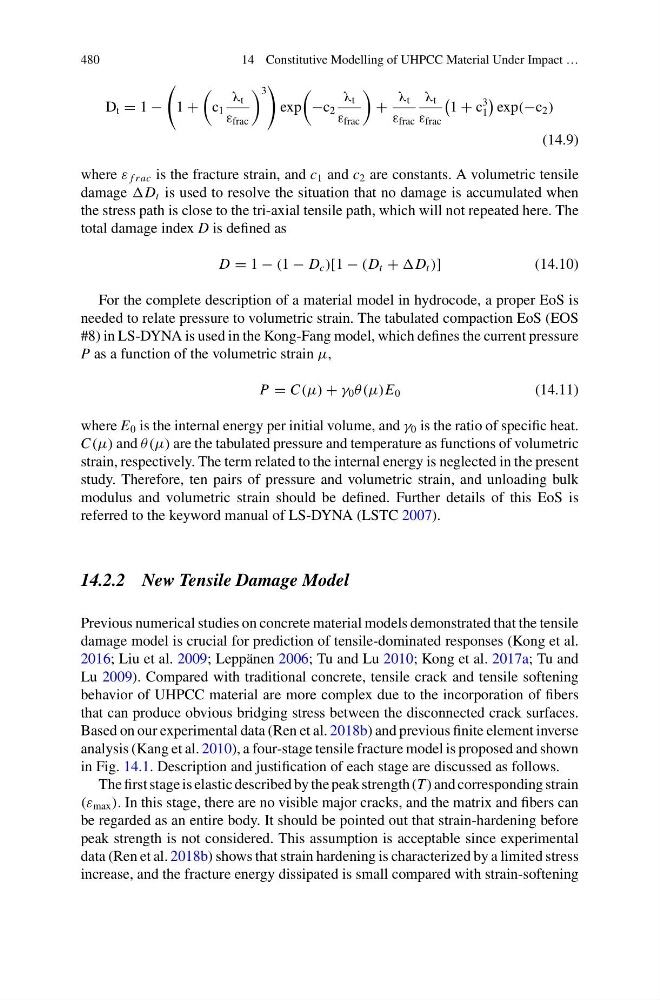
where ε f rac is the fracture strain, and c 1 and c 2 are constants. A volumetric tensile
damage D t is used to resolve the situation that no damage is accumulated when
the stress path is close to the tri-axial tensile path, which will not repeated here. The
total damage index D is defined as
D = 1 − (1 − D c )[1 − (D t + D t )]
(14.10)
For the complete description of a material model in hydrocode, a proper EoS is
needed to relate pressure to volumetric strain. The tabulated compaction EoS (EOS
#8) in LS-DYNA is used in the Kong-Fang model, which defines the current pressure
P as a function of the volumetric strain μ,
P = C(μ) + γ 0 θ (μ)E 0
(14.11)
where E 0 is the internal energy per initial volume, and γ 0 is the ratio of specific heat.
C(μ) and θ (μ) are the tabulated pressure and temperature as functions of volumetric
strain, respectively. The term related to the internal energy is neglected in the present
study. Therefore, ten pairs of pressure and volumetric strain, and unloading bulk
modulus and volumetric strain should be defined. Further details of this EoS is
referred to the keyword manual of LS-DYNA (LSTC 2007).
14.2.2 New Tensile Damage Model
Previous numerical studies on concrete material models demonstrated that the tensile
damage model is crucial for prediction of tensile-dominated responses (Kong et al.
2016; Liu et al. 2009; Leppänen 2006; Tu and Lu 2010; Kong et al. 2017a; Tu and
Lu 2009). Compared with traditional concrete, tensile crack and tensile softening
behavior of UHPCC material are more complex due to the incorporation of fibers
that can produce obvious bridging stress between the disconnected crack surfaces.
Based on our experimental data (Ren et al. 2018b) and previous finite element inverse
analysis (Kang et al. 2010), a four-stage tensile fracture model is proposed and shown
in Fig. 14.1. Description and justification of each stage are discussed as follows.
The first stage is elastic described by the peak strength (T ) and corresponding strain
(ε max ). In this stage, there are no visible major cracks, and the matrix and fibers can
be regarded as an entire body. It should be pointed out that strain-hardening before
peak strength is not considered. This assumption is acceptable since experimental
data (Ren et al. 2018b) shows that strain hardening is characterized by a limited stress
increase, and the fracture energy dissipated is small compared with strain-softening
14 Constitutive Modelling of UHPCC Material Under Impact …
D t = 1 −
1 +
c 1
λ t
ε frac
3
exp
−c 2
λ t
ε frac
+
λ t
ε frac
λ t
ε frac
1 + c
3
1
exp(−c 2 )
(14.9)
where ε f rac is the fracture strain, and c 1 and c 2 are constants. A volumetric tensile
damage D t is used to resolve the situation that no damage is accumulated when
the stress path is close to the tri-axial tensile path, which will not repeated here. The
total damage index D is defined as
D = 1 − (1 − D c )[1 − (D t + D t )]
(14.10)
For the complete description of a material model in hydrocode, a proper EoS is
needed to relate pressure to volumetric strain. The tabulated compaction EoS (EOS
#8) in LS-DYNA is used in the Kong-Fang model, which defines the current pressure
P as a function of the volumetric strain μ,
P = C(μ) + γ 0 θ (μ)E 0
(14.11)
where E 0 is the internal energy per initial volume, and γ 0 is the ratio of specific heat.
C(μ) and θ (μ) are the tabulated pressure and temperature as functions of volumetric
strain, respectively. The term related to the internal energy is neglected in the present
study. Therefore, ten pairs of pressure and volumetric strain, and unloading bulk
modulus and volumetric strain should be defined. Further details of this EoS is
referred to the keyword manual of LS-DYNA (LSTC 2007).
14.2.2 New Tensile Damage Model
Previous numerical studies on concrete material models demonstrated that the tensile
damage model is crucial for prediction of tensile-dominated responses (Kong et al.
2016; Liu et al. 2009; Leppänen 2006; Tu and Lu 2010; Kong et al. 2017a; Tu and
Lu 2009). Compared with traditional concrete, tensile crack and tensile softening
behavior of UHPCC material are more complex due to the incorporation of fibers
that can produce obvious bridging stress between the disconnected crack surfaces.
Based on our experimental data (Ren et al. 2018b) and previous finite element inverse
analysis (Kang et al. 2010), a four-stage tensile fracture model is proposed and shown
in Fig. 14.1. Description and justification of each stage are discussed as follows.
The first stage is elastic described by the peak strength (T ) and corresponding strain
(ε max ). In this stage, there are no visible major cracks, and the matrix and fibers can
be regarded as an entire body. It should be pointed out that strain-hardening before
peak strength is not considered. This assumption is acceptable since experimental
data (Ren et al. 2018b) shows that strain hardening is characterized by a limited stress
increase, and the fracture energy dissipated is small compared with strain-softening