

14.2 UHPCC Material Model
479
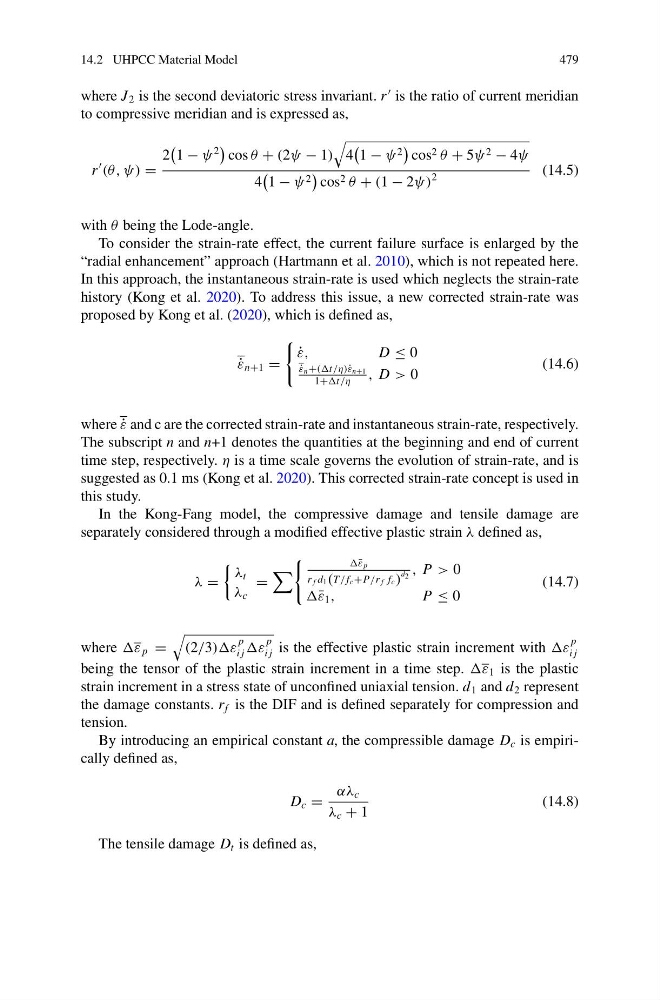
where J 2 is the second deviatoric stress invariant. r
is the ratio of current meridian
to compressive meridian and is expressed as,
r
(θ, ψ) =
2
1 − ψ
2
cos θ + (2ψ − 1)
4
1 − ψ 2
cos 2 θ + 5ψ 2 − 4ψ
4
1 − ψ 2
cos 2 θ + (1 − 2ψ)
2
(14.5)
with θ being the Lode-angle.
To consider the strain-rate effect, the current failure surface is enlarged by the
“radial enhancement” approach (Hartmann et al. 2010), which is not repeated here.
In this approach, the instantaneous strain-rate is used which neglects the strain-rate
history (Kong et al. 2020). To address this issue, a new corrected strain-rate was
proposed by Kong et al. (2020), which is defined as,
˙
ε n+1 =
˙
ε,
D ≤ 0
˙
ε n +(t/η)˙ ε n+1
1+t/η
, D > 0
(14.6)
where ˙
ε and c are the corrected strain-rate and instantaneous strain-rate, respectively.
The subscript n and n+1 denotes the quantities at the beginning and end of current
time step, respectively. η is a time scale governs the evolution of strain-rate, and is
suggested as 0.1 ms (Kong et al. 2020). This corrected strain-rate concept is used in
this study.
In the Kong-Fang model, the compressive damage and tensile damage are
separately considered through a modified effective plastic strain λ defined as,
λ =
λ t
λ c
=
¯ ε p
r f d 1 (T/fc+P/r f f c )
d 2
, P > 0
¯ ε 1 ,
P ≤ 0
(14.7)
where ε p =
(2/3)ε
p
i j ε
p
i j is the effective plastic strain increment with ε
p
i j
being the tensor of the plastic strain increment in a time step. ε 1 is the plastic
strain increment in a stress state of unconfined uniaxial tension. d 1 and d 2 represent
the damage constants. r f is the DIF and is defined separately for compression and
tension.
By introducing an empirical constant a, the compressible damage D c is empirically defined as,
D c =
αλ c
λ c + 1
(14.8)
The tensile damage D t is defined as,
479
where J 2 is the second deviatoric stress invariant. r
is the ratio of current meridian
to compressive meridian and is expressed as,
r
(θ, ψ) =
2
1 − ψ
2
cos θ + (2ψ − 1)
4
1 − ψ 2
cos 2 θ + 5ψ 2 − 4ψ
4
1 − ψ 2
cos 2 θ + (1 − 2ψ)
2
(14.5)
with θ being the Lode-angle.
To consider the strain-rate effect, the current failure surface is enlarged by the
“radial enhancement” approach (Hartmann et al. 2010), which is not repeated here.
In this approach, the instantaneous strain-rate is used which neglects the strain-rate
history (Kong et al. 2020). To address this issue, a new corrected strain-rate was
proposed by Kong et al. (2020), which is defined as,
˙
ε n+1 =
˙
ε,
D ≤ 0
˙
ε n +(t/η)˙ ε n+1
1+t/η
, D > 0
(14.6)
where ˙
ε and c are the corrected strain-rate and instantaneous strain-rate, respectively.
The subscript n and n+1 denotes the quantities at the beginning and end of current
time step, respectively. η is a time scale governs the evolution of strain-rate, and is
suggested as 0.1 ms (Kong et al. 2020). This corrected strain-rate concept is used in
this study.
In the Kong-Fang model, the compressive damage and tensile damage are
separately considered through a modified effective plastic strain λ defined as,
λ =
λ t
λ c
=
¯ ε p
r f d 1 (T/fc+P/r f f c )
d 2
, P > 0
¯ ε 1 ,
P ≤ 0
(14.7)
where ε p =
(2/3)ε
p
i j ε
p
i j is the effective plastic strain increment with ε
p
i j
being the tensor of the plastic strain increment in a time step. ε 1 is the plastic
strain increment in a stress state of unconfined uniaxial tension. d 1 and d 2 represent
the damage constants. r f is the DIF and is defined separately for compression and
tension.
By introducing an empirical constant a, the compressible damage D c is empirically defined as,
D c =
αλ c
λ c + 1
(14.8)
The tensile damage D t is defined as,