

478
14 Constitutive Modelling of UHPCC Material Under Impact …
14.2 UHPCC Material Model
The so-called Kong-Fang model recently developed (Kong et al. 2018a) is an
elastoplastic-damage based material model, which was originally developed to simulate the responses and failures of the traditional concrete under impact and blast loadings and was recently extended to rock materials (Huang et al. 2020). In this section,
a new tensile damage model for UHPCC with the consideration of fiber bridging
effect is developed, which is then incorporated into the Kong-Fang model. Finally,
based on existing and our test data, parameters for the modified material model are
carefully calibrated.
14.2.1 Brief Introduction of the Original Kong-Fang
Concrete Model
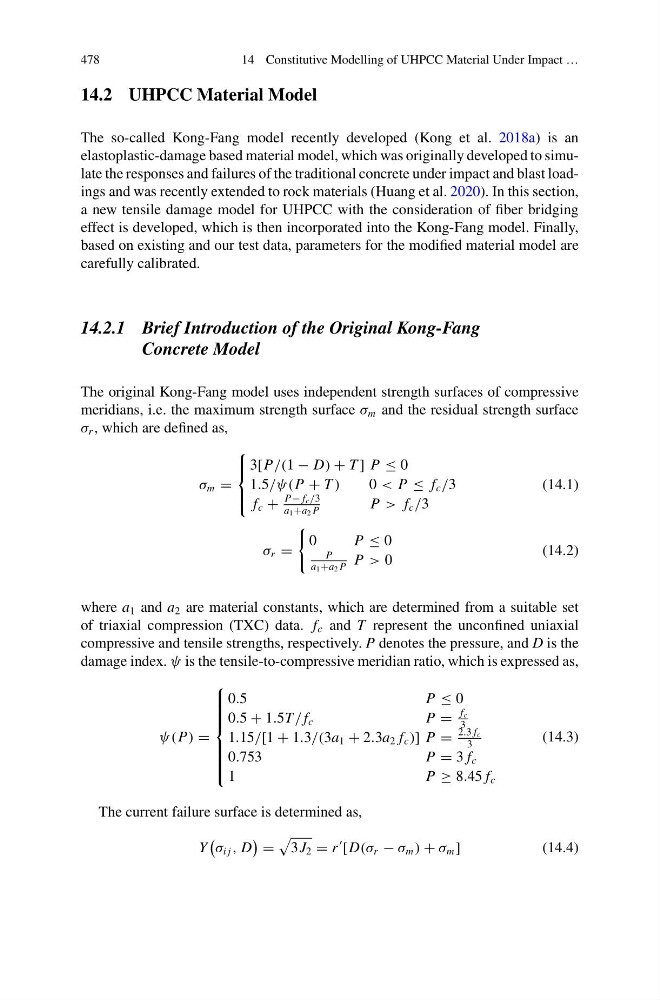
The original Kong-Fang model uses independent strength surfaces of compressive
meridians, i.e. the maximum strength surface σ m and the residual strength surface
σ r , which are defined as,
σ m =
⎧
⎪ ⎨
⎪ ⎩
3[P/(1 − D) + T ] P ≤ 0
1.5/ψ(P + T )
0 < P ≤ f c /3
f c +
P− f c /3
a 1 +a 2 P
P > f c /3
(14.1)
σ r =
0
P ≤ 0
P
a 1 +a 2 P
P > 0
(14.2)
where a 1 and a 2 are material constants, which are determined from a suitable set
of triaxial compression (TXC) data. f c and T represent the unconfined uniaxial
compressive and tensile strengths, respectively. P denotes the pressure, and D is the
damage index. ψ is the tensile-to-compressive meridian ratio, which is expressed as,
ψ(P) =
⎧
⎪ ⎪ ⎪ ⎪ ⎪ ⎨
⎪ ⎪ ⎪ ⎪ ⎪ ⎩
0.5
P ≤ 0
0.5 + 1.5T / f c
P =
f c
3
1.15/[1 + 1.3/(3a 1 + 2.3a 2 f c )] P =
2.3 f c
3
0.753
P = 3 f c
1
P ≥ 8.45 f c
(14.3)
The current failure surface is determined as,
Y
σ i j , D
=
3J 2 = r
[D(σ r − σ m ) + σ m ]
(14.4)
14 Constitutive Modelling of UHPCC Material Under Impact …
14.2 UHPCC Material Model
The so-called Kong-Fang model recently developed (Kong et al. 2018a) is an
elastoplastic-damage based material model, which was originally developed to simulate the responses and failures of the traditional concrete under impact and blast loadings and was recently extended to rock materials (Huang et al. 2020). In this section,
a new tensile damage model for UHPCC with the consideration of fiber bridging
effect is developed, which is then incorporated into the Kong-Fang model. Finally,
based on existing and our test data, parameters for the modified material model are
carefully calibrated.
14.2.1 Brief Introduction of the Original Kong-Fang
Concrete Model
The original Kong-Fang model uses independent strength surfaces of compressive
meridians, i.e. the maximum strength surface σ m and the residual strength surface
σ r , which are defined as,
σ m =
⎧
⎪ ⎨
⎪ ⎩
3[P/(1 − D) + T ] P ≤ 0
1.5/ψ(P + T )
0 < P ≤ f c /3
f c +
P− f c /3
a 1 +a 2 P
P > f c /3
(14.1)
σ r =
0
P ≤ 0
P
a 1 +a 2 P
P > 0
(14.2)
where a 1 and a 2 are material constants, which are determined from a suitable set
of triaxial compression (TXC) data. f c and T represent the unconfined uniaxial
compressive and tensile strengths, respectively. P denotes the pressure, and D is the
damage index. ψ is the tensile-to-compressive meridian ratio, which is expressed as,
ψ(P) =
⎧
⎪ ⎪ ⎪ ⎪ ⎪ ⎨
⎪ ⎪ ⎪ ⎪ ⎪ ⎩
0.5
P ≤ 0
0.5 + 1.5T / f c
P =
f c
3
1.15/[1 + 1.3/(3a 1 + 2.3a 2 f c )] P =
2.3 f c
3
0.753
P = 3 f c
1
P ≥ 8.45 f c
(14.3)
The current failure surface is determined as,
Y
σ i j , D
=
3J 2 = r
[D(σ r − σ m ) + σ m ]
(14.4)