

456
13 Experimental and Numerical Studies on Dynamic Behavior …
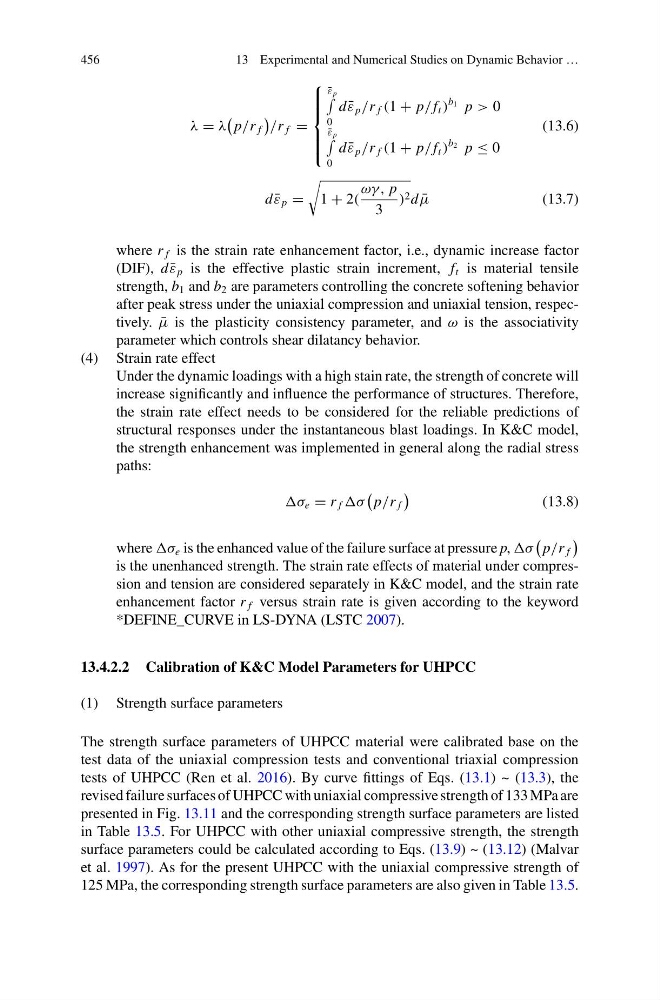
λ = λ
p/r f
/r f =
⎧
⎪ ⎪ ⎪ ⎨
⎪ ⎪ ⎪ ⎩
¯
ε p
0
d ¯
ε p /r f (1 + p/ f t )
b 1 p > 0
¯
ε p
0
d ¯
ε p /r f (1 + p/ f t )
b 2 p ≤ 0
(13.6)
d ¯
ε p =
1 + 2(
ωγ , p
3
) 2 d ¯
μ
(13.7)
where r f is the strain rate enhancement factor, i.e., dynamic increase factor
(DIF), d ¯
ε p is the effective plastic strain increment, f t is material tensile
strength, b 1 and b 2 are parameters controlling the concrete softening behavior
after peak stress under the uniaxial compression and uniaxial tension, respectively. ¯
μ is the plasticity consistency parameter, and ω is the associativity
parameter which controls shear dilatancy behavior.
(4) Strain rate effect
Under the dynamic loadings with a high stain rate, the strength of concrete will
increase significantly and influence the performance of structures. Therefore,
the strain rate effect needs to be considered for the reliable predictions of
structural responses under the instantaneous blast loadings. In K&C model,
the strength enhancement was implemented in general along the radial stress
paths:
σ e = r f σ
p/r f
(13.8)
where σ e is the enhanced value of the failure surface at pressure p, σ
p/r f
is the unenhanced strength. The strain rate effects of material under compression and tension are considered separately in K&C model, and the strain rate
enhancement factor r f versus strain rate is given according to the keyword
*DEFINE_CURVE in LS-DYNA (LSTC 2007).
13.4.2.2 Calibration of K&C Model Parameters for UHPCC
(1) Strength surface parameters
The strength surface parameters of UHPCC material were calibrated base on the
test data of the uniaxial compression tests and conventional triaxial compression
tests of UHPCC (Ren et al. 2016). By curve fittings of Eqs. (13.1) ~ (13.3), the
revised failure surfaces of UHPCC with uniaxial compressive strength of 133 MPa are
presented in Fig. 13.11 and the corresponding strength surface parameters are listed
in Table 13.5. For UHPCC with other uniaxial compressive strength, the strength
surface parameters could be calculated according to Eqs. (13.9) ~ (13.12) (Malvar
et al. 1997). As for the present UHPCC with the uniaxial compressive strength of
125 MPa, the corresponding strength surface parameters are also given in Table 13.5.
13 Experimental and Numerical Studies on Dynamic Behavior …
λ = λ
p/r f
/r f =
⎧
⎪ ⎪ ⎪ ⎨
⎪ ⎪ ⎪ ⎩
¯
ε p
0
d ¯
ε p /r f (1 + p/ f t )
b 1 p > 0
¯
ε p
0
d ¯
ε p /r f (1 + p/ f t )
b 2 p ≤ 0
(13.6)
d ¯
ε p =
1 + 2(
ωγ , p
3
) 2 d ¯
μ
(13.7)
where r f is the strain rate enhancement factor, i.e., dynamic increase factor
(DIF), d ¯
ε p is the effective plastic strain increment, f t is material tensile
strength, b 1 and b 2 are parameters controlling the concrete softening behavior
after peak stress under the uniaxial compression and uniaxial tension, respectively. ¯
μ is the plasticity consistency parameter, and ω is the associativity
parameter which controls shear dilatancy behavior.
(4) Strain rate effect
Under the dynamic loadings with a high stain rate, the strength of concrete will
increase significantly and influence the performance of structures. Therefore,
the strain rate effect needs to be considered for the reliable predictions of
structural responses under the instantaneous blast loadings. In K&C model,
the strength enhancement was implemented in general along the radial stress
paths:
σ e = r f σ
p/r f
(13.8)
where σ e is the enhanced value of the failure surface at pressure p, σ
p/r f
is the unenhanced strength. The strain rate effects of material under compression and tension are considered separately in K&C model, and the strain rate
enhancement factor r f versus strain rate is given according to the keyword
*DEFINE_CURVE in LS-DYNA (LSTC 2007).
13.4.2.2 Calibration of K&C Model Parameters for UHPCC
(1) Strength surface parameters
The strength surface parameters of UHPCC material were calibrated base on the
test data of the uniaxial compression tests and conventional triaxial compression
tests of UHPCC (Ren et al. 2016). By curve fittings of Eqs. (13.1) ~ (13.3), the
revised failure surfaces of UHPCC with uniaxial compressive strength of 133 MPa are
presented in Fig. 13.11 and the corresponding strength surface parameters are listed
in Table 13.5. For UHPCC with other uniaxial compressive strength, the strength
surface parameters could be calculated according to Eqs. (13.9) ~ (13.12) (Malvar
et al. 1997). As for the present UHPCC with the uniaxial compressive strength of
125 MPa, the corresponding strength surface parameters are also given in Table 13.5.