

13.4 Numerical Simulation
455
13.4.2.1 K&C Model
(1) Three failure surfaces
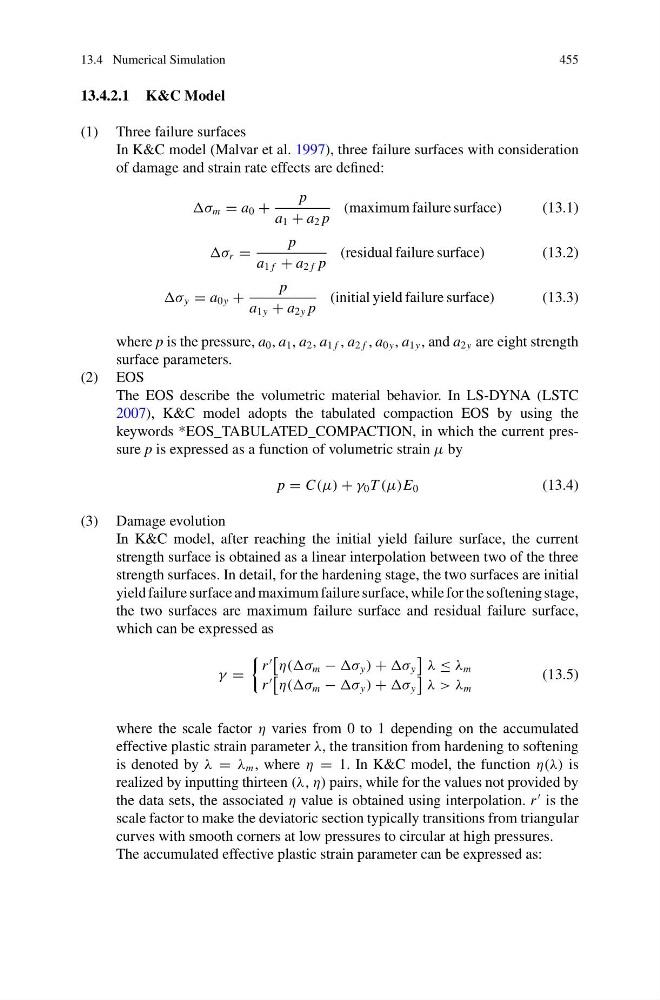
In K&C model (Malvar et al. 1997), three failure surfaces with consideration
of damage and strain rate effects are defined:
σ m = a 0 +
p
a 1 + a 2 p
(maximum failure surface)
(13.1)
σ r =
p
a 1 f + a 2 f p
(residual failure surface)
(13.2)
σ y = a 0y +
p
a 1y + a 2y p
(initial yield failure surface)
(13.3)
where p is the pressure, a 0 , a 1 , a 2 , a 1 f , a 2 f , a 0y , a 1y , and a 2y are eight strength
surface parameters.
(2) EOS
The EOS describe the volumetric material behavior. In LS-DYNA (LSTC
2007), K&C model adopts the tabulated compaction EOS by using the
keywords *EOS_TABULATED_COMPACTION, in which the current pressure p is expressed as a function of volumetric strain μ by
p = C(μ) + γ 0 T (μ)E 0
(13.4)
(3) Damage evolution
In K&C model, after reaching the initial yield failure surface, the current
strength surface is obtained as a linear interpolation between two of the three
strength surfaces. In detail, for the hardening stage, the two surfaces are initial
yield failure surface and maximum failure surface, while for the softening stage,
the two surfaces are maximum failure surface and residual failure surface,
which can be expressed as
γ =
r
η((σ m − σ y ) + σ y
λ ≤ λ m
r
η((σ m − σ y ) + σ y
λ > λ m
(13.5)
where the scale factor η varies from 0 to 1 depending on the accumulated
effective plastic strain parameter λ, the transition from hardening to softening
is denoted by λ = λ m , where η = 1. In K&C model, the function η(λ) is
realized by inputting thirteen (λ, η) pairs, while for the values not provided by
the data sets, the associated η value is obtained using interpolation. r
is the
scale factor to make the deviatoric section typically transitions from triangular
curves with smooth corners at low pressures to circular at high pressures.
The accumulated effective plastic strain parameter can be expressed as:
455
13.4.2.1 K&C Model
(1) Three failure surfaces
In K&C model (Malvar et al. 1997), three failure surfaces with consideration
of damage and strain rate effects are defined:
σ m = a 0 +
p
a 1 + a 2 p
(maximum failure surface)
(13.1)
σ r =
p
a 1 f + a 2 f p
(residual failure surface)
(13.2)
σ y = a 0y +
p
a 1y + a 2y p
(initial yield failure surface)
(13.3)
where p is the pressure, a 0 , a 1 , a 2 , a 1 f , a 2 f , a 0y , a 1y , and a 2y are eight strength
surface parameters.
(2) EOS
The EOS describe the volumetric material behavior. In LS-DYNA (LSTC
2007), K&C model adopts the tabulated compaction EOS by using the
keywords *EOS_TABULATED_COMPACTION, in which the current pressure p is expressed as a function of volumetric strain μ by
p = C(μ) + γ 0 T (μ)E 0
(13.4)
(3) Damage evolution
In K&C model, after reaching the initial yield failure surface, the current
strength surface is obtained as a linear interpolation between two of the three
strength surfaces. In detail, for the hardening stage, the two surfaces are initial
yield failure surface and maximum failure surface, while for the softening stage,
the two surfaces are maximum failure surface and residual failure surface,
which can be expressed as
γ =
r
η((σ m − σ y ) + σ y
λ ≤ λ m
r
η((σ m − σ y ) + σ y
λ > λ m
(13.5)
where the scale factor η varies from 0 to 1 depending on the accumulated
effective plastic strain parameter λ, the transition from hardening to softening
is denoted by λ = λ m , where η = 1. In K&C model, the function η(λ) is
realized by inputting thirteen (λ, η) pairs, while for the values not provided by
the data sets, the associated η value is obtained using interpolation. r
is the
scale factor to make the deviatoric section typically transitions from triangular
curves with smooth corners at low pressures to circular at high pressures.
The accumulated effective plastic strain parameter can be expressed as: