

454
13 Experimental and Numerical Studies on Dynamic Behavior …
(a)
(b)
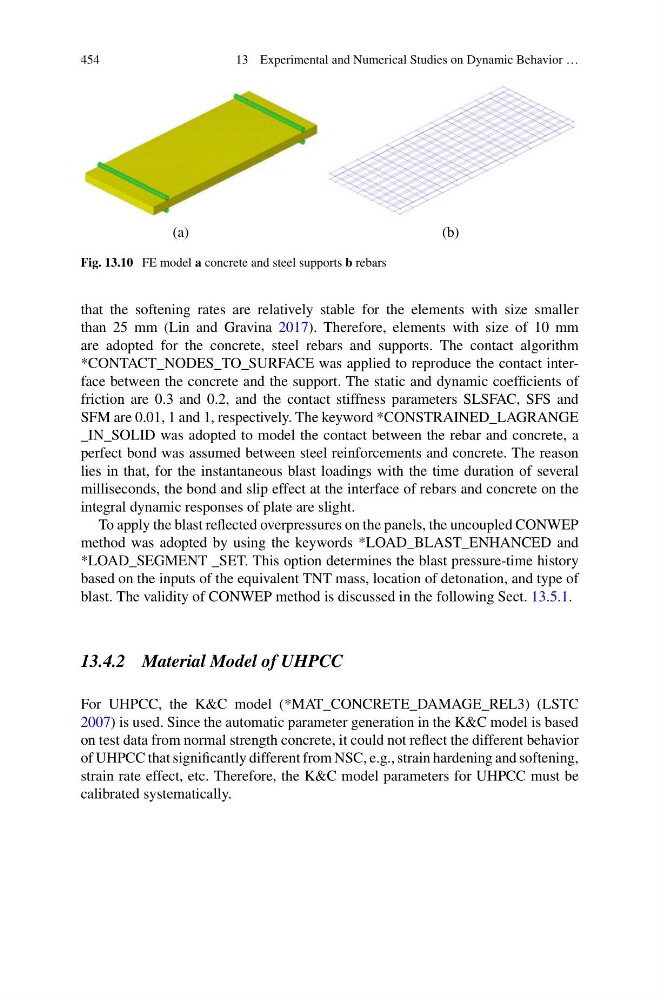
Fig. 13.10 FE model a concrete and steel supports b rebars
that the softening rates are relatively stable for the elements with size smaller
than 25 mm (Lin and Gravina 2017). Therefore, elements with size of 10 mm
are adopted for the concrete, steel rebars and supports. The contact algorithm
*CONTACT_NODES_TO_SURFACE was applied to reproduce the contact interface between the concrete and the support. The static and dynamic coefficients of
friction are 0.3 and 0.2, and the contact stiffness parameters SLSFAC, SFS and
SFM are 0.01, 1 and 1, respectively. The keyword *CONSTRAINED_LAGRANGE
_IN_SOLID was adopted to model the contact between the rebar and concrete, a
perfect bond was assumed between steel reinforcements and concrete. The reason
lies in that, for the instantaneous blast loadings with the time duration of several
milliseconds, the bond and slip effect at the interface of rebars and concrete on the
integral dynamic responses of plate are slight.
To apply the blast reflected overpressures on the panels, the uncoupled CONWEP
method was adopted by using the keywords *LOAD_BLAST_ENHANCED and
*LOAD_SEGMENT _SET. This option determines the blast pressure-time history
based on the inputs of the equivalent TNT mass, location of detonation, and type of
blast. The validity of CONWEP method is discussed in the following Sect. 13.5.1.
13.4.2 Material Model of UHPCC
For UHPCC, the K&C model (*MAT_CONCRETE_DAMAGE_REL3) (LSTC
2007) is used. Since the automatic parameter generation in the K&C model is based
on test data from normal strength concrete, it could not reflect the different behavior
of UHPCC that significantly different from NSC, e.g., strain hardening and softening,
strain rate effect, etc. Therefore, the K&C model parameters for UHPCC must be
calibrated systematically.
13 Experimental and Numerical Studies on Dynamic Behavior …
(a)
(b)
Fig. 13.10 FE model a concrete and steel supports b rebars
that the softening rates are relatively stable for the elements with size smaller
than 25 mm (Lin and Gravina 2017). Therefore, elements with size of 10 mm
are adopted for the concrete, steel rebars and supports. The contact algorithm
*CONTACT_NODES_TO_SURFACE was applied to reproduce the contact interface between the concrete and the support. The static and dynamic coefficients of
friction are 0.3 and 0.2, and the contact stiffness parameters SLSFAC, SFS and
SFM are 0.01, 1 and 1, respectively. The keyword *CONSTRAINED_LAGRANGE
_IN_SOLID was adopted to model the contact between the rebar and concrete, a
perfect bond was assumed between steel reinforcements and concrete. The reason
lies in that, for the instantaneous blast loadings with the time duration of several
milliseconds, the bond and slip effect at the interface of rebars and concrete on the
integral dynamic responses of plate are slight.
To apply the blast reflected overpressures on the panels, the uncoupled CONWEP
method was adopted by using the keywords *LOAD_BLAST_ENHANCED and
*LOAD_SEGMENT _SET. This option determines the blast pressure-time history
based on the inputs of the equivalent TNT mass, location of detonation, and type of
blast. The validity of CONWEP method is discussed in the following Sect. 13.5.1.
13.4.2 Material Model of UHPCC
For UHPCC, the K&C model (*MAT_CONCRETE_DAMAGE_REL3) (LSTC
2007) is used. Since the automatic parameter generation in the K&C model is based
on test data from normal strength concrete, it could not reflect the different behavior
of UHPCC that significantly different from NSC, e.g., strain hardening and softening,
strain rate effect, etc. Therefore, the K&C model parameters for UHPCC must be
calibrated systematically.