

13.3 Field Blast Test
453
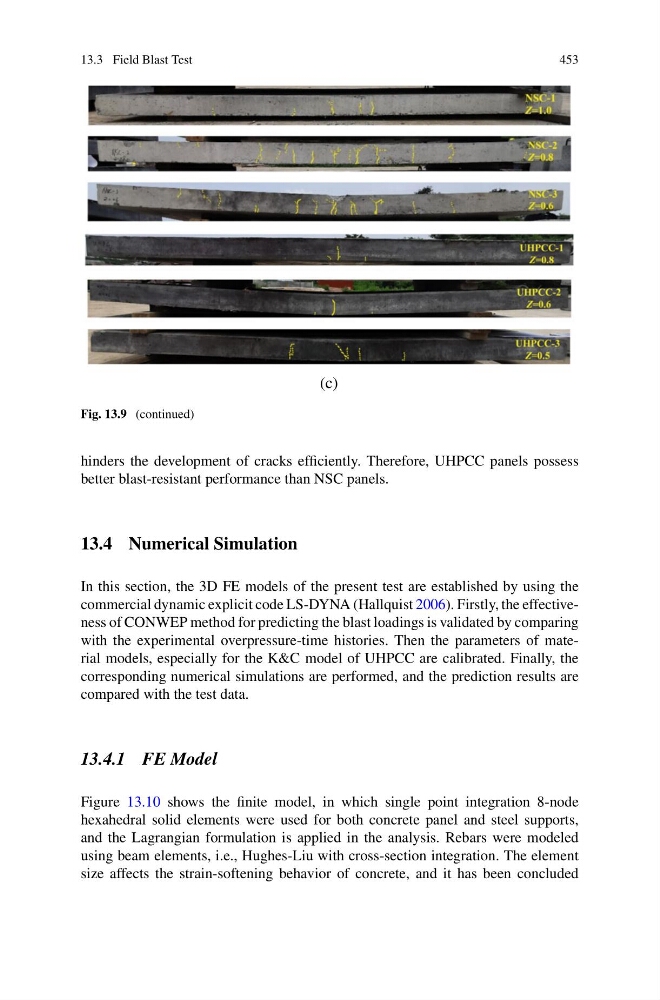
(c)
Fig. 13.9 (continued)
hinders the development of cracks efficiently. Therefore, UHPCC panels possess
better blast-resistant performance than NSC panels.
13.4 Numerical Simulation
In this section, the 3D FE models of the present test are established by using the
commercial dynamic explicit code LS-DYNA (Hallquist 2006). Firstly, the effectiveness of CONWEP method for predicting the blast loadings is validated by comparing
with the experimental overpressure-time histories. Then the parameters of material models, especially for the K&C model of UHPCC are calibrated. Finally, the
corresponding numerical simulations are performed, and the prediction results are
compared with the test data.
13.4.1 FE Model
Figure 13.10 shows the finite model, in which single point integration 8-node
hexahedral solid elements were used for both concrete panel and steel supports,
and the Lagrangian formulation is applied in the analysis. Rebars were modeled
using beam elements, i.e., Hughes-Liu with cross-section integration. The element
size affects the strain-softening behavior of concrete, and it has been concluded
453
(c)
Fig. 13.9 (continued)
hinders the development of cracks efficiently. Therefore, UHPCC panels possess
better blast-resistant performance than NSC panels.
13.4 Numerical Simulation
In this section, the 3D FE models of the present test are established by using the
commercial dynamic explicit code LS-DYNA (Hallquist 2006). Firstly, the effectiveness of CONWEP method for predicting the blast loadings is validated by comparing
with the experimental overpressure-time histories. Then the parameters of material models, especially for the K&C model of UHPCC are calibrated. Finally, the
corresponding numerical simulations are performed, and the prediction results are
compared with the test data.
13.4.1 FE Model
Figure 13.10 shows the finite model, in which single point integration 8-node
hexahedral solid elements were used for both concrete panel and steel supports,
and the Lagrangian formulation is applied in the analysis. Rebars were modeled
using beam elements, i.e., Hughes-Liu with cross-section integration. The element
size affects the strain-softening behavior of concrete, and it has been concluded