

12.5 Assessment of Residual Seismic Resistance of the Post-blast Column
425
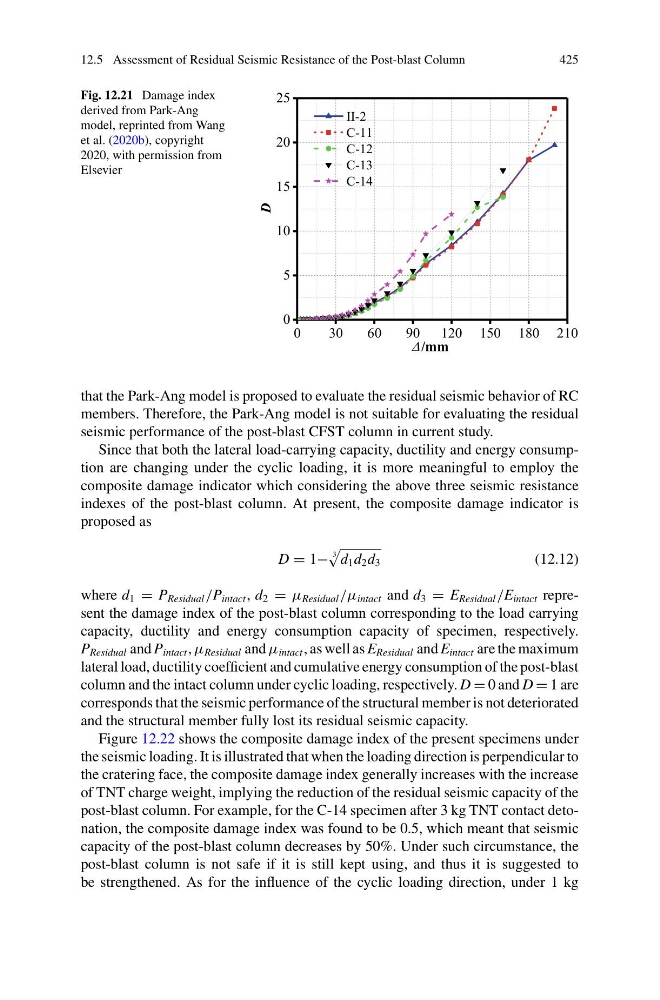
Fig. 12.21 Damage index
derived from Park-Ang
model, reprinted from Wang
et al. (2020b), copyright
2020, with permission from
Elsevier
0
30
60
90 120 150 180 210
0
5
10
15
20
25
II-2
C-11
C-12
C-13
C-14
D
/mm
that the Park-Ang model is proposed to evaluate the residual seismic behavior of RC
members. Therefore, the Park-Ang model is not suitable for evaluating the residual
seismic performance of the post-blast CFST column in current study.
Since that both the lateral load-carrying capacity, ductility and energy consumption are changing under the cyclic loading, it is more meaningful to employ the
composite damage indicator which considering the above three seismic resistance
indexes of the post-blast column. At present, the composite damage indicator is
proposed as
D = 1−
3
d 1 d 2 d 3
(12.12)
where d 1 = P Residual /P intact , d 2 = μ Residual /μ intact and d 3 = E Residual /E intact represent the damage index of the post-blast column corresponding to the load carrying
capacity, ductility and energy consumption capacity of specimen, respectively.
P Residual and P intact , μ Residual and μ intact , as well as E Residual and E intact are the maximum
lateral load, ductility coefficient and cumulative energy consumption of the post-blast
column and the intact column under cyclic loading, respectively. D = 0 and D = 1 are
corresponds that the seismic performance of the structural member is not deteriorated
and the structural member fully lost its residual seismic capacity.
Figure 12.22 shows the composite damage index of the present specimens under
the seismic loading. It is illustrated that when the loading direction is perpendicular to
the cratering face, the composite damage index generally increases with the increase
of TNT charge weight, implying the reduction of the residual seismic capacity of the
post-blast column. For example, for the C-14 specimen after 3 kg TNT contact detonation, the composite damage index was found to be 0.5, which meant that seismic
capacity of the post-blast column decreases by 50%. Under such circumstance, the
post-blast column is not safe if it is still kept using, and thus it is suggested to
be strengthened. As for the influence of the cyclic loading direction, under 1 kg
425
Fig. 12.21 Damage index
derived from Park-Ang
model, reprinted from Wang
et al. (2020b), copyright
2020, with permission from
Elsevier
0
30
60
90 120 150 180 210
0
5
10
15
20
25
II-2
C-11
C-12
C-13
C-14
D
/mm
that the Park-Ang model is proposed to evaluate the residual seismic behavior of RC
members. Therefore, the Park-Ang model is not suitable for evaluating the residual
seismic performance of the post-blast CFST column in current study.
Since that both the lateral load-carrying capacity, ductility and energy consumption are changing under the cyclic loading, it is more meaningful to employ the
composite damage indicator which considering the above three seismic resistance
indexes of the post-blast column. At present, the composite damage indicator is
proposed as
D = 1−
3
d 1 d 2 d 3
(12.12)
where d 1 = P Residual /P intact , d 2 = μ Residual /μ intact and d 3 = E Residual /E intact represent the damage index of the post-blast column corresponding to the load carrying
capacity, ductility and energy consumption capacity of specimen, respectively.
P Residual and P intact , μ Residual and μ intact , as well as E Residual and E intact are the maximum
lateral load, ductility coefficient and cumulative energy consumption of the post-blast
column and the intact column under cyclic loading, respectively. D = 0 and D = 1 are
corresponds that the seismic performance of the structural member is not deteriorated
and the structural member fully lost its residual seismic capacity.
Figure 12.22 shows the composite damage index of the present specimens under
the seismic loading. It is illustrated that when the loading direction is perpendicular to
the cratering face, the composite damage index generally increases with the increase
of TNT charge weight, implying the reduction of the residual seismic capacity of the
post-blast column. For example, for the C-14 specimen after 3 kg TNT contact detonation, the composite damage index was found to be 0.5, which meant that seismic
capacity of the post-blast column decreases by 50%. Under such circumstance, the
post-blast column is not safe if it is still kept using, and thus it is suggested to
be strengthened. As for the influence of the cyclic loading direction, under 1 kg