

424
12 Experimental Study on the Residual Seismic Resistance of UHPCC …
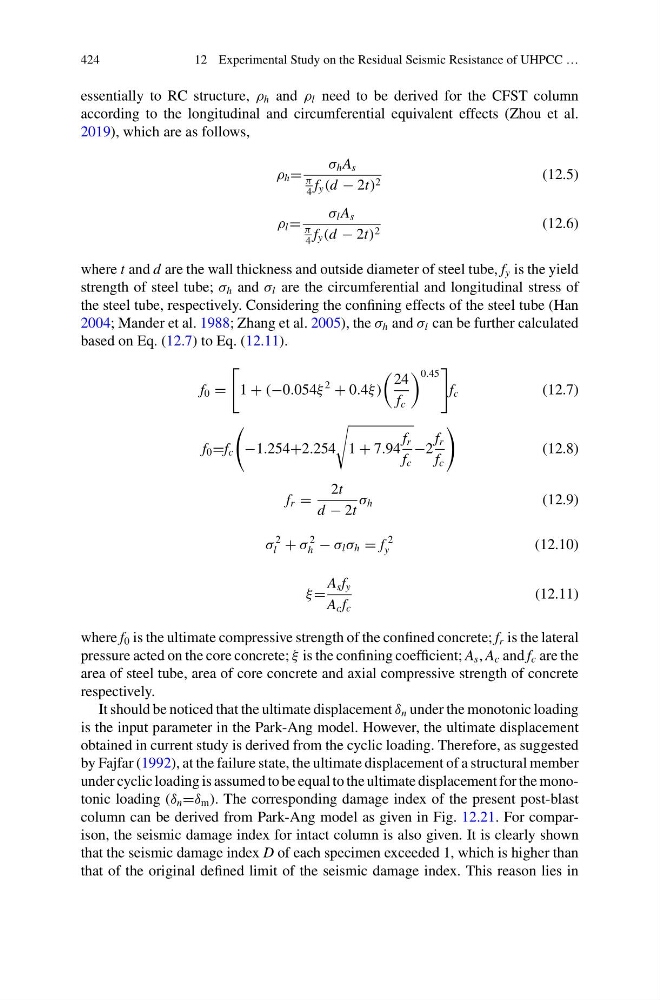
essentially to RC structure, ρ h and ρ l need to be derived for the CFST column
according to the longitudinal and circumferential equivalent effects (Zhou et al.
2019), which are as follows,
ρ h =
σ h A s
π
4
f y (d − 2t) 2
(12.5)
ρ l =
σ l A s
π
4
f y (d − 2t) 2
(12.6)
where t and d are the wall thickness and outside diameter of steel tube, f y is the yield
strength of steel tube; σ h and σ l are the circumferential and longitudinal stress of
the steel tube, respectively. Considering the confining effects of the steel tube (Han
2004; Mander et al. 1988; Zhang et al. 2005), the σ h and σ l can be further calculated
based on Eq. (12.7) to Eq. (12.11).
f 0 =
1 + (−0.054ξ
2
+ 0.4ξ)
24
f c
0.45
f c
(12.7)
f 0 =f c
−1.254+2.254
1 + 7.94
f r
f c
−2
f r
f c
(12.8)
f r =
2t
d − 2t
σ h
(12.9)
σ
2
l + σ
2
h − σ l σ h = f
2
y
(12.10)
ξ =
A s f y
A c f c
(12.11)
where f 0 is the ultimate compressive strength of the confined concrete; f r is the lateral
pressure acted on the core concrete; ξ is the confining coefficient; A s , A c and f c are the
area of steel tube, area of core concrete and axial compressive strength of concrete
respectively.
It should be noticed that the ultimate displacement δ n under the monotonic loading
is the input parameter in the Park-Ang model. However, the ultimate displacement
obtained in current study is derived from the cyclic loading. Therefore, as suggested
by Fajfar (1992), at the failure state, the ultimate displacement of a structural member
under cyclic loading is assumed to be equal to the ultimate displacement for the monotonic loading (δ n =δ m ). The corresponding damage index of the present post-blast
column can be derived from Park-Ang model as given in Fig. 12.21. For comparison, the seismic damage index for intact column is also given. It is clearly shown
that the seismic damage index D of each specimen exceeded 1, which is higher than
that of the original defined limit of the seismic damage index. This reason lies in
12 Experimental Study on the Residual Seismic Resistance of UHPCC …
essentially to RC structure, ρ h and ρ l need to be derived for the CFST column
according to the longitudinal and circumferential equivalent effects (Zhou et al.
2019), which are as follows,
ρ h =
σ h A s
π
4
f y (d − 2t) 2
(12.5)
ρ l =
σ l A s
π
4
f y (d − 2t) 2
(12.6)
where t and d are the wall thickness and outside diameter of steel tube, f y is the yield
strength of steel tube; σ h and σ l are the circumferential and longitudinal stress of
the steel tube, respectively. Considering the confining effects of the steel tube (Han
2004; Mander et al. 1988; Zhang et al. 2005), the σ h and σ l can be further calculated
based on Eq. (12.7) to Eq. (12.11).
f 0 =
1 + (−0.054ξ
2
+ 0.4ξ)
24
f c
0.45
f c
(12.7)
f 0 =f c
−1.254+2.254
1 + 7.94
f r
f c
−2
f r
f c
(12.8)
f r =
2t
d − 2t
σ h
(12.9)
σ
2
l + σ
2
h − σ l σ h = f
2
y
(12.10)
ξ =
A s f y
A c f c
(12.11)
where f 0 is the ultimate compressive strength of the confined concrete; f r is the lateral
pressure acted on the core concrete; ξ is the confining coefficient; A s , A c and f c are the
area of steel tube, area of core concrete and axial compressive strength of concrete
respectively.
It should be noticed that the ultimate displacement δ n under the monotonic loading
is the input parameter in the Park-Ang model. However, the ultimate displacement
obtained in current study is derived from the cyclic loading. Therefore, as suggested
by Fajfar (1992), at the failure state, the ultimate displacement of a structural member
under cyclic loading is assumed to be equal to the ultimate displacement for the monotonic loading (δ n =δ m ). The corresponding damage index of the present post-blast
column can be derived from Park-Ang model as given in Fig. 12.21. For comparison, the seismic damage index for intact column is also given. It is clearly shown
that the seismic damage index D of each specimen exceeded 1, which is higher than
that of the original defined limit of the seismic damage index. This reason lies in