

12.4 Low-Frequency Cyclic Loading Test
423
the column base is more prominent than that of the plastic hinge located at the blast
induced crater. When the lateral displacement is in the range of 30 mm to 120 mm,
the average equivalent viscous damping coefficient of II-2 column is almost the same
as that of C-11 specimen. Then, the average equivalent viscous damping coefficient
ratio of II-2 specimen is becoming larger, implying that the energy efficiency of
II-2 specimen is kept much better than that of C-11 column. The average equivalent
viscous damping coefficient of C-12, C-13 and C-14 specimens tend to increase with
the increase of the lateral displacement, while the corresponding average equivalent viscous damping coefficients are close to each other. It can be concluded that
the plastic hinge occurs at the location of blast induced crater is the main energyconsuming component, and hence the same level of the average equivalent viscous
damping coefficient among the above three specimens is observed.
Therefore, it is further proved that the loading direction in the cyclic loading test
plays an important role in the energy consuming of the specimen. It is also concluded
that when the loading direction is parallel to the cratering face, the influence of loading
direction is not obviously on the energy consuming capacity of the post-blast column.
12.5 Assessment of Residual Seismic Resistance
of the Post-blast Column
Based on above analysis, it is found that after the extreme blast loading, the
seismic resistance of the present UHPCC-FST specimens is obviously deteriorated.
Hence, it is necessary to quantitatively evaluate the residual seismic performance
of the post-blast column, which could provide helpful reference for the evaluation
and strengthening of the post-blast column after accidental or malicious explosion
attacks.
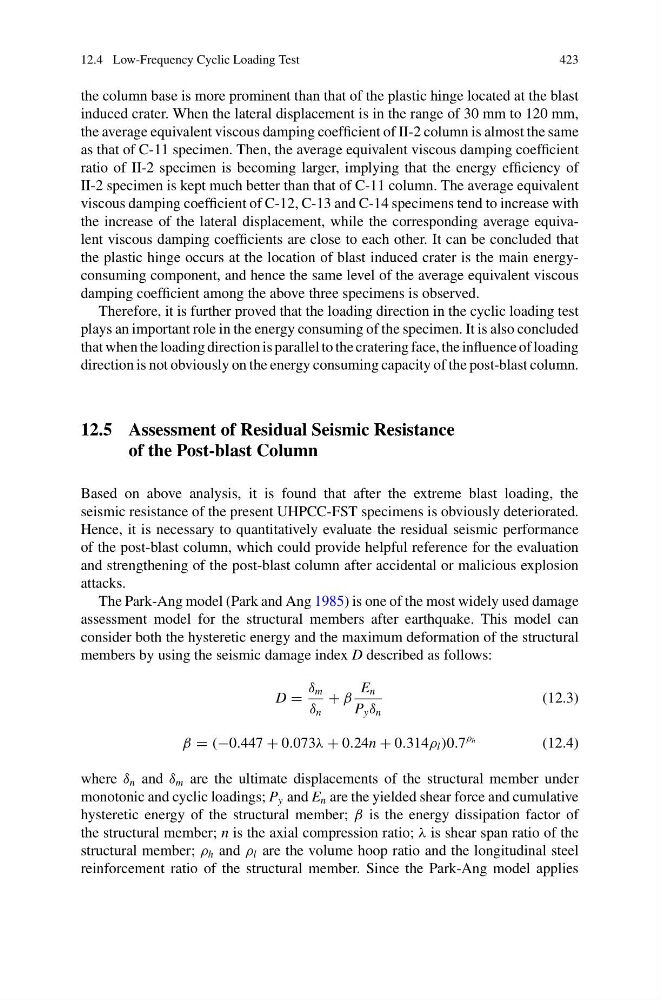
The Park-Ang model (Park and Ang 1985) is one of the most widely used damage
assessment model for the structural members after earthquake. This model can
consider both the hysteretic energy and the maximum deformation of the structural
members by using the seismic damage index D described as follows:
D =
δ m
δ n
+ β
E n
P y δ n
(12.3)
β = (−0.447 + 0.073λ + 0.24n + 0.314ρ l )0.7
ρ h
(12.4)
where δ n and δ m are the ultimate displacements of the structural member under
monotonic and cyclic loadings; P y and E n are the yielded shear force and cumulative
hysteretic energy of the structural member; β is the energy dissipation factor of
the structural member; n is the axial compression ratio; λ is shear span ratio of the
structural member; ρ h and ρ l are the volume hoop ratio and the longitudinal steel
reinforcement ratio of the structural member. Since the Park-Ang model applies
423
the column base is more prominent than that of the plastic hinge located at the blast
induced crater. When the lateral displacement is in the range of 30 mm to 120 mm,
the average equivalent viscous damping coefficient of II-2 column is almost the same
as that of C-11 specimen. Then, the average equivalent viscous damping coefficient
ratio of II-2 specimen is becoming larger, implying that the energy efficiency of
II-2 specimen is kept much better than that of C-11 column. The average equivalent
viscous damping coefficient of C-12, C-13 and C-14 specimens tend to increase with
the increase of the lateral displacement, while the corresponding average equivalent viscous damping coefficients are close to each other. It can be concluded that
the plastic hinge occurs at the location of blast induced crater is the main energyconsuming component, and hence the same level of the average equivalent viscous
damping coefficient among the above three specimens is observed.
Therefore, it is further proved that the loading direction in the cyclic loading test
plays an important role in the energy consuming of the specimen. It is also concluded
that when the loading direction is parallel to the cratering face, the influence of loading
direction is not obviously on the energy consuming capacity of the post-blast column.
12.5 Assessment of Residual Seismic Resistance
of the Post-blast Column
Based on above analysis, it is found that after the extreme blast loading, the
seismic resistance of the present UHPCC-FST specimens is obviously deteriorated.
Hence, it is necessary to quantitatively evaluate the residual seismic performance
of the post-blast column, which could provide helpful reference for the evaluation
and strengthening of the post-blast column after accidental or malicious explosion
attacks.
The Park-Ang model (Park and Ang 1985) is one of the most widely used damage
assessment model for the structural members after earthquake. This model can
consider both the hysteretic energy and the maximum deformation of the structural
members by using the seismic damage index D described as follows:
D =
δ m
δ n
+ β
E n
P y δ n
(12.3)
β = (−0.447 + 0.073λ + 0.24n + 0.314ρ l )0.7
ρ h
(12.4)
where δ n and δ m are the ultimate displacements of the structural member under
monotonic and cyclic loadings; P y and E n are the yielded shear force and cumulative
hysteretic energy of the structural member; β is the energy dissipation factor of
the structural member; n is the axial compression ratio; λ is shear span ratio of the
structural member; ρ h and ρ l are the volume hoop ratio and the longitudinal steel
reinforcement ratio of the structural member. Since the Park-Ang model applies