

422
12 Experimental Study on the Residual Seismic Resistance of UHPCC …
The equivalent viscous damping coefficient is another important index to describe
the energy consumption of structural member under seismic loadings. At present,
the energy dissipation capacity of post-blast column is further discussed by adopting
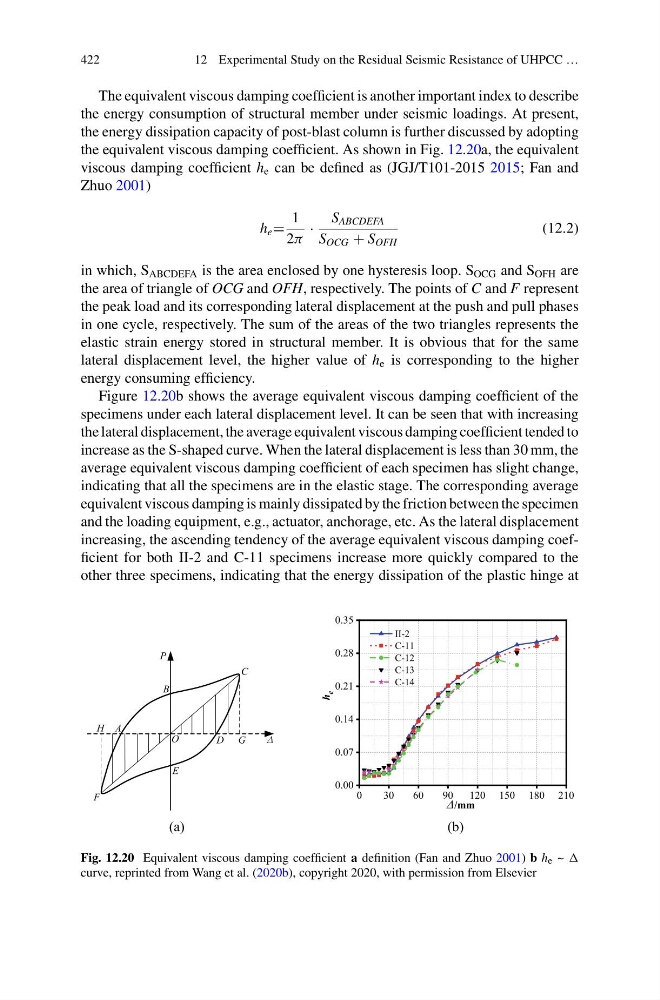
the equivalent viscous damping coefficient. As shown in Fig. 12.20a, the equivalent
viscous damping coefficient h e can be defined as (JGJ/T101-2015 2015; Fan and
Zhuo 2001)
h e =
1
2π
·
S ABCDEFA
S OCG + S OFH
(12.2)
in which, S ABCDEFA is the area enclosed by one hysteresis loop. S OCG and S OFH are
the area of triangle of OCG and OFH, respectively. The points of C and F represent
the peak load and its corresponding lateral displacement at the push and pull phases
in one cycle, respectively. The sum of the areas of the two triangles represents the
elastic strain energy stored in structural member. It is obvious that for the same
lateral displacement level, the higher value of h e is corresponding to the higher
energy consuming efficiency.
Figure 12.20b shows the average equivalent viscous damping coefficient of the
specimens under each lateral displacement level. It can be seen that with increasing
the lateral displacement, the average equivalent viscous damping coefficient tended to
increase as the S-shaped curve. When the lateral displacement is less than 30 mm, the
average equivalent viscous damping coefficient of each specimen has slight change,
indicating that all the specimens are in the elastic stage. The corresponding average
equivalent viscous damping is mainly dissipated by the friction between the specimen
and the loading equipment, e.g., actuator, anchorage, etc. As the lateral displacement
increasing, the ascending tendency of the average equivalent viscous damping coefficient for both II-2 and C-11 specimens increase more quickly compared to the
other three specimens, indicating that the energy dissipation of the plastic hinge at
O
P
A
B
C
D G
E
F
H
0
30
60
90
120 150 180 210
0.00
0.07
0.14
0.21
0.28
0.35
II-2
C-11
C-12
C-13
C-14
h
e
/mm
(a)
(b)
Fig. 12.20 Equivalent viscous damping coefficient a definition (Fan and Zhuo 2001) b h e ~
curve, reprinted from Wang et al. (2020b), copyright 2020, with permission from Elsevier
12 Experimental Study on the Residual Seismic Resistance of UHPCC …
The equivalent viscous damping coefficient is another important index to describe
the energy consumption of structural member under seismic loadings. At present,
the energy dissipation capacity of post-blast column is further discussed by adopting
the equivalent viscous damping coefficient. As shown in Fig. 12.20a, the equivalent
viscous damping coefficient h e can be defined as (JGJ/T101-2015 2015; Fan and
Zhuo 2001)
h e =
1
2π
·
S ABCDEFA
S OCG + S OFH
(12.2)
in which, S ABCDEFA is the area enclosed by one hysteresis loop. S OCG and S OFH are
the area of triangle of OCG and OFH, respectively. The points of C and F represent
the peak load and its corresponding lateral displacement at the push and pull phases
in one cycle, respectively. The sum of the areas of the two triangles represents the
elastic strain energy stored in structural member. It is obvious that for the same
lateral displacement level, the higher value of h e is corresponding to the higher
energy consuming efficiency.
Figure 12.20b shows the average equivalent viscous damping coefficient of the
specimens under each lateral displacement level. It can be seen that with increasing
the lateral displacement, the average equivalent viscous damping coefficient tended to
increase as the S-shaped curve. When the lateral displacement is less than 30 mm, the
average equivalent viscous damping coefficient of each specimen has slight change,
indicating that all the specimens are in the elastic stage. The corresponding average
equivalent viscous damping is mainly dissipated by the friction between the specimen
and the loading equipment, e.g., actuator, anchorage, etc. As the lateral displacement
increasing, the ascending tendency of the average equivalent viscous damping coefficient for both II-2 and C-11 specimens increase more quickly compared to the
other three specimens, indicating that the energy dissipation of the plastic hinge at
O
P
A
B
C
D G
E
F
H
0
30
60
90
120 150 180 210
0.00
0.07
0.14
0.21
0.28
0.35
II-2
C-11
C-12
C-13
C-14
h
e
/mm
(a)
(b)
Fig. 12.20 Equivalent viscous damping coefficient a definition (Fan and Zhuo 2001) b h e ~
curve, reprinted from Wang et al. (2020b), copyright 2020, with permission from Elsevier