

294
9 Dynamic Responses of Reinforced UHPCC Members Under …
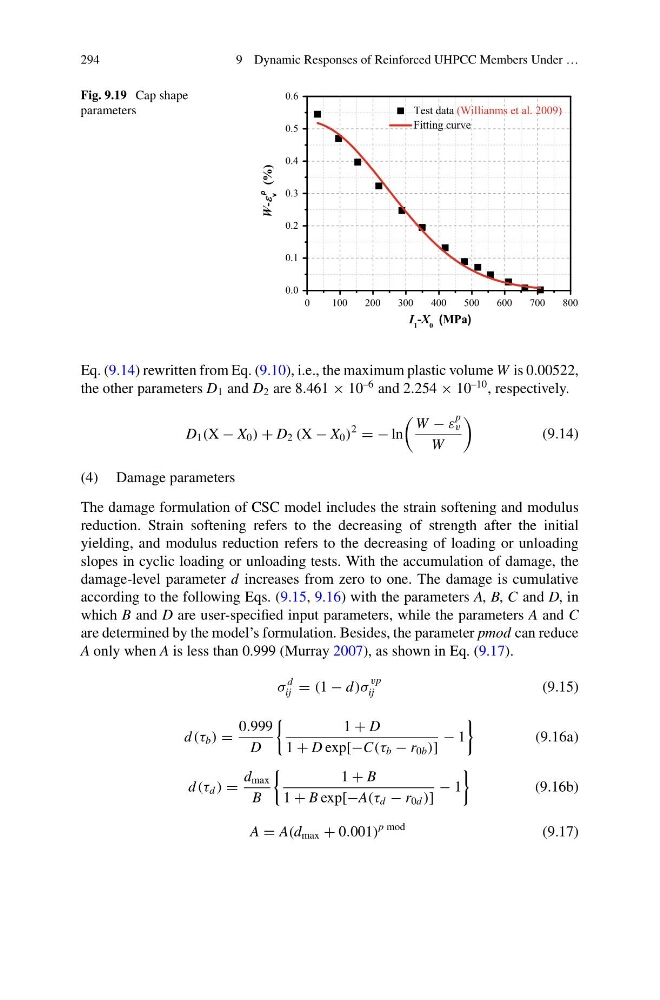
Fig. 9.19 Cap shape
parameters
0
100
200
300
400
500
600
700
800
0.0
0.1
0.2
0.3
0.4
0.5
0.6
Wp
v
(%)
Test data (Willianms et al. 2009)
Fitting curve
I 1 -X 0 (MPa)
Eq. (9.14) rewritten from Eq. (9.10), i.e., the maximum plastic volume W is 0.00522,
the other parameters D 1 and D 2 are 8.461 × 10
–6 and 2.254 × 10
–10 , respectively.
D 1 (X − X 0 ) + D 2 (X − X 0 )
2
= − ln
W − ε
p
v
W
(9.14)
(4) Damage parameters
The damage formulation of CSC model includes the strain softening and modulus
reduction. Strain softening refers to the decreasing of strength after the initial
yielding, and modulus reduction refers to the decreasing of loading or unloading
slopes in cyclic loading or unloading tests. With the accumulation of damage, the
damage-level parameter d increases from zero to one. The damage is cumulative
according to the following Eqs. (9.15, 9.16) with the parameters A, B, C and D, in
which B and D are user-specified input parameters, while the parameters A and C
are determined by the model’s formulation. Besides, the parameter pmod can reduce
A only when A is less than 0.999 (Murray 2007), as shown in Eq. (9.17).
σ
d
ij = (1 − d )σ
vp
ij
(9.15)
d (τ b ) =
0.999
D
1 + D
1 + D exp[−C(τ b − r 0b )]
− 1
(9.16a)
d (τ d ) =
d max
B
1 + B
1 + B exp[−A(τ d − r 0d )]
− 1
(9.16b)
A = A(d max + 0.001)
p mod
(9.17)
9 Dynamic Responses of Reinforced UHPCC Members Under …
Fig. 9.19 Cap shape
parameters
0
100
200
300
400
500
600
700
800
0.0
0.1
0.2
0.3
0.4
0.5
0.6
Wp
v
(%)
Test data (Willianms et al. 2009)
Fitting curve
I 1 -X 0 (MPa)
Eq. (9.14) rewritten from Eq. (9.10), i.e., the maximum plastic volume W is 0.00522,
the other parameters D 1 and D 2 are 8.461 × 10
–6 and 2.254 × 10
–10 , respectively.
D 1 (X − X 0 ) + D 2 (X − X 0 )
2
= − ln
W − ε
p
v
W
(9.14)
(4) Damage parameters
The damage formulation of CSC model includes the strain softening and modulus
reduction. Strain softening refers to the decreasing of strength after the initial
yielding, and modulus reduction refers to the decreasing of loading or unloading
slopes in cyclic loading or unloading tests. With the accumulation of damage, the
damage-level parameter d increases from zero to one. The damage is cumulative
according to the following Eqs. (9.15, 9.16) with the parameters A, B, C and D, in
which B and D are user-specified input parameters, while the parameters A and C
are determined by the model’s formulation. Besides, the parameter pmod can reduce
A only when A is less than 0.999 (Murray 2007), as shown in Eq. (9.17).
σ
d
ij = (1 − d )σ
vp
ij
(9.15)
d (τ b ) =
0.999
D
1 + D
1 + D exp[−C(τ b − r 0b )]
− 1
(9.16a)
d (τ d ) =
d max
B
1 + B
1 + B exp[−A(τ d − r 0d )]
− 1
(9.16b)
A = A(d max + 0.001)
p mod
(9.17)