

9.4 Numerical Simulation
289
respectively in this study. The other model parameters can be generated automatically based on the above three parameters. For UHPCC, since the concrete compressive strength of which is beyond the default application range of CSC model, the
constitutive model parameters of CSC model for UHPCC are calibrated in Sect. 9.4.2.
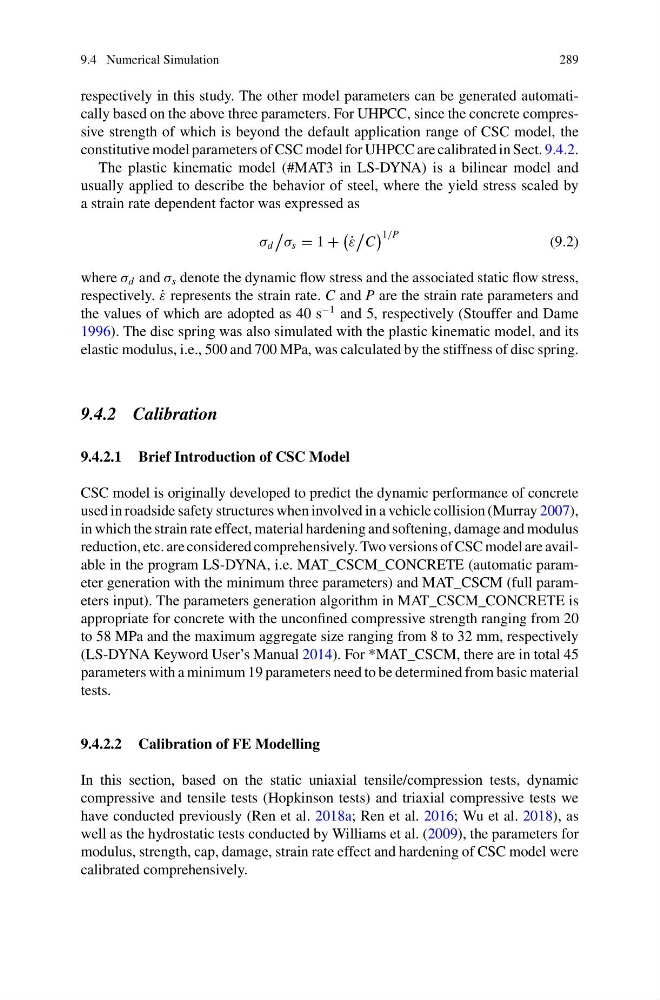
The plastic kinematic model (#MAT3 in LS-DYNA) is a bilinear model and
usually applied to describe the behavior of steel, where the yield stress scaled by
a strain rate dependent factor was expressed as
σ d
σ s = 1 +
˙
ε
C
1/P
(9.2)
where σ d and σ s denote the dynamic flow stress and the associated static flow stress,
respectively. ˙
ε represents the strain rate. C and P are the strain rate parameters and
the values of which are adopted as 40 s
−1 and 5, respectively (Stouffer and Dame
1996). The disc spring was also simulated with the plastic kinematic model, and its
elastic modulus, i.e., 500 and 700 MPa, was calculated by the stiffness of disc spring.
9.4.2 Calibration
9.4.2.1 Brief Introduction of CSC Model
CSC model is originally developed to predict the dynamic performance of concrete
used in roadside safety structures when involved in a vehicle collision (Murray 2007),
in which the strain rate effect, material hardening and softening, damage and modulus
reduction, etc. are considered comprehensively. Two versions of CSC model are available in the program LS-DYNA, i.e. MAT_CSCM_CONCRETE (automatic parameter generation with the minimum three parameters) and MAT_CSCM (full parameters input). The parameters generation algorithm in MAT_CSCM_CONCRETE is
appropriate for concrete with the unconfined compressive strength ranging from 20
to 58 MPa and the maximum aggregate size ranging from 8 to 32 mm, respectively
(LS-DYNA Keyword User’s Manual 2014). For *MAT_CSCM, there are in total 45
parameters with a minimum 19 parameters need to be determined from basic material
tests.
9.4.2.2 Calibration of FE Modelling
In this section, based on the static uniaxial tensile/compression tests, dynamic
compressive and tensile tests (Hopkinson tests) and triaxial compressive tests we
have conducted previously (Ren et al. 2018a; Ren et al. 2016; Wu et al. 2018), as
well as the hydrostatic tests conducted by Williams et al. (2009), the parameters for
modulus, strength, cap, damage, strain rate effect and hardening of CSC model were
calibrated comprehensively.
289
respectively in this study. The other model parameters can be generated automatically based on the above three parameters. For UHPCC, since the concrete compressive strength of which is beyond the default application range of CSC model, the
constitutive model parameters of CSC model for UHPCC are calibrated in Sect. 9.4.2.
The plastic kinematic model (#MAT3 in LS-DYNA) is a bilinear model and
usually applied to describe the behavior of steel, where the yield stress scaled by
a strain rate dependent factor was expressed as
σ d
σ s = 1 +
˙
ε
C
1/P
(9.2)
where σ d and σ s denote the dynamic flow stress and the associated static flow stress,
respectively. ˙
ε represents the strain rate. C and P are the strain rate parameters and
the values of which are adopted as 40 s
−1 and 5, respectively (Stouffer and Dame
1996). The disc spring was also simulated with the plastic kinematic model, and its
elastic modulus, i.e., 500 and 700 MPa, was calculated by the stiffness of disc spring.
9.4.2 Calibration
9.4.2.1 Brief Introduction of CSC Model
CSC model is originally developed to predict the dynamic performance of concrete
used in roadside safety structures when involved in a vehicle collision (Murray 2007),
in which the strain rate effect, material hardening and softening, damage and modulus
reduction, etc. are considered comprehensively. Two versions of CSC model are available in the program LS-DYNA, i.e. MAT_CSCM_CONCRETE (automatic parameter generation with the minimum three parameters) and MAT_CSCM (full parameters input). The parameters generation algorithm in MAT_CSCM_CONCRETE is
appropriate for concrete with the unconfined compressive strength ranging from 20
to 58 MPa and the maximum aggregate size ranging from 8 to 32 mm, respectively
(LS-DYNA Keyword User’s Manual 2014). For *MAT_CSCM, there are in total 45
parameters with a minimum 19 parameters need to be determined from basic material
tests.
9.4.2.2 Calibration of FE Modelling
In this section, based on the static uniaxial tensile/compression tests, dynamic
compressive and tensile tests (Hopkinson tests) and triaxial compressive tests we
have conducted previously (Ren et al. 2018a; Ren et al. 2016; Wu et al. 2018), as
well as the hydrostatic tests conducted by Williams et al. (2009), the parameters for
modulus, strength, cap, damage, strain rate effect and hardening of CSC model were
calibrated comprehensively.