

9.3 Test Results and Discussions
279
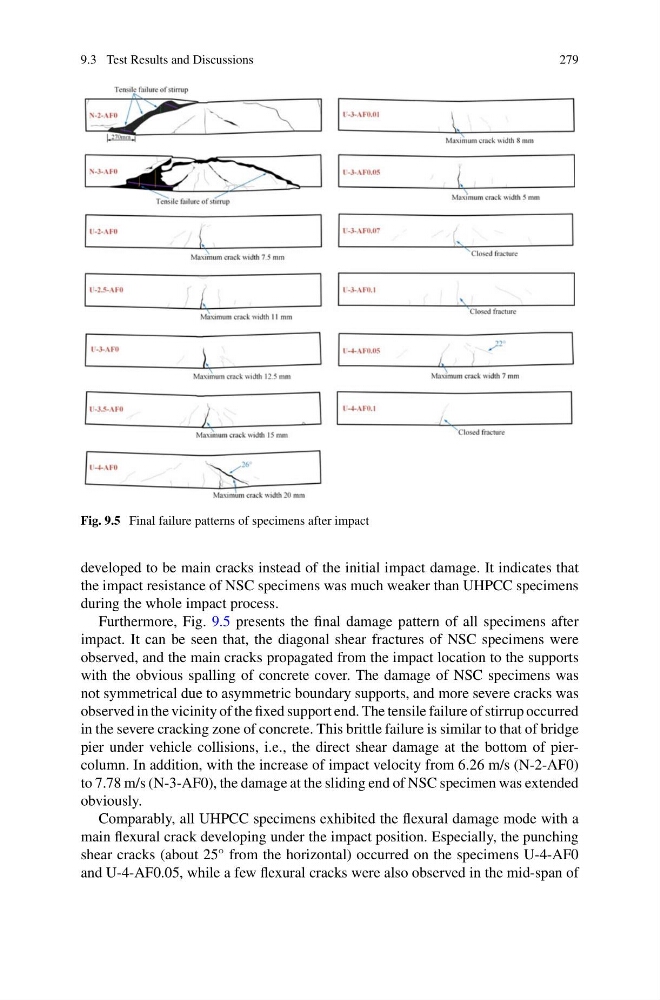
Fig. 9.5 Final failure patterns of specimens after impact
developed to be main cracks instead of the initial impact damage. It indicates that
the impact resistance of NSC specimens was much weaker than UHPCC specimens
during the whole impact process.
Furthermore, Fig. 9.5 presents the final damage pattern of all specimens after
impact. It can be seen that, the diagonal shear fractures of NSC specimens were
observed, and the main cracks propagated from the impact location to the supports
with the obvious spalling of concrete cover. The damage of NSC specimens was
not symmetrical due to asymmetric boundary supports, and more severe cracks was
observed in the vicinity of the fixed support end. The tensile failure of stirrup occurred
in the severe cracking zone of concrete. This brittle failure is similar to that of bridge
pier under vehicle collisions, i.e., the direct shear damage at the bottom of piercolumn. In addition, with the increase of impact velocity from 6.26 m/s (N-2-AF0)
to 7.78 m/s (N-3-AF0), the damage at the sliding end of NSC specimen was extended
obviously.
Comparably, all UHPCC specimens exhibited the flexural damage mode with a
main flexural crack developing under the impact position. Especially, the punching
shear cracks (about 25° from the horizontal) occurred on the specimens U-4-AF0
and U-4-AF0.05, while a few flexural cracks were also observed in the mid-span of
279
Fig. 9.5 Final failure patterns of specimens after impact
developed to be main cracks instead of the initial impact damage. It indicates that
the impact resistance of NSC specimens was much weaker than UHPCC specimens
during the whole impact process.
Furthermore, Fig. 9.5 presents the final damage pattern of all specimens after
impact. It can be seen that, the diagonal shear fractures of NSC specimens were
observed, and the main cracks propagated from the impact location to the supports
with the obvious spalling of concrete cover. The damage of NSC specimens was
not symmetrical due to asymmetric boundary supports, and more severe cracks was
observed in the vicinity of the fixed support end. The tensile failure of stirrup occurred
in the severe cracking zone of concrete. This brittle failure is similar to that of bridge
pier under vehicle collisions, i.e., the direct shear damage at the bottom of piercolumn. In addition, with the increase of impact velocity from 6.26 m/s (N-2-AF0)
to 7.78 m/s (N-3-AF0), the damage at the sliding end of NSC specimen was extended
obviously.
Comparably, all UHPCC specimens exhibited the flexural damage mode with a
main flexural crack developing under the impact position. Especially, the punching
shear cracks (about 25° from the horizontal) occurred on the specimens U-4-AF0
and U-4-AF0.05, while a few flexural cracks were also observed in the mid-span of