

280
9 Dynamic Responses of Reinforced UHPCC Members Under …
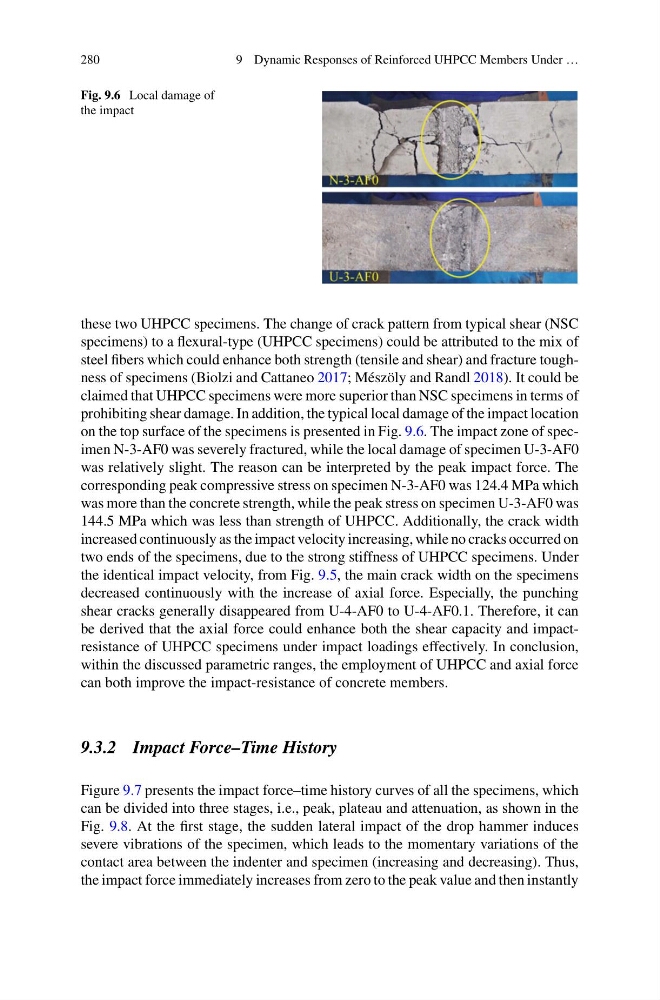
Fig. 9.6 Local damage of
the impact
these two UHPCC specimens. The change of crack pattern from typical shear (NSC
specimens) to a flexural-type (UHPCC specimens) could be attributed to the mix of
steel fibers which could enhance both strength (tensile and shear) and fracture toughness of specimens (Biolzi and Cattaneo 2017; Mészöly and Randl 2018). It could be
claimed that UHPCC specimens were more superior than NSC specimens in terms of
prohibiting shear damage. In addition, the typical local damage of the impact location
on the top surface of the specimens is presented in Fig. 9.6. The impact zone of specimen N-3-AF0 was severely fractured, while the local damage of specimen U-3-AF0
was relatively slight. The reason can be interpreted by the peak impact force. The
corresponding peak compressive stress on specimen N-3-AF0 was 124.4 MPa which
was more than the concrete strength, while the peak stress on specimen U-3-AF0 was
144.5 MPa which was less than strength of UHPCC. Additionally, the crack width
increased continuously as the impact velocity increasing, while no cracks occurred on
two ends of the specimens, due to the strong stiffness of UHPCC specimens. Under
the identical impact velocity, from Fig. 9.5, the main crack width on the specimens
decreased continuously with the increase of axial force. Especially, the punching
shear cracks generally disappeared from U-4-AF0 to U-4-AF0.1. Therefore, it can
be derived that the axial force could enhance both the shear capacity and impactresistance of UHPCC specimens under impact loadings effectively. In conclusion,
within the discussed parametric ranges, the employment of UHPCC and axial force
can both improve the impact-resistance of concrete members.
9.3.2 Impact Force–Time History
Figure 9.7 presents the impact force–time history curves of all the specimens, which
can be divided into three stages, i.e., peak, plateau and attenuation, as shown in the
Fig. 9.8. At the first stage, the sudden lateral impact of the drop hammer induces
severe vibrations of the specimen, which leads to the momentary variations of the
contact area between the indenter and specimen (increasing and decreasing). Thus,
the impact force immediately increases from zero to the peak value and then instantly
9 Dynamic Responses of Reinforced UHPCC Members Under …
Fig. 9.6 Local damage of
the impact
these two UHPCC specimens. The change of crack pattern from typical shear (NSC
specimens) to a flexural-type (UHPCC specimens) could be attributed to the mix of
steel fibers which could enhance both strength (tensile and shear) and fracture toughness of specimens (Biolzi and Cattaneo 2017; Mészöly and Randl 2018). It could be
claimed that UHPCC specimens were more superior than NSC specimens in terms of
prohibiting shear damage. In addition, the typical local damage of the impact location
on the top surface of the specimens is presented in Fig. 9.6. The impact zone of specimen N-3-AF0 was severely fractured, while the local damage of specimen U-3-AF0
was relatively slight. The reason can be interpreted by the peak impact force. The
corresponding peak compressive stress on specimen N-3-AF0 was 124.4 MPa which
was more than the concrete strength, while the peak stress on specimen U-3-AF0 was
144.5 MPa which was less than strength of UHPCC. Additionally, the crack width
increased continuously as the impact velocity increasing, while no cracks occurred on
two ends of the specimens, due to the strong stiffness of UHPCC specimens. Under
the identical impact velocity, from Fig. 9.5, the main crack width on the specimens
decreased continuously with the increase of axial force. Especially, the punching
shear cracks generally disappeared from U-4-AF0 to U-4-AF0.1. Therefore, it can
be derived that the axial force could enhance both the shear capacity and impactresistance of UHPCC specimens under impact loadings effectively. In conclusion,
within the discussed parametric ranges, the employment of UHPCC and axial force
can both improve the impact-resistance of concrete members.
9.3.2 Impact Force–Time History
Figure 9.7 presents the impact force–time history curves of all the specimens, which
can be divided into three stages, i.e., peak, plateau and attenuation, as shown in the
Fig. 9.8. At the first stage, the sudden lateral impact of the drop hammer induces
severe vibrations of the specimen, which leads to the momentary variations of the
contact area between the indenter and specimen (increasing and decreasing). Thus,
the impact force immediately increases from zero to the peak value and then instantly