

8.4 Calibration of K&C Model Parameters for UHPCC
251
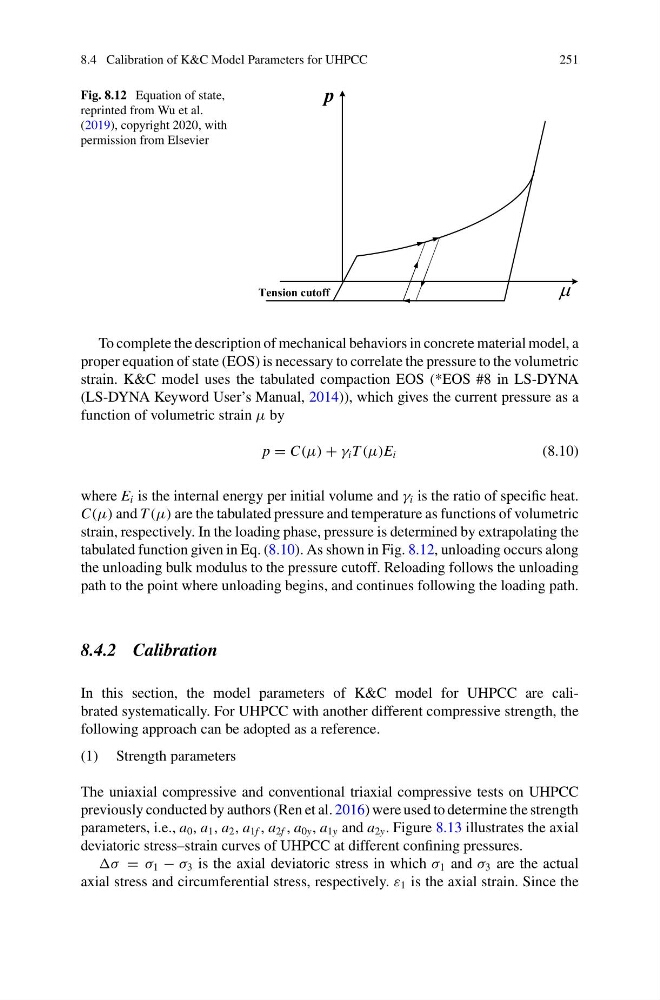
Fig. 8.12 Equation of state,
reprinted from Wu et al.
(2019), copyright 2020, with
permission from Elsevier
To complete the description of mechanical behaviors in concrete material model, a
proper equation of state (EOS) is necessary to correlate the pressure to the volumetric
strain. K&C model uses the tabulated compaction EOS (*EOS #8 in LS-DYNA
(LS-DYNA Keyword User’s Manual, 2014)), which gives the current pressure as a
function of volumetric strain μ by
p = C(μ) + γ i T (μ)E i
(8.10)
where E i is the internal energy per initial volume and γ i is the ratio of specific heat.
C(μ) and T (μ) are the tabulated pressure and temperature as functions of volumetric
strain, respectively. In the loading phase, pressure is determined by extrapolating the
tabulated function given in Eq. (8.10). As shown in Fig. 8.12, unloading occurs along
the unloading bulk modulus to the pressure cutoff. Reloading follows the unloading
path to the point where unloading begins, and continues following the loading path.
8.4.2 Calibration
In this section, the model parameters of K&C model for UHPCC are calibrated systematically. For UHPCC with another different compressive strength, the
following approach can be adopted as a reference.
(1) Strength parameters
The uniaxial compressive and conventional triaxial compressive tests on UHPCC
previously conducted by authors (Ren et al. 2016) were used to determine the strength
parameters, i.e., a 0 , a 1 , a 2 , a 1f , a 2f , a 0y , a 1y and a 2y . Figure 8.13 illustrates the axial
deviatoric stress–strain curves of UHPCC at different confining pressures.
= σ 1 − σ 3 is the axial deviatoric stress in which σ 1 and σ 3 are the actual
axial stress and circumferential stress, respectively. ε 1 is the axial strain. Since the
251
Fig. 8.12 Equation of state,
reprinted from Wu et al.
(2019), copyright 2020, with
permission from Elsevier
To complete the description of mechanical behaviors in concrete material model, a
proper equation of state (EOS) is necessary to correlate the pressure to the volumetric
strain. K&C model uses the tabulated compaction EOS (*EOS #8 in LS-DYNA
(LS-DYNA Keyword User’s Manual, 2014)), which gives the current pressure as a
function of volumetric strain μ by
p = C(μ) + γ i T (μ)E i
(8.10)
where E i is the internal energy per initial volume and γ i is the ratio of specific heat.
C(μ) and T (μ) are the tabulated pressure and temperature as functions of volumetric
strain, respectively. In the loading phase, pressure is determined by extrapolating the
tabulated function given in Eq. (8.10). As shown in Fig. 8.12, unloading occurs along
the unloading bulk modulus to the pressure cutoff. Reloading follows the unloading
path to the point where unloading begins, and continues following the loading path.
8.4.2 Calibration
In this section, the model parameters of K&C model for UHPCC are calibrated systematically. For UHPCC with another different compressive strength, the
following approach can be adopted as a reference.
(1) Strength parameters
The uniaxial compressive and conventional triaxial compressive tests on UHPCC
previously conducted by authors (Ren et al. 2016) were used to determine the strength
parameters, i.e., a 0 , a 1 , a 2 , a 1f , a 2f , a 0y , a 1y and a 2y . Figure 8.13 illustrates the axial
deviatoric stress–strain curves of UHPCC at different confining pressures.
= σ 1 − σ 3 is the axial deviatoric stress in which σ 1 and σ 3 are the actual
axial stress and circumferential stress, respectively. ε 1 is the axial strain. Since the