

7.3 Impact Test on NP450 Armor Steel/UHPCC and NP500 Armor …
227
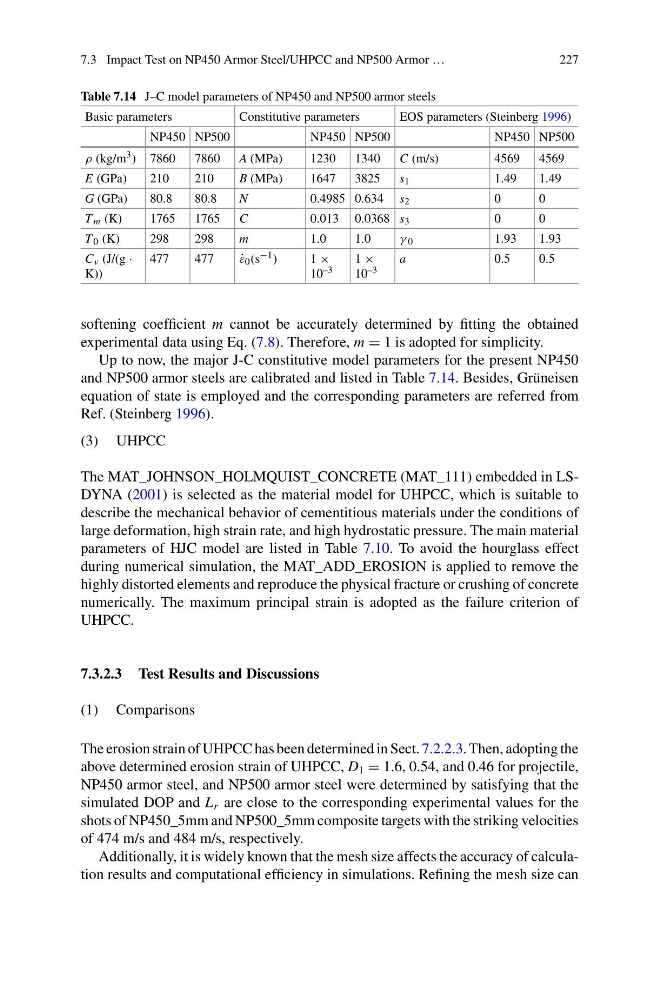
Table 7.14 J–C model parameters of NP450 and NP500 armor steels
Basic parameters
Constitutive parameters
EOS parameters (Steinberg 1996)
NP450 NP500
NP450 NP500
NP450 NP500
ρ (kg/m 3 ) 7860
7860
A (MPa)
1230
1340
C (m/s)
4569
4569
E (GPa)
210
210
B (MPa)
1647
3825
s 1
1.49
1.49
G (GPa)
80.8
80.8
N
0.4985 0.634 s 2
0
0
T m (K)
1765
1765
C
0.013 0.0368 s 3
0
0
T 0 (K)
298
298
m
1.0
1.0
γ 0
1.93
1.93
C v (J/(g ·
K))
477
477
˙
ε 0 (s −1 )
1 ×
10 –3
1 ×
10 –3
a
0.5
0.5
softening coefficient m cannot be accurately determined by fitting the obtained
experimental data using Eq. (7.8). Therefore, m = 1 is adopted for simplicity.
Up to now, the major J-C constitutive model parameters for the present NP450
and NP500 armor steels are calibrated and listed in Table 7.14. Besides, Grüneisen
equation of state is employed and the corresponding parameters are referred from
Ref. (Steinberg 1996).
(3) UHPCC
The MAT_JOHNSON_HOLMQUIST_CONCRETE (MAT_111) embedded in LSDYNA (2001) is selected as the material model for UHPCC, which is suitable to
describe the mechanical behavior of cementitious materials under the conditions of
large deformation, high strain rate, and high hydrostatic pressure. The main material
parameters of HJC model are listed in Table 7.10. To avoid the hourglass effect
during numerical simulation, the MAT_ADD_EROSION is applied to remove the
highly distorted elements and reproduce the physical fracture or crushing of concrete
numerically. The maximum principal strain is adopted as the failure criterion of
UHPCC.
7.3.2.3 Test Results and Discussions
(1) Comparisons
The erosion strain of UHPCC has been determined in Sect. 7.2.2.3. Then, adopting the
above determined erosion strain of UHPCC, D 1 = 1.6, 0.54, and 0.46 for projectile,
NP450 armor steel, and NP500 armor steel were determined by satisfying that the
simulated DOP and L r are close to the corresponding experimental values for the
shots of NP450_5mm and NP500_5mm composite targets with the striking velocities
of 474 m/s and 484 m/s, respectively.
Additionally, it is widely known that the mesh size affects the accuracy of calculation results and computational efficiency in simulations. Refining the mesh size can
227
Table 7.14 J–C model parameters of NP450 and NP500 armor steels
Basic parameters
Constitutive parameters
EOS parameters (Steinberg 1996)
NP450 NP500
NP450 NP500
NP450 NP500
ρ (kg/m 3 ) 7860
7860
A (MPa)
1230
1340
C (m/s)
4569
4569
E (GPa)
210
210
B (MPa)
1647
3825
s 1
1.49
1.49
G (GPa)
80.8
80.8
N
0.4985 0.634 s 2
0
0
T m (K)
1765
1765
C
0.013 0.0368 s 3
0
0
T 0 (K)
298
298
m
1.0
1.0
γ 0
1.93
1.93
C v (J/(g ·
K))
477
477
˙
ε 0 (s −1 )
1 ×
10 –3
1 ×
10 –3
a
0.5
0.5
softening coefficient m cannot be accurately determined by fitting the obtained
experimental data using Eq. (7.8). Therefore, m = 1 is adopted for simplicity.
Up to now, the major J-C constitutive model parameters for the present NP450
and NP500 armor steels are calibrated and listed in Table 7.14. Besides, Grüneisen
equation of state is employed and the corresponding parameters are referred from
Ref. (Steinberg 1996).
(3) UHPCC
The MAT_JOHNSON_HOLMQUIST_CONCRETE (MAT_111) embedded in LSDYNA (2001) is selected as the material model for UHPCC, which is suitable to
describe the mechanical behavior of cementitious materials under the conditions of
large deformation, high strain rate, and high hydrostatic pressure. The main material
parameters of HJC model are listed in Table 7.10. To avoid the hourglass effect
during numerical simulation, the MAT_ADD_EROSION is applied to remove the
highly distorted elements and reproduce the physical fracture or crushing of concrete
numerically. The maximum principal strain is adopted as the failure criterion of
UHPCC.
7.3.2.3 Test Results and Discussions
(1) Comparisons
The erosion strain of UHPCC has been determined in Sect. 7.2.2.3. Then, adopting the
above determined erosion strain of UHPCC, D 1 = 1.6, 0.54, and 0.46 for projectile,
NP450 armor steel, and NP500 armor steel were determined by satisfying that the
simulated DOP and L r are close to the corresponding experimental values for the
shots of NP450_5mm and NP500_5mm composite targets with the striking velocities
of 474 m/s and 484 m/s, respectively.
Additionally, it is widely known that the mesh size affects the accuracy of calculation results and computational efficiency in simulations. Refining the mesh size can