

226
7 Impact Resistance of Armor Steel/Ceramic/UHPCC Layered …
of 6 mm/min, corresponding to the strain rate of 0.001 s
−1 . Three thermocouples
were pre-fixed on the specimen to record the temperature changes at the upper,
middle and lower positions of the test specimens. The pre-set temperatures and
real-time temperatures detected by thermocouples were explicitly displayed in the
temperature control system to ensure that the temperature of specimen reached the
pre-set temperature.
Considering the high yield strength of two newly developed armor steels and
limited loading capability of the testing machine, the quasi-static tension test was
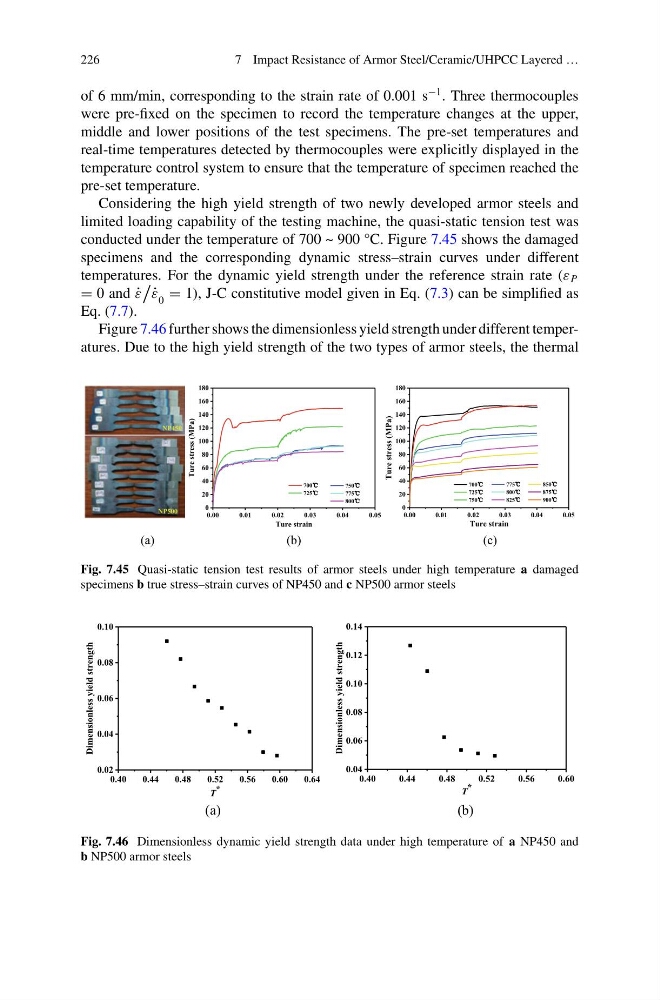
conducted under the temperature of 700 ~ 900 °C. Figure 7.45 shows the damaged
specimens and the corresponding dynamic stress–strain curves under different
temperatures. For the dynamic yield strength under the reference strain rate (ε P
= 0 and ˙
ε
˙
ε 0 = 1), J-C constitutive model given in Eq. (7.3) can be simplified as
Eq. (7.7).
Figure 7.46 further shows the dimensionless yield strength under different temperatures. Due to the high yield strength of the two types of armor steels, the thermal
Fig. 7.45 Quasi-static tension test results of armor steels under high temperature a damaged
specimens b true stress–strain curves of NP450 and c NP500 armor steels
0.40
0.44
0.48
0.52
0.56
0.60
0.64
0.02
0.04
0.06
0.08
0.10
Dimensionless yield strength
T *
0.40
0.44
0.48
0.52
0.56
0.60
0.04
0.06
0.08
0.10
0.12
0.14
Dimensionless yield strength
T *
(a)
(b)
Fig. 7.46 Dimensionless dynamic yield strength data under high temperature of a NP450 and
b NP500 armor steels
7 Impact Resistance of Armor Steel/Ceramic/UHPCC Layered …
of 6 mm/min, corresponding to the strain rate of 0.001 s
−1 . Three thermocouples
were pre-fixed on the specimen to record the temperature changes at the upper,
middle and lower positions of the test specimens. The pre-set temperatures and
real-time temperatures detected by thermocouples were explicitly displayed in the
temperature control system to ensure that the temperature of specimen reached the
pre-set temperature.
Considering the high yield strength of two newly developed armor steels and
limited loading capability of the testing machine, the quasi-static tension test was
conducted under the temperature of 700 ~ 900 °C. Figure 7.45 shows the damaged
specimens and the corresponding dynamic stress–strain curves under different
temperatures. For the dynamic yield strength under the reference strain rate (ε P
= 0 and ˙
ε
˙
ε 0 = 1), J-C constitutive model given in Eq. (7.3) can be simplified as
Eq. (7.7).
Figure 7.46 further shows the dimensionless yield strength under different temperatures. Due to the high yield strength of the two types of armor steels, the thermal
Fig. 7.45 Quasi-static tension test results of armor steels under high temperature a damaged
specimens b true stress–strain curves of NP450 and c NP500 armor steels
0.40
0.44
0.48
0.52
0.56
0.60
0.64
0.02
0.04
0.06
0.08
0.10
Dimensionless yield strength
T *
0.40
0.44
0.48
0.52
0.56
0.60
0.04
0.06
0.08
0.10
0.12
0.14
Dimensionless yield strength
T *
(a)
(b)
Fig. 7.46 Dimensionless dynamic yield strength data under high temperature of a NP450 and
b NP500 armor steels