

7.3 Impact Test on NP450 Armor Steel/UHPCC and NP500 Armor …
223
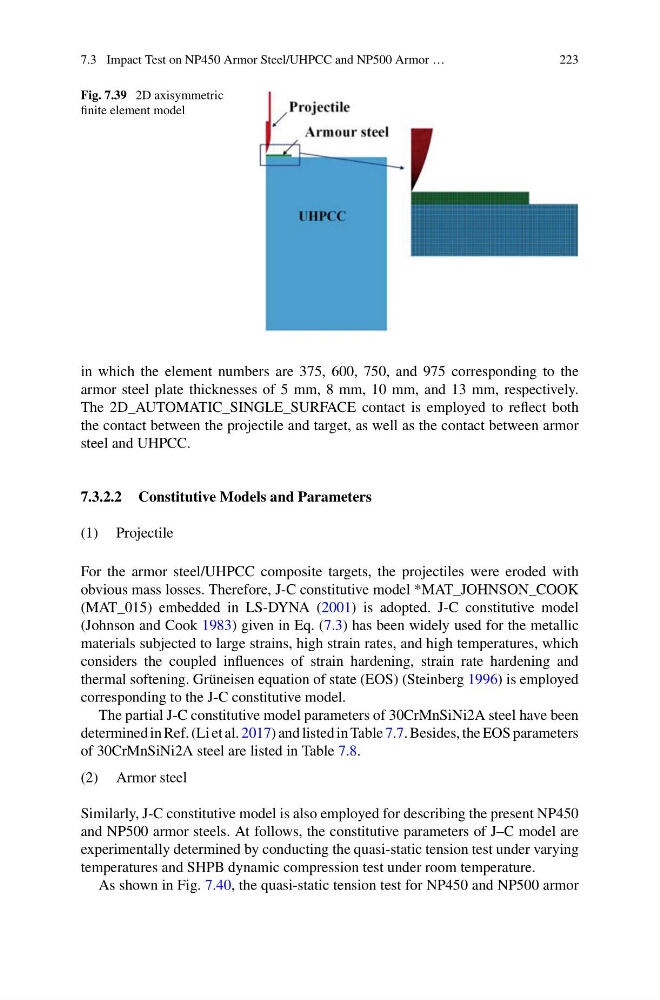
Fig. 7.39 2D axisymmetric
finite element model
in which the element numbers are 375, 600, 750, and 975 corresponding to the
armor steel plate thicknesses of 5 mm, 8 mm, 10 mm, and 13 mm, respectively.
The 2D_AUTOMATIC_SINGLE_SURFACE contact is employed to reflect both
the contact between the projectile and target, as well as the contact between armor
steel and UHPCC.
7.3.2.2 Constitutive Models and Parameters
(1) Projectile
For the armor steel/UHPCC composite targets, the projectiles were eroded with
obvious mass losses. Therefore, J-C constitutive model *MAT_JOHNSON_COOK
(MAT_015) embedded in LS-DYNA (2001) is adopted. J-C constitutive model
(Johnson and Cook 1983) given in Eq. (7.3) has been widely used for the metallic
materials subjected to large strains, high strain rates, and high temperatures, which
considers the coupled influences of strain hardening, strain rate hardening and
thermal softening. Grüneisen equation of state (EOS) (Steinberg 1996) is employed
corresponding to the J-C constitutive model.
The partial J-C constitutive model parameters of 30CrMnSiNi2A steel have been
determined in Ref. (Li et al. 2017) and listed in Table 7.7. Besides, the EOS parameters
of 30CrMnSiNi2A steel are listed in Table 7.8.
(2) Armor steel
Similarly, J-C constitutive model is also employed for describing the present NP450
and NP500 armor steels. At follows, the constitutive parameters of J–C model are
experimentally determined by conducting the quasi-static tension test under varying
temperatures and SHPB dynamic compression test under room temperature.
As shown in Fig. 7.40, the quasi-static tension test for NP450 and NP500 armor
223
Fig. 7.39 2D axisymmetric
finite element model
in which the element numbers are 375, 600, 750, and 975 corresponding to the
armor steel plate thicknesses of 5 mm, 8 mm, 10 mm, and 13 mm, respectively.
The 2D_AUTOMATIC_SINGLE_SURFACE contact is employed to reflect both
the contact between the projectile and target, as well as the contact between armor
steel and UHPCC.
7.3.2.2 Constitutive Models and Parameters
(1) Projectile
For the armor steel/UHPCC composite targets, the projectiles were eroded with
obvious mass losses. Therefore, J-C constitutive model *MAT_JOHNSON_COOK
(MAT_015) embedded in LS-DYNA (2001) is adopted. J-C constitutive model
(Johnson and Cook 1983) given in Eq. (7.3) has been widely used for the metallic
materials subjected to large strains, high strain rates, and high temperatures, which
considers the coupled influences of strain hardening, strain rate hardening and
thermal softening. Grüneisen equation of state (EOS) (Steinberg 1996) is employed
corresponding to the J-C constitutive model.
The partial J-C constitutive model parameters of 30CrMnSiNi2A steel have been
determined in Ref. (Li et al. 2017) and listed in Table 7.7. Besides, the EOS parameters
of 30CrMnSiNi2A steel are listed in Table 7.8.
(2) Armor steel
Similarly, J-C constitutive model is also employed for describing the present NP450
and NP500 armor steels. At follows, the constitutive parameters of J–C model are
experimentally determined by conducting the quasi-static tension test under varying
temperatures and SHPB dynamic compression test under room temperature.
As shown in Fig. 7.40, the quasi-static tension test for NP450 and NP500 armor