

222
7 Impact Resistance of Armor Steel/Ceramic/UHPCC Layered …
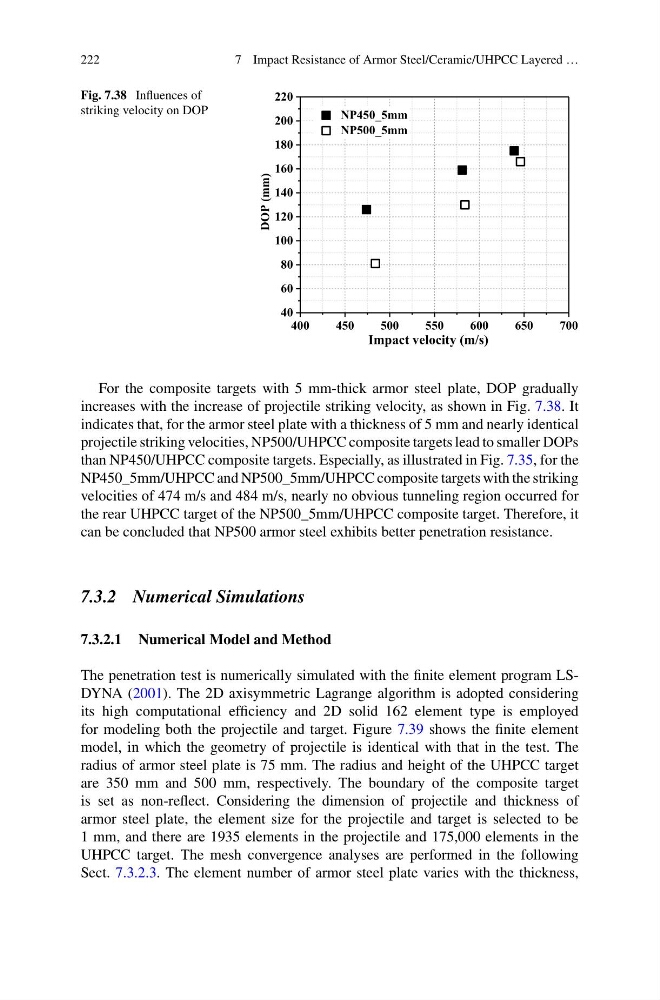
Fig. 7.38 Influences of
striking velocity on DOP
400
450
500
550
600
650
700
40
60
80
100
120
140
160
180
200
220
NP450_5mm
NP500_5mm
DOP (mm)
Impact velocity (m/s)
For the composite targets with 5 mm-thick armor steel plate, DOP gradually
increases with the increase of projectile striking velocity, as shown in Fig. 7.38. It
indicates that, for the armor steel plate with a thickness of 5 mm and nearly identical
projectile striking velocities, NP500/UHPCC composite targets lead to smaller DOPs
than NP450/UHPCC composite targets. Especially, as illustrated in Fig. 7.35, for the
NP450_5mm/UHPCC and NP500_5mm/UHPCC composite targets with the striking
velocities of 474 m/s and 484 m/s, nearly no obvious tunneling region occurred for
the rear UHPCC target of the NP500_5mm/UHPCC composite target. Therefore, it
can be concluded that NP500 armor steel exhibits better penetration resistance.
7.3.2 Numerical Simulations
7.3.2.1 Numerical Model and Method
The penetration test is numerically simulated with the finite element program LSDYNA (2001). The 2D axisymmetric Lagrange algorithm is adopted considering
its high computational efficiency and 2D solid 162 element type is employed
for modeling both the projectile and target. Figure 7.39 shows the finite element
model, in which the geometry of projectile is identical with that in the test. The
radius of armor steel plate is 75 mm. The radius and height of the UHPCC target
are 350 mm and 500 mm, respectively. The boundary of the composite target
is set as non-reflect. Considering the dimension of projectile and thickness of
armor steel plate, the element size for the projectile and target is selected to be
1 mm, and there are 1935 elements in the projectile and 175,000 elements in the
UHPCC target. The mesh convergence analyses are performed in the following
Sect. 7.3.2.3. The element number of armor steel plate varies with the thickness,
7 Impact Resistance of Armor Steel/Ceramic/UHPCC Layered …
Fig. 7.38 Influences of
striking velocity on DOP
400
450
500
550
600
650
700
40
60
80
100
120
140
160
180
200
220
NP450_5mm
NP500_5mm
DOP (mm)
Impact velocity (m/s)
For the composite targets with 5 mm-thick armor steel plate, DOP gradually
increases with the increase of projectile striking velocity, as shown in Fig. 7.38. It
indicates that, for the armor steel plate with a thickness of 5 mm and nearly identical
projectile striking velocities, NP500/UHPCC composite targets lead to smaller DOPs
than NP450/UHPCC composite targets. Especially, as illustrated in Fig. 7.35, for the
NP450_5mm/UHPCC and NP500_5mm/UHPCC composite targets with the striking
velocities of 474 m/s and 484 m/s, nearly no obvious tunneling region occurred for
the rear UHPCC target of the NP500_5mm/UHPCC composite target. Therefore, it
can be concluded that NP500 armor steel exhibits better penetration resistance.
7.3.2 Numerical Simulations
7.3.2.1 Numerical Model and Method
The penetration test is numerically simulated with the finite element program LSDYNA (2001). The 2D axisymmetric Lagrange algorithm is adopted considering
its high computational efficiency and 2D solid 162 element type is employed
for modeling both the projectile and target. Figure 7.39 shows the finite element
model, in which the geometry of projectile is identical with that in the test. The
radius of armor steel plate is 75 mm. The radius and height of the UHPCC target
are 350 mm and 500 mm, respectively. The boundary of the composite target
is set as non-reflect. Considering the dimension of projectile and thickness of
armor steel plate, the element size for the projectile and target is selected to be
1 mm, and there are 1935 elements in the projectile and 175,000 elements in the
UHPCC target. The mesh convergence analyses are performed in the following
Sect. 7.3.2.3. The element number of armor steel plate varies with the thickness,