

216
7 Impact Resistance of Armor Steel/Ceramic/UHPCC Layered …
0.0
0.2
0.4
0.6
0.8
0.0
0.2
0.4
0.6
0.8
1.0
Test S5
Test S10
Test C6
Test C11
Test S5/C6
Normalized KE of projectile
Time (ms)
Projectile
Ceramic plate
UHPCC
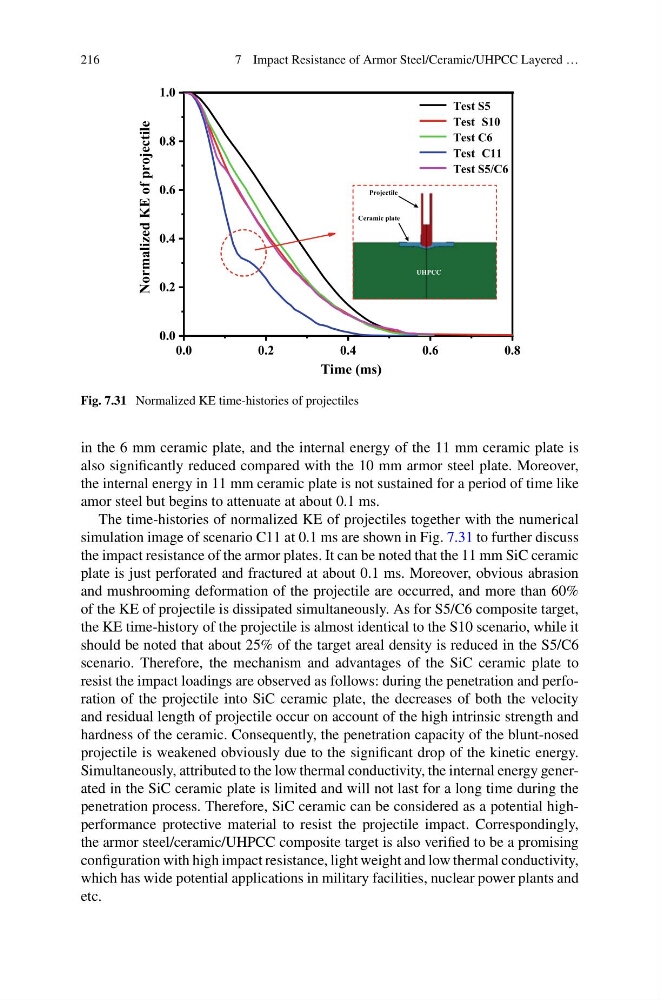
Fig. 7.31 Normalized KE time-histories of projectiles
in the 6 mm ceramic plate, and the internal energy of the 11 mm ceramic plate is
also significantly reduced compared with the 10 mm armor steel plate. Moreover,
the internal energy in 11 mm ceramic plate is not sustained for a period of time like
amor steel but begins to attenuate at about 0.1 ms.
The time-histories of normalized KE of projectiles together with the numerical
simulation image of scenario C11 at 0.1 ms are shown in Fig. 7.31 to further discuss
the impact resistance of the armor plates. It can be noted that the 11 mm SiC ceramic
plate is just perforated and fractured at about 0.1 ms. Moreover, obvious abrasion
and mushrooming deformation of the projectile are occurred, and more than 60%
of the KE of projectile is dissipated simultaneously. As for S5/C6 composite target,
the KE time-history of the projectile is almost identical to the S10 scenario, while it
should be noted that about 25% of the target areal density is reduced in the S5/C6
scenario. Therefore, the mechanism and advantages of the SiC ceramic plate to
resist the impact loadings are observed as follows: during the penetration and perforation of the projectile into SiC ceramic plate, the decreases of both the velocity
and residual length of projectile occur on account of the high intrinsic strength and
hardness of the ceramic. Consequently, the penetration capacity of the blunt-nosed
projectile is weakened obviously due to the significant drop of the kinetic energy.
Simultaneously, attributed to the low thermal conductivity, the internal energy generated in the SiC ceramic plate is limited and will not last for a long time during the
penetration process. Therefore, SiC ceramic can be considered as a potential highperformance protective material to resist the projectile impact. Correspondingly,
the armor steel/ceramic/UHPCC composite target is also verified to be a promising
configuration with high impact resistance, light weight and low thermal conductivity,
which has wide potential applications in military facilities, nuclear power plants and
etc.
7 Impact Resistance of Armor Steel/Ceramic/UHPCC Layered …
0.0
0.2
0.4
0.6
0.8
0.0
0.2
0.4
0.6
0.8
1.0
Test S5
Test S10
Test C6
Test C11
Test S5/C6
Normalized KE of projectile
Time (ms)
Projectile
Ceramic plate
UHPCC
Fig. 7.31 Normalized KE time-histories of projectiles
in the 6 mm ceramic plate, and the internal energy of the 11 mm ceramic plate is
also significantly reduced compared with the 10 mm armor steel plate. Moreover,
the internal energy in 11 mm ceramic plate is not sustained for a period of time like
amor steel but begins to attenuate at about 0.1 ms.
The time-histories of normalized KE of projectiles together with the numerical
simulation image of scenario C11 at 0.1 ms are shown in Fig. 7.31 to further discuss
the impact resistance of the armor plates. It can be noted that the 11 mm SiC ceramic
plate is just perforated and fractured at about 0.1 ms. Moreover, obvious abrasion
and mushrooming deformation of the projectile are occurred, and more than 60%
of the KE of projectile is dissipated simultaneously. As for S5/C6 composite target,
the KE time-history of the projectile is almost identical to the S10 scenario, while it
should be noted that about 25% of the target areal density is reduced in the S5/C6
scenario. Therefore, the mechanism and advantages of the SiC ceramic plate to
resist the impact loadings are observed as follows: during the penetration and perforation of the projectile into SiC ceramic plate, the decreases of both the velocity
and residual length of projectile occur on account of the high intrinsic strength and
hardness of the ceramic. Consequently, the penetration capacity of the blunt-nosed
projectile is weakened obviously due to the significant drop of the kinetic energy.
Simultaneously, attributed to the low thermal conductivity, the internal energy generated in the SiC ceramic plate is limited and will not last for a long time during the
penetration process. Therefore, SiC ceramic can be considered as a potential highperformance protective material to resist the projectile impact. Correspondingly,
the armor steel/ceramic/UHPCC composite target is also verified to be a promising
configuration with high impact resistance, light weight and low thermal conductivity,
which has wide potential applications in military facilities, nuclear power plants and
etc.