

152
5 Projectile Penetrations into Coarse Aggregated UHPCC Targets
(a)
(b)
(c)
(d)
(e)
(f)
(g)
(h)
(i)
(j)
(k)
(l)
(m)
(n)
(o)
(p)
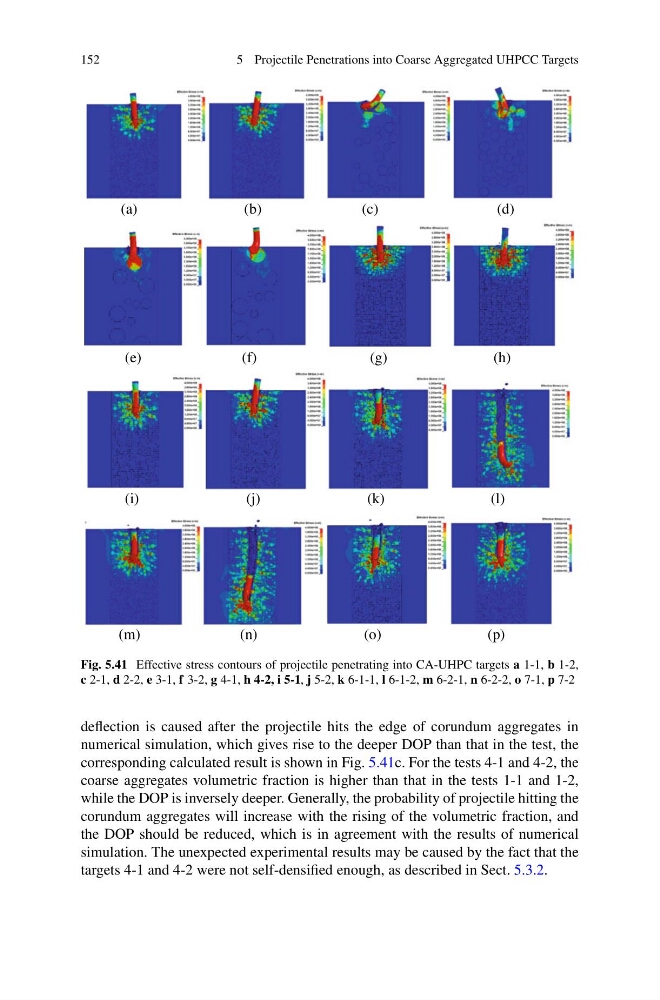
Fig. 5.41 Effective stress contours of projectile penetrating into CA-UHPC targets a 1-1, b 1-2,
c 2-1, d 2-2, e 3-1, f 3-2, g 4-1, h 4-2, i 5-1, j 5-2, k 6-1-1, l 6-1-2, m 6-2-1, n 6-2-2, o 7-1, p 7-2
deflection is caused after the projectile hits the edge of corundum aggregates in
numerical simulation, which gives rise to the deeper DOP than that in the test, the
corresponding calculated result is shown in Fig. 5.41c. For the tests 4-1 and 4-2, the
coarse aggregates volumetric fraction is higher than that in the tests 1-1 and 1-2,
while the DOP is inversely deeper. Generally, the probability of projectile hitting the
corundum aggregates will increase with the rising of the volumetric fraction, and
the DOP should be reduced, which is in agreement with the results of numerical
simulation. The unexpected experimental results may be caused by the fact that the
targets 4-1 and 4-2 were not self-densified enough, as described in Sect. 5.3.2.
5 Projectile Penetrations into Coarse Aggregated UHPCC Targets
(a)
(b)
(c)
(d)
(e)
(f)
(g)
(h)
(i)
(j)
(k)
(l)
(m)
(n)
(o)
(p)
Fig. 5.41 Effective stress contours of projectile penetrating into CA-UHPC targets a 1-1, b 1-2,
c 2-1, d 2-2, e 3-1, f 3-2, g 4-1, h 4-2, i 5-1, j 5-2, k 6-1-1, l 6-1-2, m 6-2-1, n 6-2-2, o 7-1, p 7-2
deflection is caused after the projectile hits the edge of corundum aggregates in
numerical simulation, which gives rise to the deeper DOP than that in the test, the
corresponding calculated result is shown in Fig. 5.41c. For the tests 4-1 and 4-2, the
coarse aggregates volumetric fraction is higher than that in the tests 1-1 and 1-2,
while the DOP is inversely deeper. Generally, the probability of projectile hitting the
corundum aggregates will increase with the rising of the volumetric fraction, and
the DOP should be reduced, which is in agreement with the results of numerical
simulation. The unexpected experimental results may be caused by the fact that the
targets 4-1 and 4-2 were not self-densified enough, as described in Sect. 5.3.2.