

5.4 Numerical Simulations Based on 3D Mesoscopic Concrete Model
153
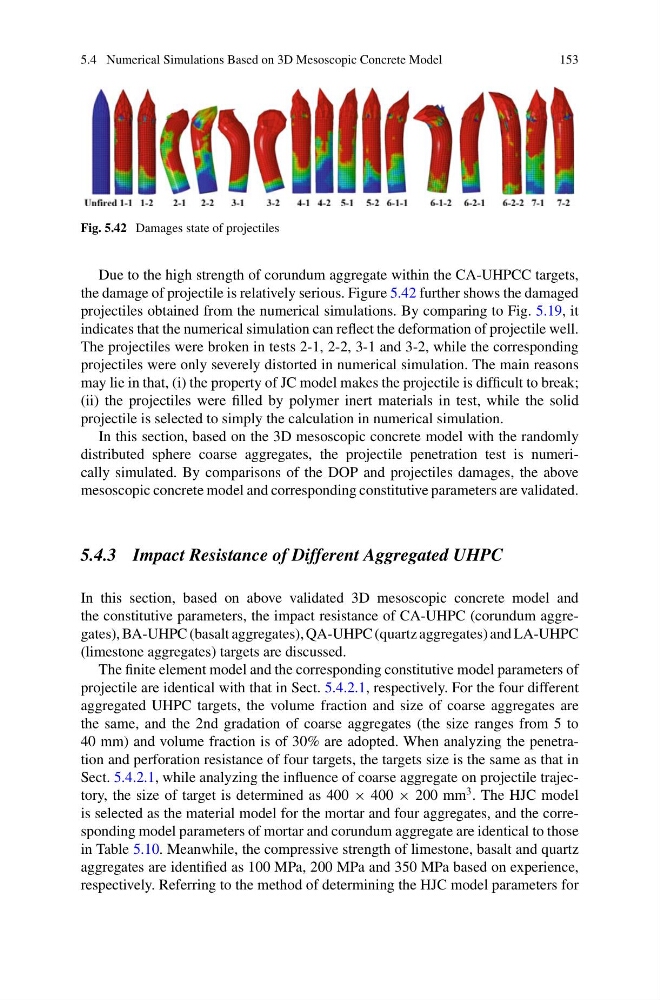
Fig. 5.42 Damages state of projectiles
Due to the high strength of corundum aggregate within the CA-UHPCC targets,
the damage of projectile is relatively serious. Figure 5.42 further shows the damaged
projectiles obtained from the numerical simulations. By comparing to Fig. 5.19, it
indicates that the numerical simulation can reflect the deformation of projectile well.
The projectiles were broken in tests 2-1, 2-2, 3-1 and 3-2, while the corresponding
projectiles were only severely distorted in numerical simulation. The main reasons
may lie in that, (i) the property of JC model makes the projectile is difficult to break;
(ii) the projectiles were filled by polymer inert materials in test, while the solid
projectile is selected to simply the calculation in numerical simulation.
In this section, based on the 3D mesoscopic concrete model with the randomly
distributed sphere coarse aggregates, the projectile penetration test is numerically simulated. By comparisons of the DOP and projectiles damages, the above
mesoscopic concrete model and corresponding constitutive parameters are validated.
5.4.3 Impact Resistance of Different Aggregated UHPC
In this section, based on above validated 3D mesoscopic concrete model and
the constitutive parameters, the impact resistance of CA-UHPC (corundum aggregates), BA-UHPC (basalt aggregates), QA-UHPC (quartz aggregates) and LA-UHPC
(limestone aggregates) targets are discussed.
The finite element model and the corresponding constitutive model parameters of
projectile are identical with that in Sect. 5.4.2.1, respectively. For the four different
aggregated UHPC targets, the volume fraction and size of coarse aggregates are
the same, and the 2nd gradation of coarse aggregates (the size ranges from 5 to
40 mm) and volume fraction is of 30% are adopted. When analyzing the penetration and perforation resistance of four targets, the targets size is the same as that in
Sect. 5.4.2.1, while analyzing the influence of coarse aggregate on projectile trajectory, the size of target is determined as 400 × 400 × 200 mm
3 . The HJC model
is selected as the material model for the mortar and four aggregates, and the corresponding model parameters of mortar and corundum aggregate are identical to those
in Table 5.10. Meanwhile, the compressive strength of limestone, basalt and quartz
aggregates are identified as 100 MPa, 200 MPa and 350 MPa based on experience,
respectively. Referring to the method of determining the HJC model parameters for
153
Fig. 5.42 Damages state of projectiles
Due to the high strength of corundum aggregate within the CA-UHPCC targets,
the damage of projectile is relatively serious. Figure 5.42 further shows the damaged
projectiles obtained from the numerical simulations. By comparing to Fig. 5.19, it
indicates that the numerical simulation can reflect the deformation of projectile well.
The projectiles were broken in tests 2-1, 2-2, 3-1 and 3-2, while the corresponding
projectiles were only severely distorted in numerical simulation. The main reasons
may lie in that, (i) the property of JC model makes the projectile is difficult to break;
(ii) the projectiles were filled by polymer inert materials in test, while the solid
projectile is selected to simply the calculation in numerical simulation.
In this section, based on the 3D mesoscopic concrete model with the randomly
distributed sphere coarse aggregates, the projectile penetration test is numerically simulated. By comparisons of the DOP and projectiles damages, the above
mesoscopic concrete model and corresponding constitutive parameters are validated.
5.4.3 Impact Resistance of Different Aggregated UHPC
In this section, based on above validated 3D mesoscopic concrete model and
the constitutive parameters, the impact resistance of CA-UHPC (corundum aggregates), BA-UHPC (basalt aggregates), QA-UHPC (quartz aggregates) and LA-UHPC
(limestone aggregates) targets are discussed.
The finite element model and the corresponding constitutive model parameters of
projectile are identical with that in Sect. 5.4.2.1, respectively. For the four different
aggregated UHPC targets, the volume fraction and size of coarse aggregates are
the same, and the 2nd gradation of coarse aggregates (the size ranges from 5 to
40 mm) and volume fraction is of 30% are adopted. When analyzing the penetration and perforation resistance of four targets, the targets size is the same as that in
Sect. 5.4.2.1, while analyzing the influence of coarse aggregate on projectile trajectory, the size of target is determined as 400 × 400 × 200 mm
3 . The HJC model
is selected as the material model for the mortar and four aggregates, and the corresponding model parameters of mortar and corundum aggregate are identical to those
in Table 5.10. Meanwhile, the compressive strength of limestone, basalt and quartz
aggregates are identified as 100 MPa, 200 MPa and 350 MPa based on experience,
respectively. Referring to the method of determining the HJC model parameters for