

146
5 Projectile Penetrations into Coarse Aggregated UHPCC Targets
A
A
ITZ
Mortar
A-A Cross- Section
Aggregate
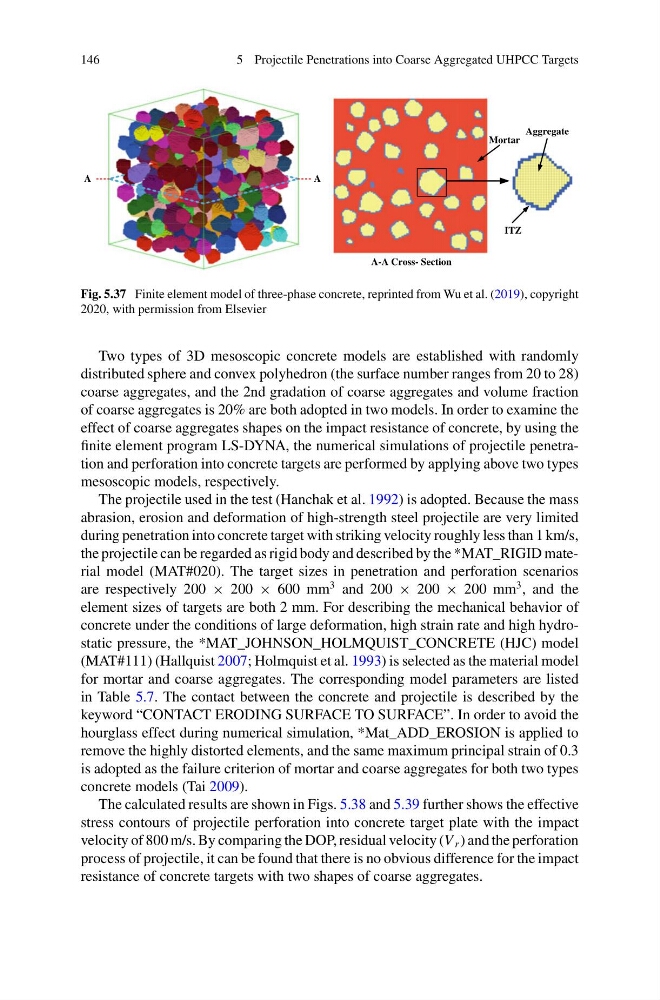
Fig. 5.37 Finite element model of three-phase concrete, reprinted from Wu et al. (2019), copyright
2020, with permission from Elsevier
Two types of 3D mesoscopic concrete models are established with randomly
distributed sphere and convex polyhedron (the surface number ranges from 20 to 28)
coarse aggregates, and the 2nd gradation of coarse aggregates and volume fraction
of coarse aggregates is 20% are both adopted in two models. In order to examine the
effect of coarse aggregates shapes on the impact resistance of concrete, by using the
finite element program LS-DYNA, the numerical simulations of projectile penetration and perforation into concrete targets are performed by applying above two types
mesoscopic models, respectively.
The projectile used in the test (Hanchak et al. 1992) is adopted. Because the mass
abrasion, erosion and deformation of high-strength steel projectile are very limited
during penetration into concrete target with striking velocity roughly less than 1 km/s,
the projectile can be regarded as rigid body and described by the *MAT_RIGID material model (MAT#020). The target sizes in penetration and perforation scenarios
are respectively 200 × 200 × 600 mm
3 and 200 × 200 × 200 mm
3 , and the
element sizes of targets are both 2 mm. For describing the mechanical behavior of
concrete under the conditions of large deformation, high strain rate and high hydrostatic pressure, the *MAT_JOHNSON_HOLMQUIST_CONCRETE (HJC) model
(MAT#111) (Hallquist 2007; Holmquist et al. 1993) is selected as the material model
for mortar and coarse aggregates. The corresponding model parameters are listed
in Table 5.7. The contact between the concrete and projectile is described by the
keyword “CONTACT ERODING SURFACE TO SURFACE”. In order to avoid the
hourglass effect during numerical simulation, *Mat_ADD_EROSION is applied to
remove the highly distorted elements, and the same maximum principal strain of 0.3
is adopted as the failure criterion of mortar and coarse aggregates for both two types
concrete models (Tai 2009).
The calculated results are shown in Figs. 5.38 and 5.39 further shows the effective
stress contours of projectile perforation into concrete target plate with the impact
velocity of 800 m/s. By comparing the DOP, residual velocity (V r ) and the perforation
process of projectile, it can be found that there is no obvious difference for the impact
resistance of concrete targets with two shapes of coarse aggregates.
5 Projectile Penetrations into Coarse Aggregated UHPCC Targets
A
A
ITZ
Mortar
A-A Cross- Section
Aggregate
Fig. 5.37 Finite element model of three-phase concrete, reprinted from Wu et al. (2019), copyright
2020, with permission from Elsevier
Two types of 3D mesoscopic concrete models are established with randomly
distributed sphere and convex polyhedron (the surface number ranges from 20 to 28)
coarse aggregates, and the 2nd gradation of coarse aggregates and volume fraction
of coarse aggregates is 20% are both adopted in two models. In order to examine the
effect of coarse aggregates shapes on the impact resistance of concrete, by using the
finite element program LS-DYNA, the numerical simulations of projectile penetration and perforation into concrete targets are performed by applying above two types
mesoscopic models, respectively.
The projectile used in the test (Hanchak et al. 1992) is adopted. Because the mass
abrasion, erosion and deformation of high-strength steel projectile are very limited
during penetration into concrete target with striking velocity roughly less than 1 km/s,
the projectile can be regarded as rigid body and described by the *MAT_RIGID material model (MAT#020). The target sizes in penetration and perforation scenarios
are respectively 200 × 200 × 600 mm
3 and 200 × 200 × 200 mm
3 , and the
element sizes of targets are both 2 mm. For describing the mechanical behavior of
concrete under the conditions of large deformation, high strain rate and high hydrostatic pressure, the *MAT_JOHNSON_HOLMQUIST_CONCRETE (HJC) model
(MAT#111) (Hallquist 2007; Holmquist et al. 1993) is selected as the material model
for mortar and coarse aggregates. The corresponding model parameters are listed
in Table 5.7. The contact between the concrete and projectile is described by the
keyword “CONTACT ERODING SURFACE TO SURFACE”. In order to avoid the
hourglass effect during numerical simulation, *Mat_ADD_EROSION is applied to
remove the highly distorted elements, and the same maximum principal strain of 0.3
is adopted as the failure criterion of mortar and coarse aggregates for both two types
concrete models (Tai 2009).
The calculated results are shown in Figs. 5.38 and 5.39 further shows the effective
stress contours of projectile perforation into concrete target plate with the impact
velocity of 800 m/s. By comparing the DOP, residual velocity (V r ) and the perforation
process of projectile, it can be found that there is no obvious difference for the impact
resistance of concrete targets with two shapes of coarse aggregates.