

5.4 Numerical Simulations Based on 3D Mesoscopic Concrete Model
145
⎧
⎪ ⎪ ⎪ ⎪ ⎪ ⎪ ⎪ ⎨
⎪ ⎪ ⎪ ⎪ ⎪ ⎪ ⎪ ⎩
max
x 0 − R 0
E x
, 0
≤ n x ≤ min
x 0 + R 0
E x
,
X max
E x
− 1
max
y 0 − R 0
E y
, 0
≤ n y ≤ min
y 0 + R 0
E y
,
Y max
E y
− 1
max
z 0 − R 0
E z
, 0
≤ n z ≤ min
z 0 + R 0
E z
,
Z max
E z
− 1
(5.10)
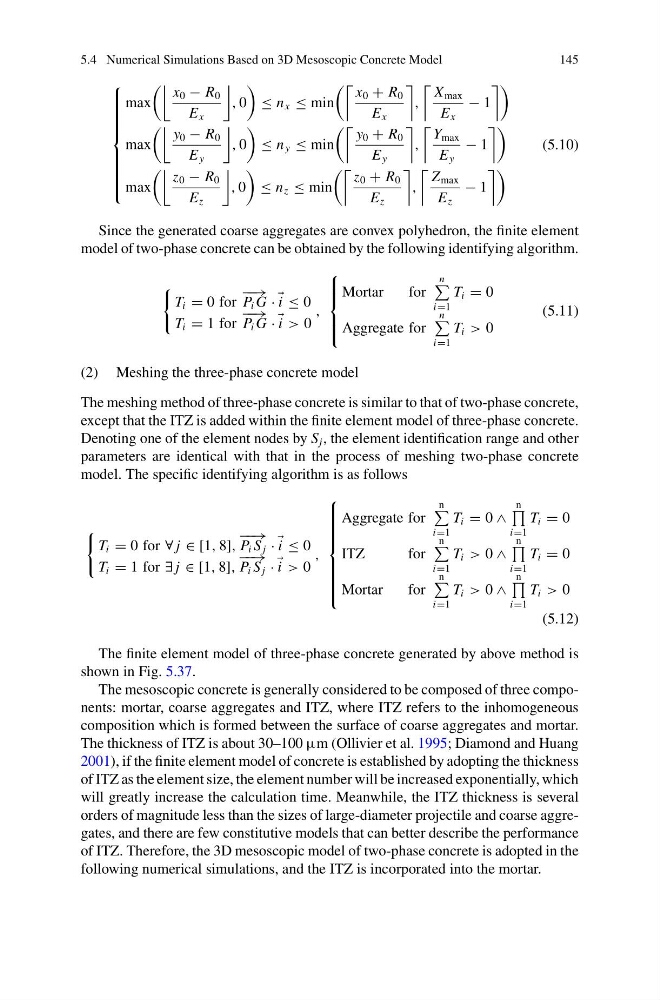
Since the generated coarse aggregates are convex polyhedron, the finite element
model of two-phase concrete can be obtained by the following identifying algorithm.
T i = 0 for
− − →
P i G · i ≤ 0
T i = 1 for
− − →
P i G · i > 0
,
⎧
⎪ ⎪ ⎨
⎪ ⎪ ⎩
Mortar
for
n
i=1
T i = 0
Aggregate for
n
i=1
T i > 0
(5.11)
(2) Meshing the three-phase concrete model
The meshing method of three-phase concrete is similar to that of two-phase concrete,
except that the ITZ is added within the finite element model of three-phase concrete.
Denoting one of the element nodes by S j , the element identification range and other
parameters are identical with that in the process of meshing two-phase concrete
model. The specific identifying algorithm is as follows
T i = 0 for ∀ j ∈ [1, 8],
− − →
P i S j · i ≤ 0
T i = 1 for ∃ j ∈ [1, 8],
− − →
P i S j · i > 0
,
⎧
⎪ ⎪ ⎪ ⎪ ⎪ ⎪ ⎨
⎪ ⎪ ⎪ ⎪ ⎪ ⎪ ⎩
Aggregate for
n
i=1
T i = 0 ∧
n
i=1
T i = 0
ITZ
for
n
i=1
T i > 0 ∧
n
i=1
T i = 0
Mortar
for
n
i=1
T i > 0 ∧
n
i=1
T i > 0
(5.12)
The finite element model of three-phase concrete generated by above method is
shown in Fig. 5.37.
The mesoscopic concrete is generally considered to be composed of three components: mortar, coarse aggregates and ITZ, where ITZ refers to the inhomogeneous
composition which is formed between the surface of coarse aggregates and mortar.
The thickness of ITZ is about 30–100 µm (Ollivier et al. 1995; Diamond and Huang
2001), if the finite element model of concrete is established by adopting the thickness
of ITZ as the element size, the element number will be increased exponentially, which
will greatly increase the calculation time. Meanwhile, the ITZ thickness is several
orders of magnitude less than the sizes of large-diameter projectile and coarse aggregates, and there are few constitutive models that can better describe the performance
of ITZ. Therefore, the 3D mesoscopic model of two-phase concrete is adopted in the
following numerical simulations, and the ITZ is incorporated into the mortar.
145
⎧
⎪ ⎪ ⎪ ⎪ ⎪ ⎪ ⎪ ⎨
⎪ ⎪ ⎪ ⎪ ⎪ ⎪ ⎪ ⎩
max
x 0 − R 0
E x
, 0
≤ n x ≤ min
x 0 + R 0
E x
,
X max
E x
− 1
max
y 0 − R 0
E y
, 0
≤ n y ≤ min
y 0 + R 0
E y
,
Y max
E y
− 1
max
z 0 − R 0
E z
, 0
≤ n z ≤ min
z 0 + R 0
E z
,
Z max
E z
− 1
(5.10)
Since the generated coarse aggregates are convex polyhedron, the finite element
model of two-phase concrete can be obtained by the following identifying algorithm.
T i = 0 for
− − →
P i G · i ≤ 0
T i = 1 for
− − →
P i G · i > 0
,
⎧
⎪ ⎪ ⎨
⎪ ⎪ ⎩
Mortar
for
n
i=1
T i = 0
Aggregate for
n
i=1
T i > 0
(5.11)
(2) Meshing the three-phase concrete model
The meshing method of three-phase concrete is similar to that of two-phase concrete,
except that the ITZ is added within the finite element model of three-phase concrete.
Denoting one of the element nodes by S j , the element identification range and other
parameters are identical with that in the process of meshing two-phase concrete
model. The specific identifying algorithm is as follows
T i = 0 for ∀ j ∈ [1, 8],
− − →
P i S j · i ≤ 0
T i = 1 for ∃ j ∈ [1, 8],
− − →
P i S j · i > 0
,
⎧
⎪ ⎪ ⎪ ⎪ ⎪ ⎪ ⎨
⎪ ⎪ ⎪ ⎪ ⎪ ⎪ ⎩
Aggregate for
n
i=1
T i = 0 ∧
n
i=1
T i = 0
ITZ
for
n
i=1
T i > 0 ∧
n
i=1
T i = 0
Mortar
for
n
i=1
T i > 0 ∧
n
i=1
T i > 0
(5.12)
The finite element model of three-phase concrete generated by above method is
shown in Fig. 5.37.
The mesoscopic concrete is generally considered to be composed of three components: mortar, coarse aggregates and ITZ, where ITZ refers to the inhomogeneous
composition which is formed between the surface of coarse aggregates and mortar.
The thickness of ITZ is about 30–100 µm (Ollivier et al. 1995; Diamond and Huang
2001), if the finite element model of concrete is established by adopting the thickness
of ITZ as the element size, the element number will be increased exponentially, which
will greatly increase the calculation time. Meanwhile, the ITZ thickness is several
orders of magnitude less than the sizes of large-diameter projectile and coarse aggregates, and there are few constitutive models that can better describe the performance
of ITZ. Therefore, the 3D mesoscopic model of two-phase concrete is adopted in the
following numerical simulations, and the ITZ is incorporated into the mortar.