

5.4 Numerical Simulations Based on 3D Mesoscopic Concrete Model
147
Table 5.7 Parameters of the HJC model for mortar and aggregates (Ren et al. 2016, 2017)
Parameter
Mortar Aggregate Parameter
Mortar
Aggregate
Density ρ (kg/m 3 )
2300
2600
Pressure hardening
exponent N
15
7.0
Shear modulus G
(GPa)
12.5
30.0
Crushing pressure
P crush (MPa)
0.013
0.068
Normalized cohesive
strength A
0.28
0.3
Crushing volumetric
strain U crush
8 × 10 –4 1.2 × 10 –3
Normalized pressure
hardening B
1.85
1.73
Locking pressure
P lock (GPa)
1.21
3.47
Strain rate coefficient
C
0.006
0.005
Locking volumetric
strain U lock
0.12
0.1
Uniaxial compressive
strength f c (MPa)
40
160
Damage constant D 1 0.04
0.04
Maximum tensile
pressure T (MPa)
3.92
7.84
Damage constant D 2 1.0
1.0
Quasi-static threshold
strain rate EPS0
1
1
Pressure constant K 1
(GPa)
12
116
Plastic strain before
fracture EFMIN
0.01
0.01
Pressure constant K 2
(GPa)
135
−243
Normalized maximum
strength SFMAX
15
7.0
Pressure constant K 3
(GPa)
698
506
100
200
300
400
500
600
700
800
0.0
0.1
0.2
0.3
0.4
0.5
Polyhedral aggregate
Sphere aggregate
DOP (m)
V 0 (m/s)
300 400 500 600 700 800 900 1000 1100
-200
0
200
400
600
800
1000
Polyhedral aggregate
Sphere aggregate
V
r (m/s)
V 0 (m/s)
(a)
(b)
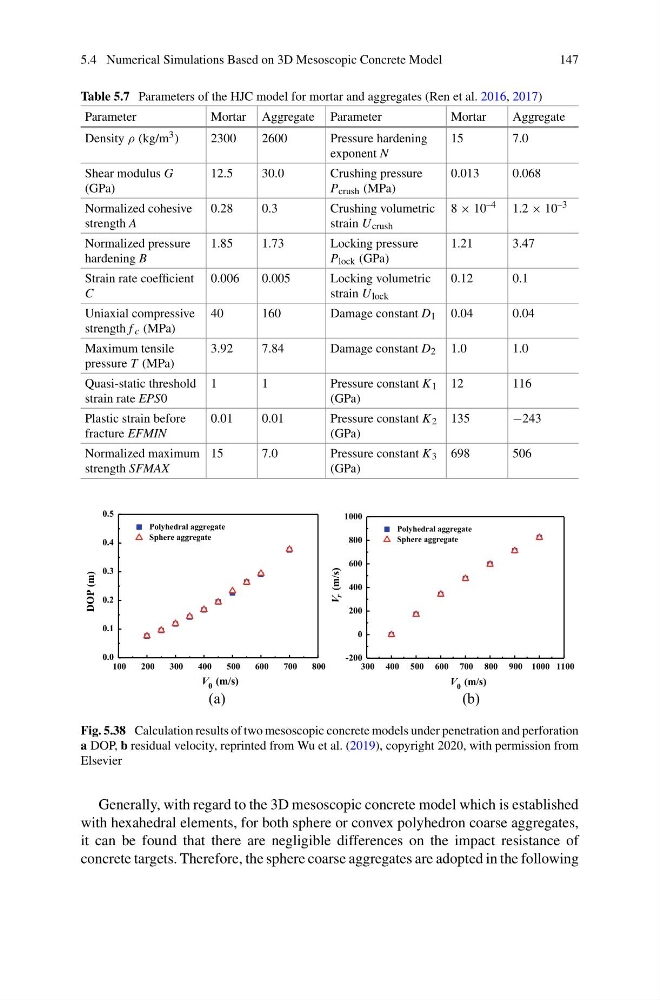
Fig. 5.38 Calculation results of two mesoscopic concrete models under penetration and perforation
a DOP, b residual velocity, reprinted from Wu et al. (2019), copyright 2020, with permission from
Elsevier
Generally, with regard to the 3D mesoscopic concrete model which is established
with hexahedral elements, for both sphere or convex polyhedron coarse aggregates,
it can be found that there are negligible differences on the impact resistance of
concrete targets. Therefore, the sphere coarse aggregates are adopted in the following
147
Table 5.7 Parameters of the HJC model for mortar and aggregates (Ren et al. 2016, 2017)
Parameter
Mortar Aggregate Parameter
Mortar
Aggregate
Density ρ (kg/m 3 )
2300
2600
Pressure hardening
exponent N
15
7.0
Shear modulus G
(GPa)
12.5
30.0
Crushing pressure
P crush (MPa)
0.013
0.068
Normalized cohesive
strength A
0.28
0.3
Crushing volumetric
strain U crush
8 × 10 –4 1.2 × 10 –3
Normalized pressure
hardening B
1.85
1.73
Locking pressure
P lock (GPa)
1.21
3.47
Strain rate coefficient
C
0.006
0.005
Locking volumetric
strain U lock
0.12
0.1
Uniaxial compressive
strength f c (MPa)
40
160
Damage constant D 1 0.04
0.04
Maximum tensile
pressure T (MPa)
3.92
7.84
Damage constant D 2 1.0
1.0
Quasi-static threshold
strain rate EPS0
1
1
Pressure constant K 1
(GPa)
12
116
Plastic strain before
fracture EFMIN
0.01
0.01
Pressure constant K 2
(GPa)
135
−243
Normalized maximum
strength SFMAX
15
7.0
Pressure constant K 3
(GPa)
698
506
100
200
300
400
500
600
700
800
0.0
0.1
0.2
0.3
0.4
0.5
Polyhedral aggregate
Sphere aggregate
DOP (m)
V 0 (m/s)
300 400 500 600 700 800 900 1000 1100
-200
0
200
400
600
800
1000
Polyhedral aggregate
Sphere aggregate
V
r (m/s)
V 0 (m/s)
(a)
(b)
Fig. 5.38 Calculation results of two mesoscopic concrete models under penetration and perforation
a DOP, b residual velocity, reprinted from Wu et al. (2019), copyright 2020, with permission from
Elsevier
Generally, with regard to the 3D mesoscopic concrete model which is established
with hexahedral elements, for both sphere or convex polyhedron coarse aggregates,
it can be found that there are negligible differences on the impact resistance of
concrete targets. Therefore, the sphere coarse aggregates are adopted in the following