

134
5 Projectile Penetrations into Coarse Aggregated UHPCC Targets
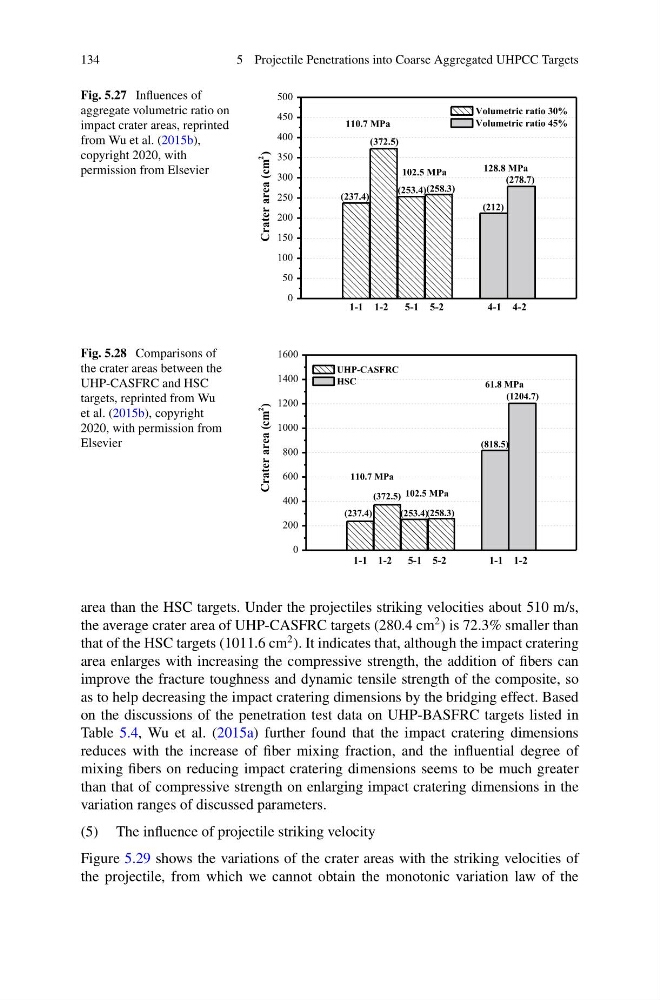
Fig. 5.27 Influences of
aggregate volumetric ratio on
impact crater areas, reprinted
from Wu et al. (2015b),
copyright 2020, with
permission from Elsevier
0
50
100
150
200
250
300
350
400
450
500
(278.7)
128.8 MPa
102.5 MPa
(258.3)
(253.4)
110.7 MPa
(237.4)
1-1 1-2
5-1 5-2
4-1 4-2
(212)
(372.5)
Crater area (cm
2
)
Volumetric ratio 30%
Volumetric ratio 45%
Fig. 5.28 Comparisons of
the crater areas between the
UHP-CASFRC and HSC
targets, reprinted from Wu
et al. (2015b), copyright
2020, with permission from
Elsevier
0
200
400
600
800
1000
1200
1400
1600
(1204.7)
61.8 MPa
102.5 MPa
(258.3)
(253.4)
110.7 MPa
(237.4)
(818.5)
(372.5)
Crater area (cm
2
)
UHP-CASFRC
HSC
1-1 1-2
5-1 5-2
1-1 1-2
area than the HSC targets. Under the projectiles striking velocities about 510 m/s,
the average crater area of UHP-CASFRC targets (280.4 cm
2 ) is 72.3% smaller than
that of the HSC targets (1011.6 cm
2 ). It indicates that, although the impact cratering
area enlarges with increasing the compressive strength, the addition of fibers can
improve the fracture toughness and dynamic tensile strength of the composite, so
as to help decreasing the impact cratering dimensions by the bridging effect. Based
on the discussions of the penetration test data on UHP-BASFRC targets listed in
Table 5.4, Wu et al. (2015a) further found that the impact cratering dimensions
reduces with the increase of fiber mixing fraction, and the influential degree of
mixing fibers on reducing impact cratering dimensions seems to be much greater
than that of compressive strength on enlarging impact cratering dimensions in the
variation ranges of discussed parameters.
(5) The influence of projectile striking velocity
Figure 5.29 shows the variations of the crater areas with the striking velocities of
the projectile, from which we cannot obtain the monotonic variation law of the
5 Projectile Penetrations into Coarse Aggregated UHPCC Targets
Fig. 5.27 Influences of
aggregate volumetric ratio on
impact crater areas, reprinted
from Wu et al. (2015b),
copyright 2020, with
permission from Elsevier
0
50
100
150
200
250
300
350
400
450
500
(278.7)
128.8 MPa
102.5 MPa
(258.3)
(253.4)
110.7 MPa
(237.4)
1-1 1-2
5-1 5-2
4-1 4-2
(212)
(372.5)
Crater area (cm
2
)
Volumetric ratio 30%
Volumetric ratio 45%
Fig. 5.28 Comparisons of
the crater areas between the
UHP-CASFRC and HSC
targets, reprinted from Wu
et al. (2015b), copyright
2020, with permission from
Elsevier
0
200
400
600
800
1000
1200
1400
1600
(1204.7)
61.8 MPa
102.5 MPa
(258.3)
(253.4)
110.7 MPa
(237.4)
(818.5)
(372.5)
Crater area (cm
2
)
UHP-CASFRC
HSC
1-1 1-2
5-1 5-2
1-1 1-2
area than the HSC targets. Under the projectiles striking velocities about 510 m/s,
the average crater area of UHP-CASFRC targets (280.4 cm
2 ) is 72.3% smaller than
that of the HSC targets (1011.6 cm
2 ). It indicates that, although the impact cratering
area enlarges with increasing the compressive strength, the addition of fibers can
improve the fracture toughness and dynamic tensile strength of the composite, so
as to help decreasing the impact cratering dimensions by the bridging effect. Based
on the discussions of the penetration test data on UHP-BASFRC targets listed in
Table 5.4, Wu et al. (2015a) further found that the impact cratering dimensions
reduces with the increase of fiber mixing fraction, and the influential degree of
mixing fibers on reducing impact cratering dimensions seems to be much greater
than that of compressive strength on enlarging impact cratering dimensions in the
variation ranges of discussed parameters.
(5) The influence of projectile striking velocity
Figure 5.29 shows the variations of the crater areas with the striking velocities of
the projectile, from which we cannot obtain the monotonic variation law of the