

5.3 Corundum Aggregated UHPCC Target
135
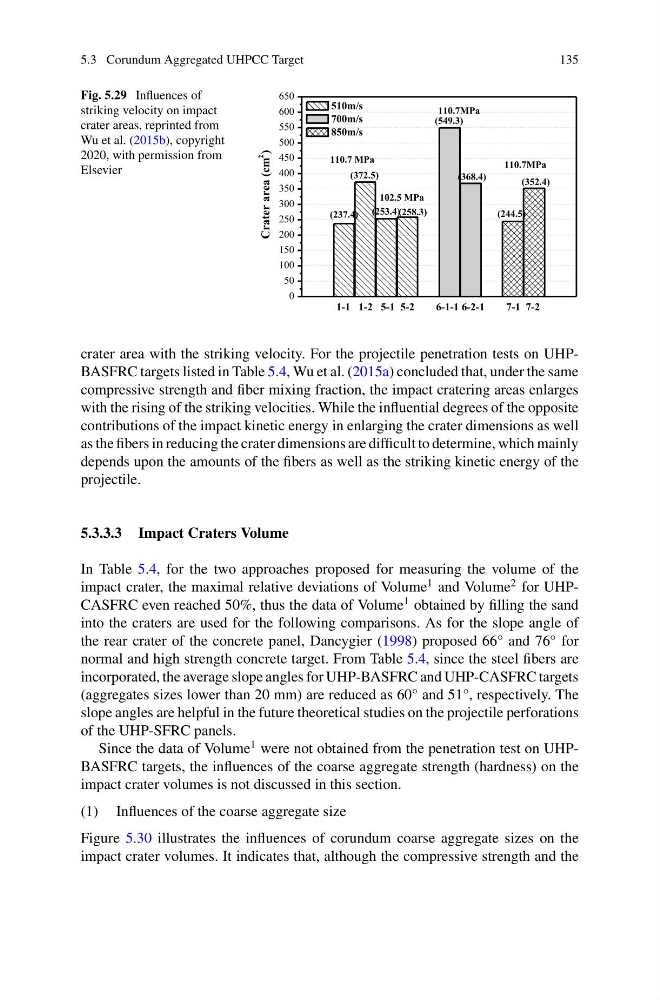
Fig. 5.29 Influences of
striking velocity on impact
crater areas, reprinted from
Wu et al. (2015b), copyright
2020, with permission from
Elsevier
0
50
100
150
200
250
300
350
400
450
500
550
600
650
102.5 MPa
(352.4)
(372.5)
110.7MPa
(368.4)
(549.3)
110.7 MPa
110.7MPa
(244.5)
(258.3)
1-1 1-2 5-1 5-2
6-1-1 6-2-1
7-1 7-2
(253.4)
(237.4)
Crater area (cm
2
)
510m/s
700m/s
850m/s
crater area with the striking velocity. For the projectile penetration tests on UHPBASFRC targets listed in Table 5.4, Wu et al. (2015a) concluded that, under the same
compressive strength and fiber mixing fraction, the impact cratering areas enlarges
with the rising of the striking velocities. While the influential degrees of the opposite
contributions of the impact kinetic energy in enlarging the crater dimensions as well
as the fibers in reducing the crater dimensions are difficult to determine, which mainly
depends upon the amounts of the fibers as well as the striking kinetic energy of the
projectile.
5.3.3.3 Impact Craters Volume
In Table 5.4, for the two approaches proposed for measuring the volume of the
impact crater, the maximal relative deviations of Volume
1 and Volume
2 for UHPCASFRC even reached 50%, thus the data of Volume
1 obtained by filling the sand
into the craters are used for the following comparisons. As for the slope angle of
the rear crater of the concrete panel, Dancygier (1998) proposed 66° and 76° for
normal and high strength concrete target. From Table 5.4, since the steel fibers are
incorporated, the average slope angles for UHP-BASFRC and UHP-CASFRC targets
(aggregates sizes lower than 20 mm) are reduced as 60° and 51°, respectively. The
slope angles are helpful in the future theoretical studies on the projectile perforations
of the UHP-SFRC panels.
Since the data of Volume
1 were not obtained from the penetration test on UHPBASFRC targets, the influences of the coarse aggregate strength (hardness) on the
impact crater volumes is not discussed in this section.
(1) Influences of the coarse aggregate size
Figure 5.30 illustrates the influences of corundum coarse aggregate sizes on the
impact crater volumes. It indicates that, although the compressive strength and the
135
Fig. 5.29 Influences of
striking velocity on impact
crater areas, reprinted from
Wu et al. (2015b), copyright
2020, with permission from
Elsevier
0
50
100
150
200
250
300
350
400
450
500
550
600
650
102.5 MPa
(352.4)
(372.5)
110.7MPa
(368.4)
(549.3)
110.7 MPa
110.7MPa
(244.5)
(258.3)
1-1 1-2 5-1 5-2
6-1-1 6-2-1
7-1 7-2
(253.4)
(237.4)
Crater area (cm
2
)
510m/s
700m/s
850m/s
crater area with the striking velocity. For the projectile penetration tests on UHPBASFRC targets listed in Table 5.4, Wu et al. (2015a) concluded that, under the same
compressive strength and fiber mixing fraction, the impact cratering areas enlarges
with the rising of the striking velocities. While the influential degrees of the opposite
contributions of the impact kinetic energy in enlarging the crater dimensions as well
as the fibers in reducing the crater dimensions are difficult to determine, which mainly
depends upon the amounts of the fibers as well as the striking kinetic energy of the
projectile.
5.3.3.3 Impact Craters Volume
In Table 5.4, for the two approaches proposed for measuring the volume of the
impact crater, the maximal relative deviations of Volume
1 and Volume
2 for UHPCASFRC even reached 50%, thus the data of Volume
1 obtained by filling the sand
into the craters are used for the following comparisons. As for the slope angle of
the rear crater of the concrete panel, Dancygier (1998) proposed 66° and 76° for
normal and high strength concrete target. From Table 5.4, since the steel fibers are
incorporated, the average slope angles for UHP-BASFRC and UHP-CASFRC targets
(aggregates sizes lower than 20 mm) are reduced as 60° and 51°, respectively. The
slope angles are helpful in the future theoretical studies on the projectile perforations
of the UHP-SFRC panels.
Since the data of Volume
1 were not obtained from the penetration test on UHPBASFRC targets, the influences of the coarse aggregate strength (hardness) on the
impact crater volumes is not discussed in this section.
(1) Influences of the coarse aggregate size
Figure 5.30 illustrates the influences of corundum coarse aggregate sizes on the
impact crater volumes. It indicates that, although the compressive strength and the