

132
5 Projectile Penetrations into Coarse Aggregated UHPCC Targets
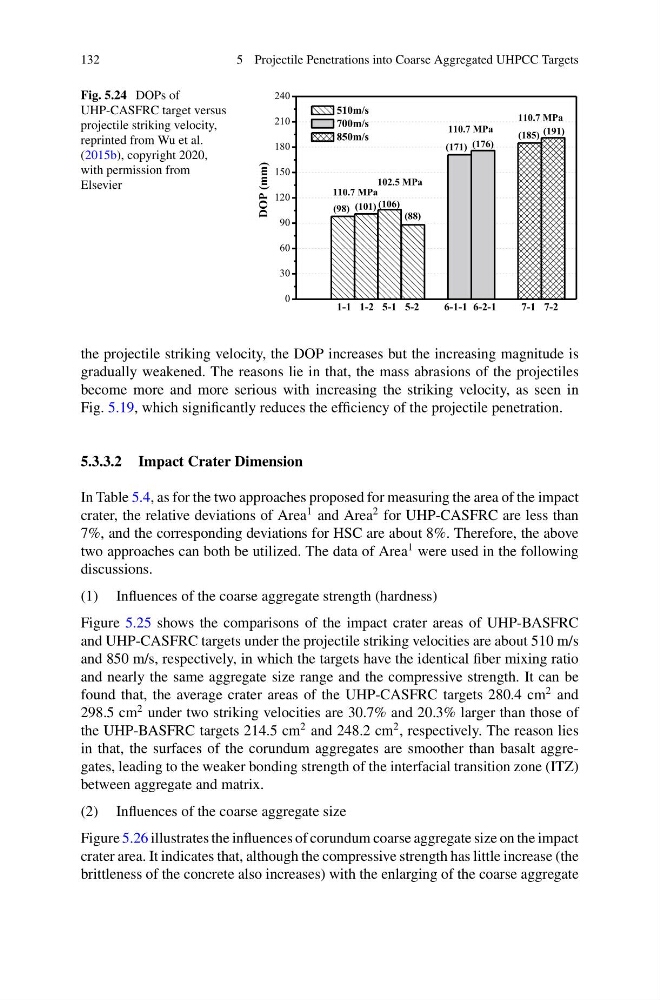
Fig. 5.24 DOPs of
UHP-CASFRC target versus
projectile striking velocity,
reprinted from Wu et al.
(2015b), copyright 2020,
with permission from
Elsevier
0
30
60
90
120
150
180
210
240
102.5 MPa
110.7 MPa
110.7 MPa
(191)
(185)
(176)
(171)
(88)
(106)
1-1 1-2 5-1 5-2
6-1-1 6-2-1
7-1 7-2
110.7 MPa
(101)
(98)
DOP (mm)
510m/s
700m/s
850m/s
the projectile striking velocity, the DOP increases but the increasing magnitude is
gradually weakened. The reasons lie in that, the mass abrasions of the projectiles
become more and more serious with increasing the striking velocity, as seen in
Fig. 5.19, which significantly reduces the efficiency of the projectile penetration.
5.3.3.2 Impact Crater Dimension
In Table 5.4, as for the two approaches proposed for measuring the area of the impact
crater, the relative deviations of Area
1 and Area
2 for UHP-CASFRC are less than
7%, and the corresponding deviations for HSC are about 8%. Therefore, the above
two approaches can both be utilized. The data of Area
1 were used in the following
discussions.
(1) Influences of the coarse aggregate strength (hardness)
Figure 5.25 shows the comparisons of the impact crater areas of UHP-BASFRC
and UHP-CASFRC targets under the projectile striking velocities are about 510 m/s
and 850 m/s, respectively, in which the targets have the identical fiber mixing ratio
and nearly the same aggregate size range and the compressive strength. It can be
found that, the average crater areas of the UHP-CASFRC targets 280.4 cm
2 and
298.5 cm
2 under two striking velocities are 30.7% and 20.3% larger than those of
the UHP-BASFRC targets 214.5 cm
2 and 248.2 cm
2 , respectively. The reason lies
in that, the surfaces of the corundum aggregates are smoother than basalt aggregates, leading to the weaker bonding strength of the interfacial transition zone (ITZ)
between aggregate and matrix.
(2) Influences of the coarse aggregate size
Figure 5.26 illustrates the influences of corundum coarse aggregate size on the impact
crater area. It indicates that, although the compressive strength has little increase (the
brittleness of the concrete also increases) with the enlarging of the coarse aggregate
5 Projectile Penetrations into Coarse Aggregated UHPCC Targets
Fig. 5.24 DOPs of
UHP-CASFRC target versus
projectile striking velocity,
reprinted from Wu et al.
(2015b), copyright 2020,
with permission from
Elsevier
0
30
60
90
120
150
180
210
240
102.5 MPa
110.7 MPa
110.7 MPa
(191)
(185)
(176)
(171)
(88)
(106)
1-1 1-2 5-1 5-2
6-1-1 6-2-1
7-1 7-2
110.7 MPa
(101)
(98)
DOP (mm)
510m/s
700m/s
850m/s
the projectile striking velocity, the DOP increases but the increasing magnitude is
gradually weakened. The reasons lie in that, the mass abrasions of the projectiles
become more and more serious with increasing the striking velocity, as seen in
Fig. 5.19, which significantly reduces the efficiency of the projectile penetration.
5.3.3.2 Impact Crater Dimension
In Table 5.4, as for the two approaches proposed for measuring the area of the impact
crater, the relative deviations of Area
1 and Area
2 for UHP-CASFRC are less than
7%, and the corresponding deviations for HSC are about 8%. Therefore, the above
two approaches can both be utilized. The data of Area
1 were used in the following
discussions.
(1) Influences of the coarse aggregate strength (hardness)
Figure 5.25 shows the comparisons of the impact crater areas of UHP-BASFRC
and UHP-CASFRC targets under the projectile striking velocities are about 510 m/s
and 850 m/s, respectively, in which the targets have the identical fiber mixing ratio
and nearly the same aggregate size range and the compressive strength. It can be
found that, the average crater areas of the UHP-CASFRC targets 280.4 cm
2 and
298.5 cm
2 under two striking velocities are 30.7% and 20.3% larger than those of
the UHP-BASFRC targets 214.5 cm
2 and 248.2 cm
2 , respectively. The reason lies
in that, the surfaces of the corundum aggregates are smoother than basalt aggregates, leading to the weaker bonding strength of the interfacial transition zone (ITZ)
between aggregate and matrix.
(2) Influences of the coarse aggregate size
Figure 5.26 illustrates the influences of corundum coarse aggregate size on the impact
crater area. It indicates that, although the compressive strength has little increase (the
brittleness of the concrete also increases) with the enlarging of the coarse aggregate