

130
5 Projectile Penetrations into Coarse Aggregated UHPCC Targets
help decreasing the DOP, and moreover, it seems that the decreasing degree of coarse
aggregate was more influential than that of compressive strength, which agrees with
the theoretical conclusions of Wu et al. (2014). Thus the harder coarse aggregate can
reduce the DOP by aggravating the mass abrasion of the projectile.
(2) Influences of the coarse aggregate size
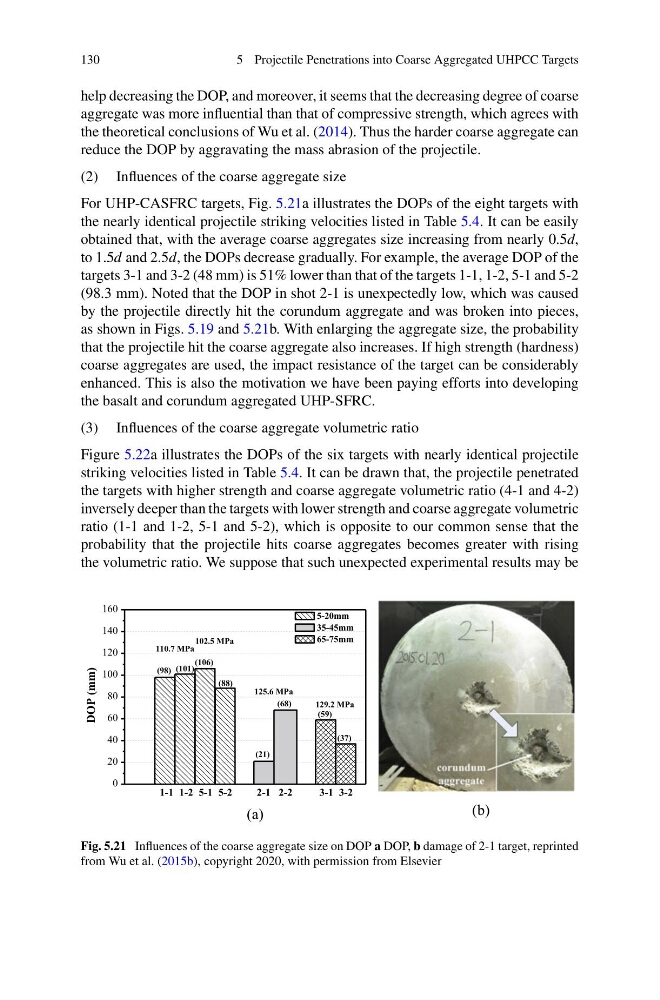
For UHP-CASFRC targets, Fig. 5.21a illustrates the DOPs of the eight targets with
the nearly identical projectile striking velocities listed in Table 5.4. It can be easily
obtained that, with the average coarse aggregates size increasing from nearly 0.5d,
to 1.5d and 2.5d, the DOPs decrease gradually. For example, the average DOP of the
targets 3-1 and 3-2 (48 mm) is 51% lower than that of the targets 1-1, 1-2, 5-1 and 5-2
(98.3 mm). Noted that the DOP in shot 2-1 is unexpectedly low, which was caused
by the projectile directly hit the corundum aggregate and was broken into pieces,
as shown in Figs. 5.19 and 5.21b. With enlarging the aggregate size, the probability
that the projectile hit the coarse aggregate also increases. If high strength (hardness)
coarse aggregates are used, the impact resistance of the target can be considerably
enhanced. This is also the motivation we have been paying efforts into developing
the basalt and corundum aggregated UHP-SFRC.
(3) Influences of the coarse aggregate volumetric ratio
Figure 5.22a illustrates the DOPs of the six targets with nearly identical projectile
striking velocities listed in Table 5.4. It can be drawn that, the projectile penetrated
the targets with higher strength and coarse aggregate volumetric ratio (4-1 and 4-2)
inversely deeper than the targets with lower strength and coarse aggregate volumetric
ratio (1-1 and 1-2, 5-1 and 5-2), which is opposite to our common sense that the
probability that the projectile hits coarse aggregates becomes greater with rising
the volumetric ratio. We suppose that such unexpected experimental results may be
(a)
(b)
0
20
40
60
80
100
120
140
160
102.5 MPa
110.7 MPa
125.6 MPa
(37)
(59)
(68)
(21)
(88)
(106)
1-1 1-2 5-1 5-2
2-1 2-2
3-1 3-2
129.2 MPa
(101)
(98)
DOP (mm)
5-20mm
35-45mm
65-75mm
Fig. 5.21 Influences of the coarse aggregate size on DOP a DOP, b damage of 2-1 target, reprinted
from Wu et al. (2015b), copyright 2020, with permission from Elsevier
5 Projectile Penetrations into Coarse Aggregated UHPCC Targets
help decreasing the DOP, and moreover, it seems that the decreasing degree of coarse
aggregate was more influential than that of compressive strength, which agrees with
the theoretical conclusions of Wu et al. (2014). Thus the harder coarse aggregate can
reduce the DOP by aggravating the mass abrasion of the projectile.
(2) Influences of the coarse aggregate size
For UHP-CASFRC targets, Fig. 5.21a illustrates the DOPs of the eight targets with
the nearly identical projectile striking velocities listed in Table 5.4. It can be easily
obtained that, with the average coarse aggregates size increasing from nearly 0.5d,
to 1.5d and 2.5d, the DOPs decrease gradually. For example, the average DOP of the
targets 3-1 and 3-2 (48 mm) is 51% lower than that of the targets 1-1, 1-2, 5-1 and 5-2
(98.3 mm). Noted that the DOP in shot 2-1 is unexpectedly low, which was caused
by the projectile directly hit the corundum aggregate and was broken into pieces,
as shown in Figs. 5.19 and 5.21b. With enlarging the aggregate size, the probability
that the projectile hit the coarse aggregate also increases. If high strength (hardness)
coarse aggregates are used, the impact resistance of the target can be considerably
enhanced. This is also the motivation we have been paying efforts into developing
the basalt and corundum aggregated UHP-SFRC.
(3) Influences of the coarse aggregate volumetric ratio
Figure 5.22a illustrates the DOPs of the six targets with nearly identical projectile
striking velocities listed in Table 5.4. It can be drawn that, the projectile penetrated
the targets with higher strength and coarse aggregate volumetric ratio (4-1 and 4-2)
inversely deeper than the targets with lower strength and coarse aggregate volumetric
ratio (1-1 and 1-2, 5-1 and 5-2), which is opposite to our common sense that the
probability that the projectile hits coarse aggregates becomes greater with rising
the volumetric ratio. We suppose that such unexpected experimental results may be
(a)
(b)
0
20
40
60
80
100
120
140
160
102.5 MPa
110.7 MPa
125.6 MPa
(37)
(59)
(68)
(21)
(88)
(106)
1-1 1-2 5-1 5-2
2-1 2-2
3-1 3-2
129.2 MPa
(101)
(98)
DOP (mm)
5-20mm
35-45mm
65-75mm
Fig. 5.21 Influences of the coarse aggregate size on DOP a DOP, b damage of 2-1 target, reprinted
from Wu et al. (2015b), copyright 2020, with permission from Elsevier