

5.2 Basalt Aggregated UHPCC Target
121
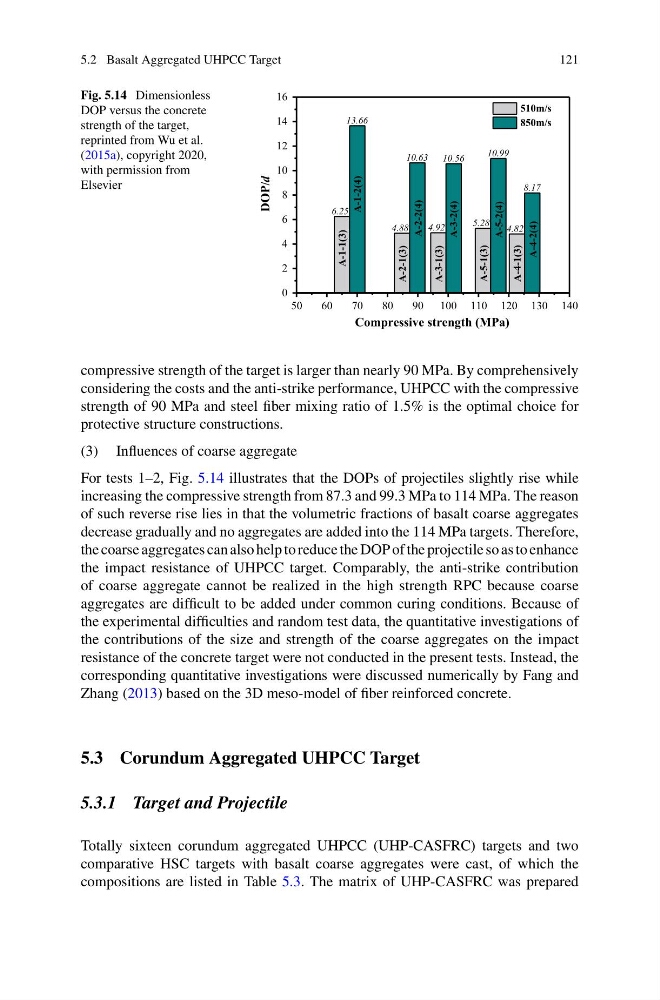
Fig. 5.14 Dimensionless
DOP versus the concrete
strength of the target,
reprinted from Wu et al.
(2015a), copyright 2020,
with permission from
Elsevier
6.25
4.88
4.92
5.28
4.82
13.66
10.63
10.56
10.99
8.17
50
60
70
80
90 100 110 120 130 140
0
2
4
6
8
10
12
14
16
A-4-2(4)
A-5-2(4)
A-3-2(4)
A-2-2(4)
A-1-2(4)
A-4-1(3)
A-5-1(3)
A-3-1(3)
A-2-1(3)
A-1-1(3)
DOP/d
Compressive strength (MPa)
510m/s
850m/s
compressive strength of the target is larger than nearly 90 MPa. By comprehensively
considering the costs and the anti-strike performance, UHPCC with the compressive
strength of 90 MPa and steel fiber mixing ratio of 1.5% is the optimal choice for
protective structure constructions.
(3) Influences of coarse aggregate
For tests 1–2, Fig. 5.14 illustrates that the DOPs of projectiles slightly rise while
increasing the compressive strength from 87.3 and 99.3 MPa to 114 MPa. The reason
of such reverse rise lies in that the volumetric fractions of basalt coarse aggregates
decrease gradually and no aggregates are added into the 114 MPa targets. Therefore,
the coarse aggregates can also help to reduce the DOP of the projectile so as to enhance
the impact resistance of UHPCC target. Comparably, the anti-strike contribution
of coarse aggregate cannot be realized in the high strength RPC because coarse
aggregates are difficult to be added under common curing conditions. Because of
the experimental difficulties and random test data, the quantitative investigations of
the contributions of the size and strength of the coarse aggregates on the impact
resistance of the concrete target were not conducted in the present tests. Instead, the
corresponding quantitative investigations were discussed numerically by Fang and
Zhang (2013) based on the 3D meso-model of fiber reinforced concrete.
5.3 Corundum Aggregated UHPCC Target
5.3.1 Target and Projectile
Totally sixteen corundum aggregated UHPCC (UHP-CASFRC) targets and two
comparative HSC targets with basalt coarse aggregates were cast, of which the
compositions are listed in Table 5.3. The matrix of UHP-CASFRC was prepared
121
Fig. 5.14 Dimensionless
DOP versus the concrete
strength of the target,
reprinted from Wu et al.
(2015a), copyright 2020,
with permission from
Elsevier
6.25
4.88
4.92
5.28
4.82
13.66
10.63
10.56
10.99
8.17
50
60
70
80
90 100 110 120 130 140
0
2
4
6
8
10
12
14
16
A-4-2(4)
A-5-2(4)
A-3-2(4)
A-2-2(4)
A-1-2(4)
A-4-1(3)
A-5-1(3)
A-3-1(3)
A-2-1(3)
A-1-1(3)
DOP/d
Compressive strength (MPa)
510m/s
850m/s
compressive strength of the target is larger than nearly 90 MPa. By comprehensively
considering the costs and the anti-strike performance, UHPCC with the compressive
strength of 90 MPa and steel fiber mixing ratio of 1.5% is the optimal choice for
protective structure constructions.
(3) Influences of coarse aggregate
For tests 1–2, Fig. 5.14 illustrates that the DOPs of projectiles slightly rise while
increasing the compressive strength from 87.3 and 99.3 MPa to 114 MPa. The reason
of such reverse rise lies in that the volumetric fractions of basalt coarse aggregates
decrease gradually and no aggregates are added into the 114 MPa targets. Therefore,
the coarse aggregates can also help to reduce the DOP of the projectile so as to enhance
the impact resistance of UHPCC target. Comparably, the anti-strike contribution
of coarse aggregate cannot be realized in the high strength RPC because coarse
aggregates are difficult to be added under common curing conditions. Because of
the experimental difficulties and random test data, the quantitative investigations of
the contributions of the size and strength of the coarse aggregates on the impact
resistance of the concrete target were not conducted in the present tests. Instead, the
corresponding quantitative investigations were discussed numerically by Fang and
Zhang (2013) based on the 3D meso-model of fiber reinforced concrete.
5.3 Corundum Aggregated UHPCC Target
5.3.1 Target and Projectile
Totally sixteen corundum aggregated UHPCC (UHP-CASFRC) targets and two
comparative HSC targets with basalt coarse aggregates were cast, of which the
compositions are listed in Table 5.3. The matrix of UHP-CASFRC was prepared