

120
5 Projectile Penetrations into Coarse Aggregated UHPCC Targets
457.5
488
309
250
295.5
58
100.5
110
102
0
50 100 150 200 250 300 350 400
0
100
200
300
400
500
600
700
B-2-3
B-2-2
B-2-1
A-2-2(4)
A-2-1(3)
Dimensions of crater (mm)
Impact kinetic energy (kJ)
Average cratering diameter
Average cratering depth
(a)
(b)
162.5
182.5
252.5 238.8
448.8
49
59.5
115
119 130
0
50 100 150 200 250 300 350 400
0
100
200
300
400
500
600
B-3-3
B-3-2
B-3-1
A-4-2(4)
A-4-1(3)
Dimensions of crater (mm)
Impact kinetic energy (kJ)
Average cratering diameter
Average cratering depth
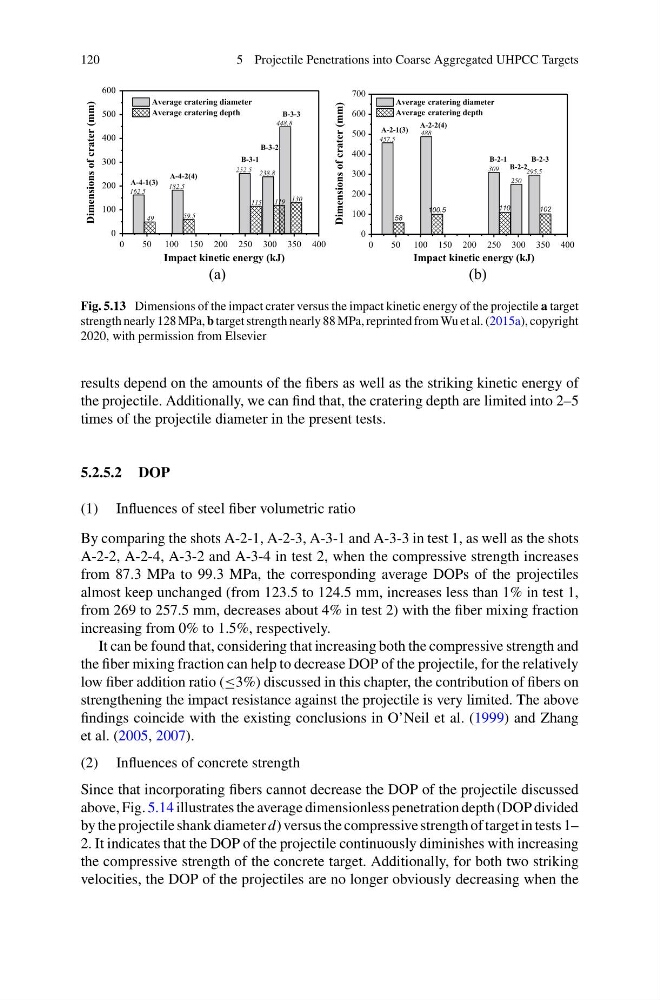
Fig. 5.13 Dimensions of the impact crater versus the impact kinetic energy of the projectile a target
strength nearly 128 MPa, b target strength nearly 88 MPa, reprinted from Wu et al. (2015a), copyright
2020, with permission from Elsevier
results depend on the amounts of the fibers as well as the striking kinetic energy of
the projectile. Additionally, we can find that, the cratering depth are limited into 2–5
times of the projectile diameter in the present tests.
5.2.5.2 DOP
(1) Influences of steel fiber volumetric ratio
By comparing the shots A-2-1, A-2-3, A-3-1 and A-3-3 in test 1, as well as the shots
A-2-2, A-2-4, A-3-2 and A-3-4 in test 2, when the compressive strength increases
from 87.3 MPa to 99.3 MPa, the corresponding average DOPs of the projectiles
almost keep unchanged (from 123.5 to 124.5 mm, increases less than 1% in test 1,
from 269 to 257.5 mm, decreases about 4% in test 2) with the fiber mixing fraction
increasing from 0% to 1.5%, respectively.
It can be found that, considering that increasing both the compressive strength and
the fiber mixing fraction can help to decrease DOP of the projectile, for the relatively
low fiber addition ratio (≤3%) discussed in this chapter, the contribution of fibers on
strengthening the impact resistance against the projectile is very limited. The above
findings coincide with the existing conclusions in O’Neil et al. (1999) and Zhang
et al. (2005, 2007).
(2) Influences of concrete strength
Since that incorporating fibers cannot decrease the DOP of the projectile discussed
above, Fig. 5.14 illustrates the average dimensionless penetration depth (DOP divided
by the projectile shank diameter d) versus the compressive strength of target in tests 1–
2. It indicates that the DOP of the projectile continuously diminishes with increasing
the compressive strength of the concrete target. Additionally, for both two striking
velocities, the DOP of the projectiles are no longer obviously decreasing when the
5 Projectile Penetrations into Coarse Aggregated UHPCC Targets
457.5
488
309
250
295.5
58
100.5
110
102
0
50 100 150 200 250 300 350 400
0
100
200
300
400
500
600
700
B-2-3
B-2-2
B-2-1
A-2-2(4)
A-2-1(3)
Dimensions of crater (mm)
Impact kinetic energy (kJ)
Average cratering diameter
Average cratering depth
(a)
(b)
162.5
182.5
252.5 238.8
448.8
49
59.5
115
119 130
0
50 100 150 200 250 300 350 400
0
100
200
300
400
500
600
B-3-3
B-3-2
B-3-1
A-4-2(4)
A-4-1(3)
Dimensions of crater (mm)
Impact kinetic energy (kJ)
Average cratering diameter
Average cratering depth
Fig. 5.13 Dimensions of the impact crater versus the impact kinetic energy of the projectile a target
strength nearly 128 MPa, b target strength nearly 88 MPa, reprinted from Wu et al. (2015a), copyright
2020, with permission from Elsevier
results depend on the amounts of the fibers as well as the striking kinetic energy of
the projectile. Additionally, we can find that, the cratering depth are limited into 2–5
times of the projectile diameter in the present tests.
5.2.5.2 DOP
(1) Influences of steel fiber volumetric ratio
By comparing the shots A-2-1, A-2-3, A-3-1 and A-3-3 in test 1, as well as the shots
A-2-2, A-2-4, A-3-2 and A-3-4 in test 2, when the compressive strength increases
from 87.3 MPa to 99.3 MPa, the corresponding average DOPs of the projectiles
almost keep unchanged (from 123.5 to 124.5 mm, increases less than 1% in test 1,
from 269 to 257.5 mm, decreases about 4% in test 2) with the fiber mixing fraction
increasing from 0% to 1.5%, respectively.
It can be found that, considering that increasing both the compressive strength and
the fiber mixing fraction can help to decrease DOP of the projectile, for the relatively
low fiber addition ratio (≤3%) discussed in this chapter, the contribution of fibers on
strengthening the impact resistance against the projectile is very limited. The above
findings coincide with the existing conclusions in O’Neil et al. (1999) and Zhang
et al. (2005, 2007).
(2) Influences of concrete strength
Since that incorporating fibers cannot decrease the DOP of the projectile discussed
above, Fig. 5.14 illustrates the average dimensionless penetration depth (DOP divided
by the projectile shank diameter d) versus the compressive strength of target in tests 1–
2. It indicates that the DOP of the projectile continuously diminishes with increasing
the compressive strength of the concrete target. Additionally, for both two striking
velocities, the DOP of the projectiles are no longer obviously decreasing when the