

5.2 Basalt Aggregated UHPCC Target
117
(a)
(b)
(c)
(d)
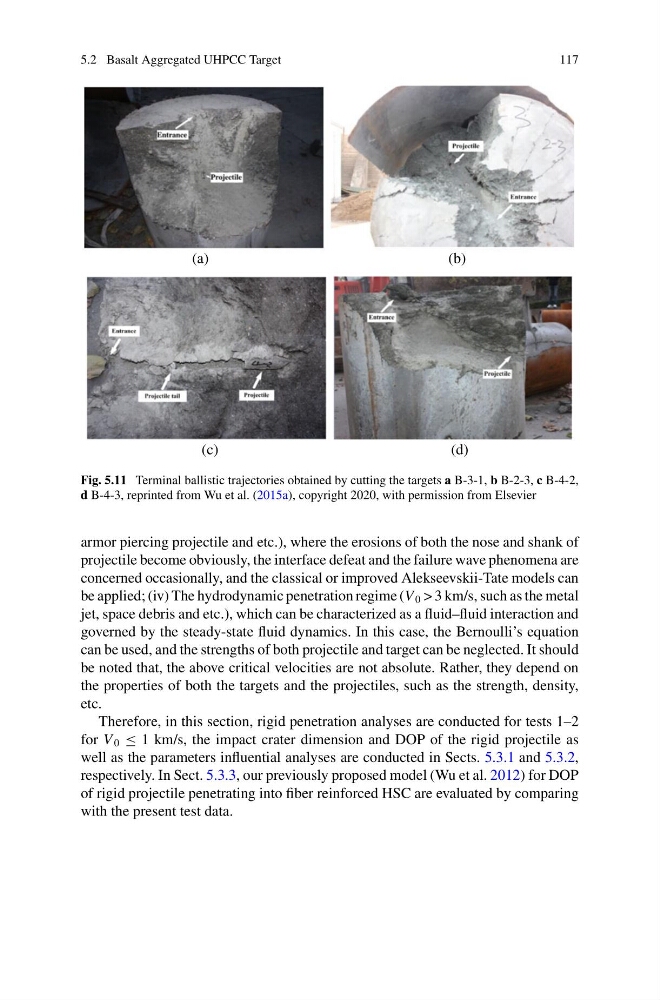
Fig. 5.11 Terminal ballistic trajectories obtained by cutting the targets a B-3-1, b B-2-3, c B-4-2,
d B-4-3, reprinted from Wu et al. (2015a), copyright 2020, with permission from Elsevier
armor piercing projectile and etc.), where the erosions of both the nose and shank of
projectile become obviously, the interface defeat and the failure wave phenomena are
concerned occasionally, and the classical or improved Alekseevskii-Tate models can
be applied; (iv) The hydrodynamic penetration regime (V 0 > 3 km/s, such as the metal
jet, space debris and etc.), which can be characterized as a fluid–fluid interaction and
governed by the steady-state fluid dynamics. In this case, the Bernoulli’s equation
can be used, and the strengths of both projectile and target can be neglected. It should
be noted that, the above critical velocities are not absolute. Rather, they depend on
the properties of both the targets and the projectiles, such as the strength, density,
etc.
Therefore, in this section, rigid penetration analyses are conducted for tests 1–2
for V 0 ≤ 1 km/s, the impact crater dimension and DOP of the rigid projectile as
well as the parameters influential analyses are conducted in Sects. 5.3.1 and 5.3.2,
respectively. In Sect. 5.3.3, our previously proposed model (Wu et al. 2012) for DOP
of rigid projectile penetrating into fiber reinforced HSC are evaluated by comparing
with the present test data.
117
(a)
(b)
(c)
(d)
Fig. 5.11 Terminal ballistic trajectories obtained by cutting the targets a B-3-1, b B-2-3, c B-4-2,
d B-4-3, reprinted from Wu et al. (2015a), copyright 2020, with permission from Elsevier
armor piercing projectile and etc.), where the erosions of both the nose and shank of
projectile become obviously, the interface defeat and the failure wave phenomena are
concerned occasionally, and the classical or improved Alekseevskii-Tate models can
be applied; (iv) The hydrodynamic penetration regime (V 0 > 3 km/s, such as the metal
jet, space debris and etc.), which can be characterized as a fluid–fluid interaction and
governed by the steady-state fluid dynamics. In this case, the Bernoulli’s equation
can be used, and the strengths of both projectile and target can be neglected. It should
be noted that, the above critical velocities are not absolute. Rather, they depend on
the properties of both the targets and the projectiles, such as the strength, density,
etc.
Therefore, in this section, rigid penetration analyses are conducted for tests 1–2
for V 0 ≤ 1 km/s, the impact crater dimension and DOP of the rigid projectile as
well as the parameters influential analyses are conducted in Sects. 5.3.1 and 5.3.2,
respectively. In Sect. 5.3.3, our previously proposed model (Wu et al. 2012) for DOP
of rigid projectile penetrating into fiber reinforced HSC are evaluated by comparing
with the present test data.