

118
5 Projectile Penetrations into Coarse Aggregated UHPCC Targets
5.2.5.1 Impact Crater Dimension
(1) The influence of target strength
In Table 5.2, under the same striking velocity and fiber mixing fraction, taking A1-1, A-1-3, A-3-1 and A-3-3 in test 1 (V 0 = 510 m/s) for example, increasing the
compressive strength of the target by 47% (from 67.5 to 99.3 MPa) increases the
average impact cratering depth h c and diameter d c by 35% and 43% (h c ranges from
50.5 to 68 mm, d c ranges from 187 to 267 mm), respectively. Comparably, for A-1-2,
A-1-4, A-3-2 and A-3-4 in tests 2 (V 0 = 850 m/s), with the same increment of the
compressive strength of the target, h c decreases by 13% (from 65.5 to 57 mm) and
d c increases by 15% (from 233 to 267 mm), respectively.
It indicates that, with the increase of the compressive strength of the target, the
impact cratering depth and diameter both increases, while the above increasing degree
tends to decrease with gradually rising the striking velocity of the projectile.
(2) The influence of fiber mixing fraction
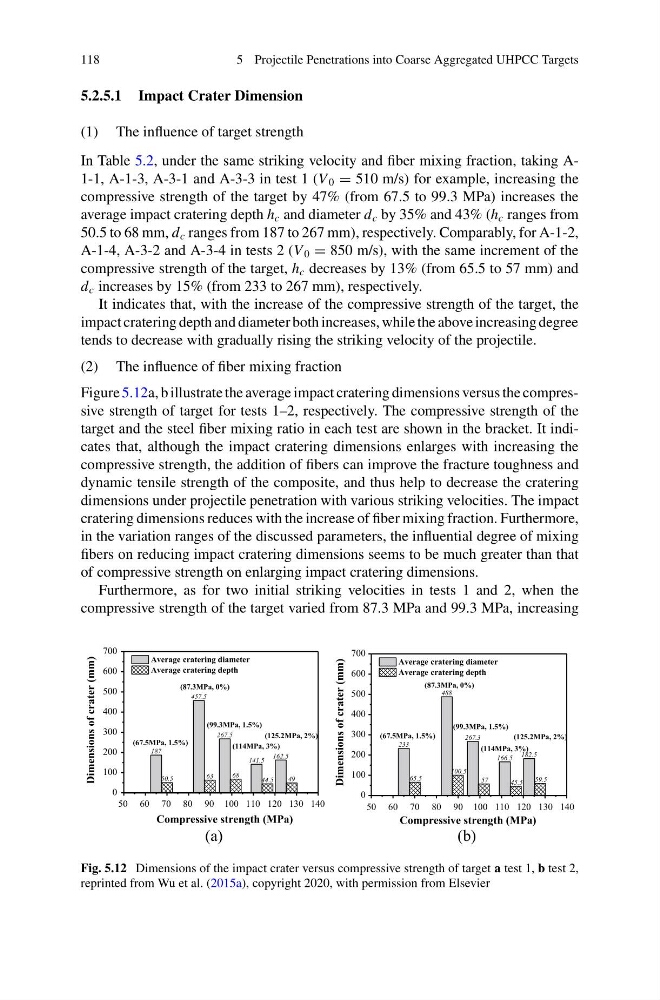
Figure 5.12a, b illustrate the average impact cratering dimensions versus the compressive strength of target for tests 1–2, respectively. The compressive strength of the
target and the steel fiber mixing ratio in each test are shown in the bracket. It indicates that, although the impact cratering dimensions enlarges with increasing the
compressive strength, the addition of fibers can improve the fracture toughness and
dynamic tensile strength of the composite, and thus help to decrease the cratering
dimensions under projectile penetration with various striking velocities. The impact
cratering dimensions reduces with the increase of fiber mixing fraction. Furthermore,
in the variation ranges of the discussed parameters, the influential degree of mixing
fibers on reducing impact cratering dimensions seems to be much greater than that
of compressive strength on enlarging impact cratering dimensions.
Furthermore, as for two initial striking velocities in tests 1 and 2, when the
compressive strength of the target varied from 87.3 MPa and 99.3 MPa, increasing
(a)
(b)
457.5
267.5
187
162.5
141.5
63
68
50.5
49
44.5
50 60 70 80 90 100 110 120 130 140
0
100
200
300
400
500
600
700
(114MPa, 3%)
(125.2MPa, 2%)
(99.3MPa, 1.5%)
(87.3MPa, 0%)
Dimensions of crater (mm)
Compressive strength (MPa)
Average cratering diameter
Average cratering depth
(67.5MPa, 1.5%)
488
267.3
233
182.5
166.5
100.5
57
65.5
59.5
45.5
50 60 70 80 90 100 110 120 130 140
0
100
200
300
400
500
600
700
(125.2MPa, 2%)
(114MPa, 3%)
(99.3MPa, 1.5%)
(87.3MPa, 0%)
(67.5MPa, 1.5%)
Dimensions of crater (mm)
Compressive strength (MPa)
Average cratering diameter
Average cratering depth
Fig. 5.12 Dimensions of the impact crater versus compressive strength of target a test 1, b test 2,
reprinted from Wu et al. (2015a), copyright 2020, with permission from Elsevier
5 Projectile Penetrations into Coarse Aggregated UHPCC Targets
5.2.5.1 Impact Crater Dimension
(1) The influence of target strength
In Table 5.2, under the same striking velocity and fiber mixing fraction, taking A1-1, A-1-3, A-3-1 and A-3-3 in test 1 (V 0 = 510 m/s) for example, increasing the
compressive strength of the target by 47% (from 67.5 to 99.3 MPa) increases the
average impact cratering depth h c and diameter d c by 35% and 43% (h c ranges from
50.5 to 68 mm, d c ranges from 187 to 267 mm), respectively. Comparably, for A-1-2,
A-1-4, A-3-2 and A-3-4 in tests 2 (V 0 = 850 m/s), with the same increment of the
compressive strength of the target, h c decreases by 13% (from 65.5 to 57 mm) and
d c increases by 15% (from 233 to 267 mm), respectively.
It indicates that, with the increase of the compressive strength of the target, the
impact cratering depth and diameter both increases, while the above increasing degree
tends to decrease with gradually rising the striking velocity of the projectile.
(2) The influence of fiber mixing fraction
Figure 5.12a, b illustrate the average impact cratering dimensions versus the compressive strength of target for tests 1–2, respectively. The compressive strength of the
target and the steel fiber mixing ratio in each test are shown in the bracket. It indicates that, although the impact cratering dimensions enlarges with increasing the
compressive strength, the addition of fibers can improve the fracture toughness and
dynamic tensile strength of the composite, and thus help to decrease the cratering
dimensions under projectile penetration with various striking velocities. The impact
cratering dimensions reduces with the increase of fiber mixing fraction. Furthermore,
in the variation ranges of the discussed parameters, the influential degree of mixing
fibers on reducing impact cratering dimensions seems to be much greater than that
of compressive strength on enlarging impact cratering dimensions.
Furthermore, as for two initial striking velocities in tests 1 and 2, when the
compressive strength of the target varied from 87.3 MPa and 99.3 MPa, increasing
(a)
(b)
457.5
267.5
187
162.5
141.5
63
68
50.5
49
44.5
50 60 70 80 90 100 110 120 130 140
0
100
200
300
400
500
600
700
(114MPa, 3%)
(125.2MPa, 2%)
(99.3MPa, 1.5%)
(87.3MPa, 0%)
Dimensions of crater (mm)
Compressive strength (MPa)
Average cratering diameter
Average cratering depth
(67.5MPa, 1.5%)
488
267.3
233
182.5
166.5
100.5
57
65.5
59.5
45.5
50 60 70 80 90 100 110 120 130 140
0
100
200
300
400
500
600
700
(125.2MPa, 2%)
(114MPa, 3%)
(99.3MPa, 1.5%)
(87.3MPa, 0%)
(67.5MPa, 1.5%)
Dimensions of crater (mm)
Compressive strength (MPa)
Average cratering diameter
Average cratering depth
Fig. 5.12 Dimensions of the impact crater versus compressive strength of target a test 1, b test 2,
reprinted from Wu et al. (2015a), copyright 2020, with permission from Elsevier