

98
4 Triaxial Compressive Behavior of UHPCC …
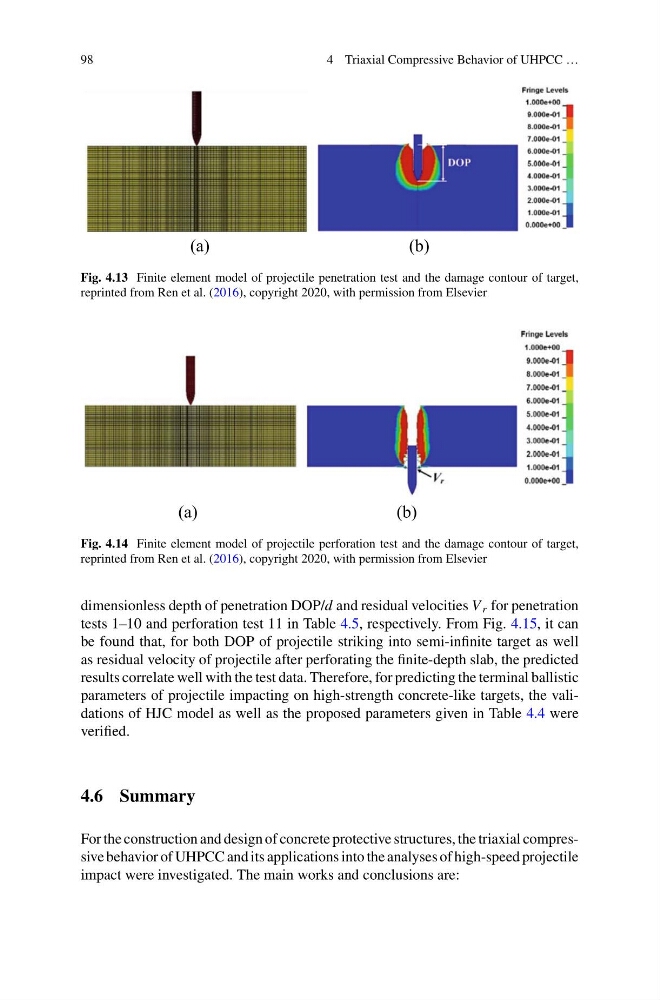
Fig. 4.13 Finite element model of projectile penetration test and the damage contour of target,
reprinted from Ren et al. (2016), copyright 2020, with permission from Elsevier
Fig. 4.14 Finite element model of projectile perforation test and the damage contour of target,
reprinted from Ren et al. (2016), copyright 2020, with permission from Elsevier
dimensionless depth of penetration DOP/d and residual velocities V r for penetration
tests 1–10 and perforation test 11 in Table 4.5, respectively. From Fig. 4.15, it can
be found that, for both DOP of projectile striking into semi-infinite target as well
as residual velocity of projectile after perforating the finite-depth slab, the predicted
results correlate well with the test data. Therefore, for predicting the terminal ballistic
parameters of projectile impacting on high-strength concrete-like targets, the validations of HJC model as well as the proposed parameters given in Table 4.4 were
verified.
4.6 Summary
For the construction and design of concrete protective structures, the triaxial compressive behavior of UHPCC and its applications into the analyses of high-speed projectile
impact were investigated. The main works and conclusions are:
4 Triaxial Compressive Behavior of UHPCC …
Fig. 4.13 Finite element model of projectile penetration test and the damage contour of target,
reprinted from Ren et al. (2016), copyright 2020, with permission from Elsevier
Fig. 4.14 Finite element model of projectile perforation test and the damage contour of target,
reprinted from Ren et al. (2016), copyright 2020, with permission from Elsevier
dimensionless depth of penetration DOP/d and residual velocities V r for penetration
tests 1–10 and perforation test 11 in Table 4.5, respectively. From Fig. 4.15, it can
be found that, for both DOP of projectile striking into semi-infinite target as well
as residual velocity of projectile after perforating the finite-depth slab, the predicted
results correlate well with the test data. Therefore, for predicting the terminal ballistic
parameters of projectile impacting on high-strength concrete-like targets, the validations of HJC model as well as the proposed parameters given in Table 4.4 were
verified.
4.6 Summary
For the construction and design of concrete protective structures, the triaxial compressive behavior of UHPCC and its applications into the analyses of high-speed projectile
impact were investigated. The main works and conclusions are: