

380
9 Topologic Optimization of Vibrations of Size-Dependent Beams
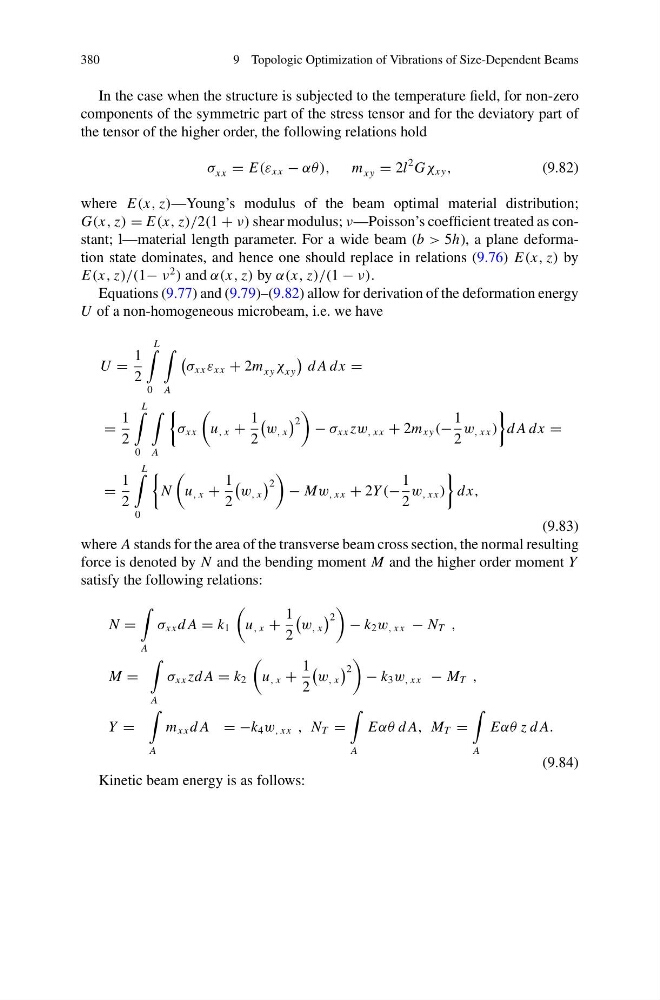
In the case when the structure is subjected to the temperature field, for non-zero
components of the symmetric part of the stress tensor and for the deviatory part of
the tensor of the higher order, the following relations hold
σ xx = E(ε xx − αθ), m xy = 2l
2 Gχ xy ,
(9.82)
where E(x, z)—Young’s modulus of the beam optimal material distribution;
G(x, z) = E(x, z)/2(1 + ν) shear modulus; ν—Poisson’s coefficient treated as constant; l—material length parameter. For a wide beam (b > 5h), a plane deformation state dominates, and hence one should replace in relations (9.76) E(x, z) by
E(x, z)/(1− ν
2
) and α(x, z) by α(x, z)/(1 − ν).
Equations (9.77) and (9.79)–(9.82) allow for derivation of the deformation energy
U of a non-homogeneous microbeam, i.e. we have
U =
1
2
L
0
A
σ xx ε xx + 2m xy χ xy
d A dx =
=
1
2
L
0
A
σ xx
u , x +
1
2
w , x
2
− σ xx zw , xx + 2m xy (−
1
2
w , xx )
d A dx =
=
1
2
L
0
N
u , x +
1
2
w , x
2
− Mw , xx + 2Y (−
1
2
w , xx )
dx,
(9.83)
where A stands for the area of the transverse beam cross section, the normal resulting
force is denoted by N and the bending moment M and the higher order moment Y
satisfy the following relations:
N =
A
σ xx d A = k 1
u , x +
1
2
w , x
2
− k 2 w , xx − N T ,
M =
A
σ xx zd A = k 2
u , x +
1
2
w , x
2
− k 3 w , xx − M T ,
Y =
A
m xx d A = −k 4 w , xx , N T =
A
Eαθ d A, M T =
A
Eαθ z d A.
(9.84)
Kinetic beam energy is as follows:
9 Topologic Optimization of Vibrations of Size-Dependent Beams
In the case when the structure is subjected to the temperature field, for non-zero
components of the symmetric part of the stress tensor and for the deviatory part of
the tensor of the higher order, the following relations hold
σ xx = E(ε xx − αθ), m xy = 2l
2 Gχ xy ,
(9.82)
where E(x, z)—Young’s modulus of the beam optimal material distribution;
G(x, z) = E(x, z)/2(1 + ν) shear modulus; ν—Poisson’s coefficient treated as constant; l—material length parameter. For a wide beam (b > 5h), a plane deformation state dominates, and hence one should replace in relations (9.76) E(x, z) by
E(x, z)/(1− ν
2
) and α(x, z) by α(x, z)/(1 − ν).
Equations (9.77) and (9.79)–(9.82) allow for derivation of the deformation energy
U of a non-homogeneous microbeam, i.e. we have
U =
1
2
L
0
A
σ xx ε xx + 2m xy χ xy
d A dx =
=
1
2
L
0
A
σ xx
u , x +
1
2
w , x
2
− σ xx zw , xx + 2m xy (−
1
2
w , xx )
d A dx =
=
1
2
L
0
N
u , x +
1
2
w , x
2
− Mw , xx + 2Y (−
1
2
w , xx )
dx,
(9.83)
where A stands for the area of the transverse beam cross section, the normal resulting
force is denoted by N and the bending moment M and the higher order moment Y
satisfy the following relations:
N =
A
σ xx d A = k 1
u , x +
1
2
w , x
2
− k 2 w , xx − N T ,
M =
A
σ xx zd A = k 2
u , x +
1
2
w , x
2
− k 3 w , xx − M T ,
Y =
A
m xx d A = −k 4 w , xx , N T =
A
Eαθ d A, M T =
A
Eαθ z d A.
(9.84)
Kinetic beam energy is as follows: