

9.7 Size-Dependent Euler-Bernoulli Beams with Topologically Optimized Microstructure 381
K =
1
2
L
0
A
ρ
u , t − zw , xt
2 + w
2
, t
d A dx =
=
1
2
L
0
A
ρ
u
2
, t − 2zu , t w , xt + z
2
w , xt + w
2
, t
d A dx =
=
1
2
L
0
b 0 u
2
, t − 2b 1 u , t w , xt + b 2 w
2
, xt + b 0 w
2
, t
dx .
(9.85)
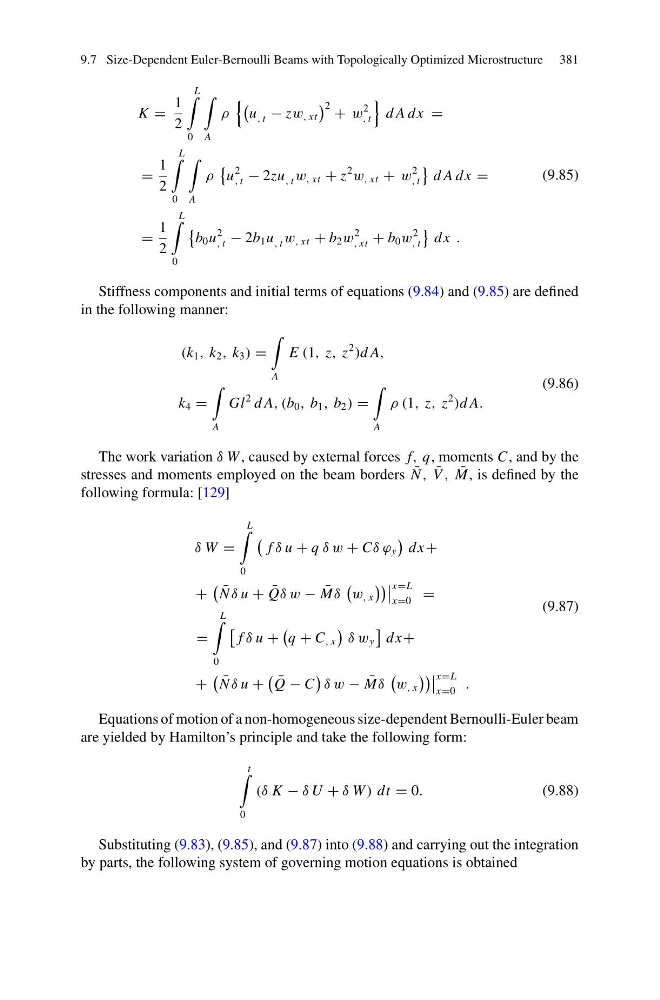
Stiffness components and initial terms of equations (9.84) and (9.85) are defined
in the following manner:
(k 1 , k 2 , k 3 ) =
A
E (1, z, z
2
)d A,
k 4 =
A
Gl
2 d A, (b 0 , b 1 , b 2 ) =
A
ρ (1, z, z
2
)d A.
(9.86)
The work variation δ W , caused by external forces f, q, moments C, and by the
stresses and moments employed on the beam borders ¯
N , ¯
V , ¯
M, is defined by the
following formula: [129]
δ W =
L
0
f δ u + q δ w + Cδ ϕ y
dx+
+
¯
N δ u + ¯
Qδ w − ¯
Mδ
w , x
x=L
x=0
=
=
L
0
f δ u +
q + C , x
δ w y
dx+
+
¯
N δ u +
¯
Q − C
δ w − ¯
Mδ
w , x
x=L
x=0
.
(9.87)
Equations of motion of a non-homogeneous size-dependent Bernoulli-Euler beam
are yielded by Hamilton’s principle and take the following form:
t
0
(δ K − δ U + δ W ) dt = 0.
(9.88)
Substituting (9.83), (9.85), and (9.87) into (9.88) and carrying out the integration
by parts, the following system of governing motion equations is obtained
K =
1
2
L
0
A
ρ
u , t − zw , xt
2 + w
2
, t
d A dx =
=
1
2
L
0
A
ρ
u
2
, t − 2zu , t w , xt + z
2
w , xt + w
2
, t
d A dx =
=
1
2
L
0
b 0 u
2
, t − 2b 1 u , t w , xt + b 2 w
2
, xt + b 0 w
2
, t
dx .
(9.85)
Stiffness components and initial terms of equations (9.84) and (9.85) are defined
in the following manner:
(k 1 , k 2 , k 3 ) =
A
E (1, z, z
2
)d A,
k 4 =
A
Gl
2 d A, (b 0 , b 1 , b 2 ) =
A
ρ (1, z, z
2
)d A.
(9.86)
The work variation δ W , caused by external forces f, q, moments C, and by the
stresses and moments employed on the beam borders ¯
N , ¯
V , ¯
M, is defined by the
following formula: [129]
δ W =
L
0
f δ u + q δ w + Cδ ϕ y
dx+
+
¯
N δ u + ¯
Qδ w − ¯
Mδ
w , x
x=L
x=0
=
=
L
0
f δ u +
q + C , x
δ w y
dx+
+
¯
N δ u +
¯
Q − C
δ w − ¯
Mδ
w , x
x=L
x=0
.
(9.87)
Equations of motion of a non-homogeneous size-dependent Bernoulli-Euler beam
are yielded by Hamilton’s principle and take the following form:
t
0
(δ K − δ U + δ W ) dt = 0.
(9.88)
Substituting (9.83), (9.85), and (9.87) into (9.88) and carrying out the integration
by parts, the following system of governing motion equations is obtained