

378
9 Topologic Optimization of Vibrations of Size-Dependent Beams
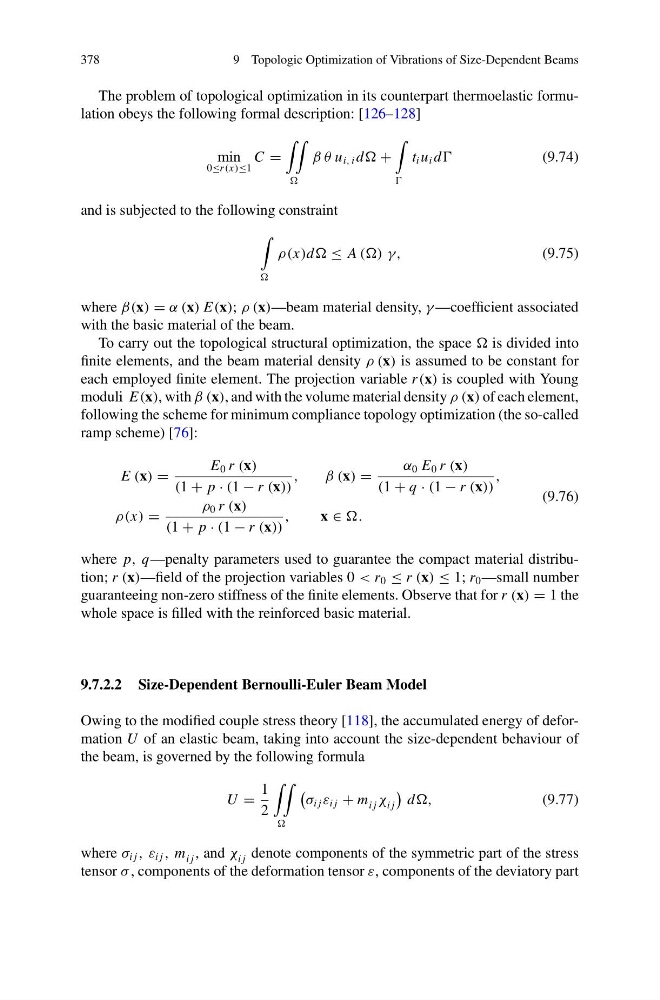
The problem of topological optimization in its counterpart thermoelastic formulation obeys the following formal description: [126–128]
min
0≤r (x)≤1
C =
β θ u i, i d +
t i u i d
(9.74)
and is subjected to the following constraint
ρ(x)d ≤ A () γ,
(9.75)
where β(x) = α (x) E(x); ρ (x)—beam material density, γ —coefficient associated
with the basic material of the beam.
To carry out the topological structural optimization, the space is divided into
finite elements, and the beam material density ρ (x) is assumed to be constant for
each employed finite element. The projection variable r (x) is coupled with Young
moduli E(x), with β (x), and with the volume material density ρ (x) of each element,
following the scheme for minimum compliance topology optimization (the so-called
ramp scheme) [76]:
E (x) =
E 0 r (x)
(1 + p · (1 − r (x))
,
β(x) =
α 0 E 0 r (x)
(1 + q · (1 − r (x))
,
ρ(x) =
ρ 0 r (x)
(1 + p · (1 − r (x))
,
x ∈ .
(9.76)
where p, q—penalty parameters used to guarantee the compact material distribution; r (x)—field of the projection variables 0 < r 0 ≤ r (x) ≤ 1; r 0 —small number
guaranteeing non-zero stiffness of the finite elements. Observe that for r (x) = 1 the
whole space is filled with the reinforced basic material.
9.7.2.2 Size-Dependent Bernoulli-Euler Beam Model
Owing to the modified couple stress theory [118], the accumulated energy of deformation U of an elastic beam, taking into account the size-dependent behaviour of
the beam, is governed by the following formula
U =
1
2
σ i j ε i j + m i j χ i j
d,
(9.77)
where σ i j , ε i j , m i j , and χ i j denote components of the symmetric part of the stress
tensor σ , components of the deformation tensor ε, components of the deviatory part
9 Topologic Optimization of Vibrations of Size-Dependent Beams
The problem of topological optimization in its counterpart thermoelastic formulation obeys the following formal description: [126–128]
min
0≤r (x)≤1
C =
β θ u i, i d +
t i u i d
(9.74)
and is subjected to the following constraint
ρ(x)d ≤ A () γ,
(9.75)
where β(x) = α (x) E(x); ρ (x)—beam material density, γ —coefficient associated
with the basic material of the beam.
To carry out the topological structural optimization, the space is divided into
finite elements, and the beam material density ρ (x) is assumed to be constant for
each employed finite element. The projection variable r (x) is coupled with Young
moduli E(x), with β (x), and with the volume material density ρ (x) of each element,
following the scheme for minimum compliance topology optimization (the so-called
ramp scheme) [76]:
E (x) =
E 0 r (x)
(1 + p · (1 − r (x))
,
β(x) =
α 0 E 0 r (x)
(1 + q · (1 − r (x))
,
ρ(x) =
ρ 0 r (x)
(1 + p · (1 − r (x))
,
x ∈ .
(9.76)
where p, q—penalty parameters used to guarantee the compact material distribution; r (x)—field of the projection variables 0 < r 0 ≤ r (x) ≤ 1; r 0 —small number
guaranteeing non-zero stiffness of the finite elements. Observe that for r (x) = 1 the
whole space is filled with the reinforced basic material.
9.7.2.2 Size-Dependent Bernoulli-Euler Beam Model
Owing to the modified couple stress theory [118], the accumulated energy of deformation U of an elastic beam, taking into account the size-dependent behaviour of
the beam, is governed by the following formula
U =
1
2
σ i j ε i j + m i j χ i j
d,
(9.77)
where σ i j , ε i j , m i j , and χ i j denote components of the symmetric part of the stress
tensor σ , components of the deformation tensor ε, components of the deviatory part