

9.7 Size-Dependent Euler-Bernoulli Beams with Topologically Optimized Microstructure 373
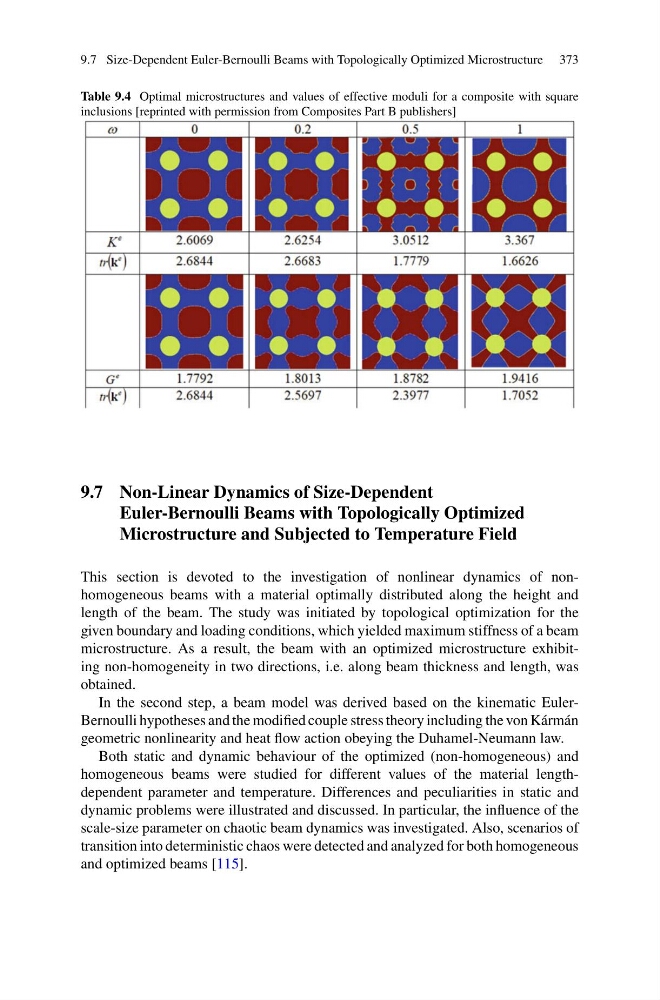
Table 9.4 Optimal microstructures and values of effective moduli for a composite with square
inclusions [reprinted with permission from Composites Part B publishers]
9.7 Non-Linear Dynamics of Size-Dependent
Euler-Bernoulli Beams with Topologically Optimized
Microstructure and Subjected to Temperature Field
This section is devoted to the investigation of nonlinear dynamics of nonhomogeneous beams with a material optimally distributed along the height and
length of the beam. The study was initiated by topological optimization for the
given boundary and loading conditions, which yielded maximum stiffness of a beam
microstructure. As a result, the beam with an optimized microstructure exhibiting non-homogeneity in two directions, i.e. along beam thickness and length, was
obtained.
In the second step, a beam model was derived based on the kinematic EulerBernoulli hypotheses and the modified couple stress theory including the von Kármán
geometric nonlinearity and heat flow action obeying the Duhamel-Neumann law.
Both static and dynamic behaviour of the optimized (non-homogeneous) and
homogeneous beams were studied for different values of the material lengthdependent parameter and temperature. Differences and peculiarities in static and
dynamic problems were illustrated and discussed. In particular, the influence of the
scale-size parameter on chaotic beam dynamics was investigated. Also, scenarios of
transition into deterministic chaos were detected and analyzed for both homogeneous
and optimized beams [115].
Table 9.4 Optimal microstructures and values of effective moduli for a composite with square
inclusions [reprinted with permission from Composites Part B publishers]
9.7 Non-Linear Dynamics of Size-Dependent
Euler-Bernoulli Beams with Topologically Optimized
Microstructure and Subjected to Temperature Field
This section is devoted to the investigation of nonlinear dynamics of nonhomogeneous beams with a material optimally distributed along the height and
length of the beam. The study was initiated by topological optimization for the
given boundary and loading conditions, which yielded maximum stiffness of a beam
microstructure. As a result, the beam with an optimized microstructure exhibiting non-homogeneity in two directions, i.e. along beam thickness and length, was
obtained.
In the second step, a beam model was derived based on the kinematic EulerBernoulli hypotheses and the modified couple stress theory including the von Kármán
geometric nonlinearity and heat flow action obeying the Duhamel-Neumann law.
Both static and dynamic behaviour of the optimized (non-homogeneous) and
homogeneous beams were studied for different values of the material lengthdependent parameter and temperature. Differences and peculiarities in static and
dynamic problems were illustrated and discussed. In particular, the influence of the
scale-size parameter on chaotic beam dynamics was investigated. Also, scenarios of
transition into deterministic chaos were detected and analyzed for both homogeneous
and optimized beams [115].