

374
9 Topologic Optimization of Vibrations of Size-Dependent Beams
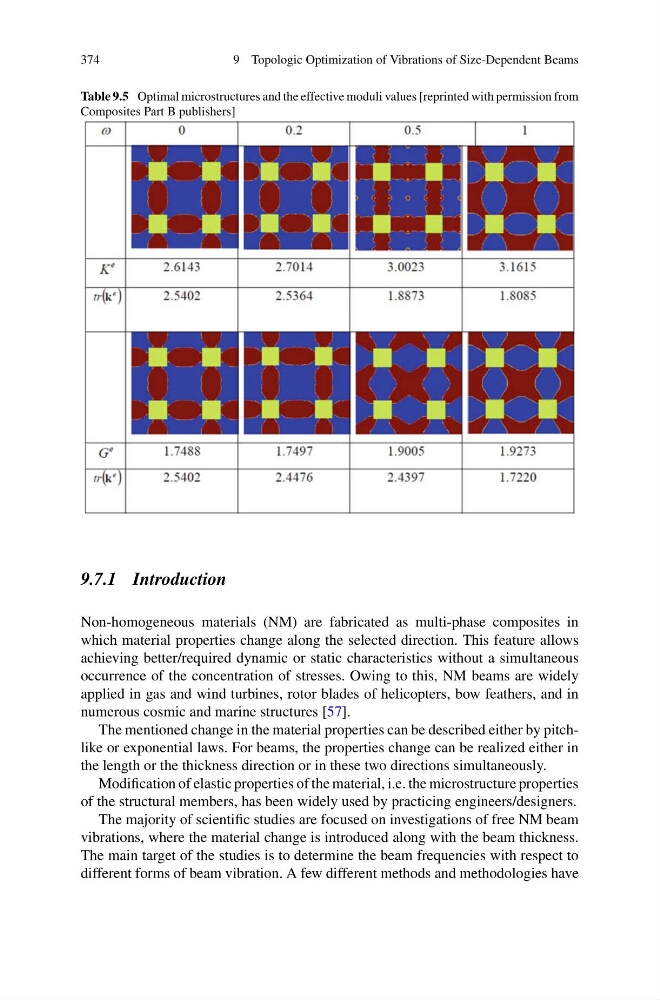
Table 9.5 Optimal microstructures and the effective moduli values [reprinted with permission from
Composites Part B publishers]
9.7.1 Introduction
Non-homogeneous materials (NM) are fabricated as multi-phase composites in
which material properties change along the selected direction. This feature allows
achieving better/required dynamic or static characteristics without a simultaneous
occurrence of the concentration of stresses. Owing to this, NM beams are widely
applied in gas and wind turbines, rotor blades of helicopters, bow feathers, and in
numerous cosmic and marine structures [57].
The mentioned change in the material properties can be described either by pitchlike or exponential laws. For beams, the properties change can be realized either in
the length or the thickness direction or in these two directions simultaneously.
Modification of elastic properties of the material, i.e. the microstructure properties
of the structural members, has been widely used by practicing engineers/designers.
The majority of scientific studies are focused on investigations of free NM beam
vibrations, where the material change is introduced along with the beam thickness.
The main target of the studies is to determine the beam frequencies with respect to
different forms of beam vibration. A few different methods and methodologies have
9 Topologic Optimization of Vibrations of Size-Dependent Beams
Table 9.5 Optimal microstructures and the effective moduli values [reprinted with permission from
Composites Part B publishers]
9.7.1 Introduction
Non-homogeneous materials (NM) are fabricated as multi-phase composites in
which material properties change along the selected direction. This feature allows
achieving better/required dynamic or static characteristics without a simultaneous
occurrence of the concentration of stresses. Owing to this, NM beams are widely
applied in gas and wind turbines, rotor blades of helicopters, bow feathers, and in
numerous cosmic and marine structures [57].
The mentioned change in the material properties can be described either by pitchlike or exponential laws. For beams, the properties change can be realized either in
the length or the thickness direction or in these two directions simultaneously.
Modification of elastic properties of the material, i.e. the microstructure properties
of the structural members, has been widely used by practicing engineers/designers.
The majority of scientific studies are focused on investigations of free NM beam
vibrations, where the material change is introduced along with the beam thickness.
The main target of the studies is to determine the beam frequencies with respect to
different forms of beam vibration. A few different methods and methodologies have