

372
9 Topologic Optimization of Vibrations of Size-Dependent Beams
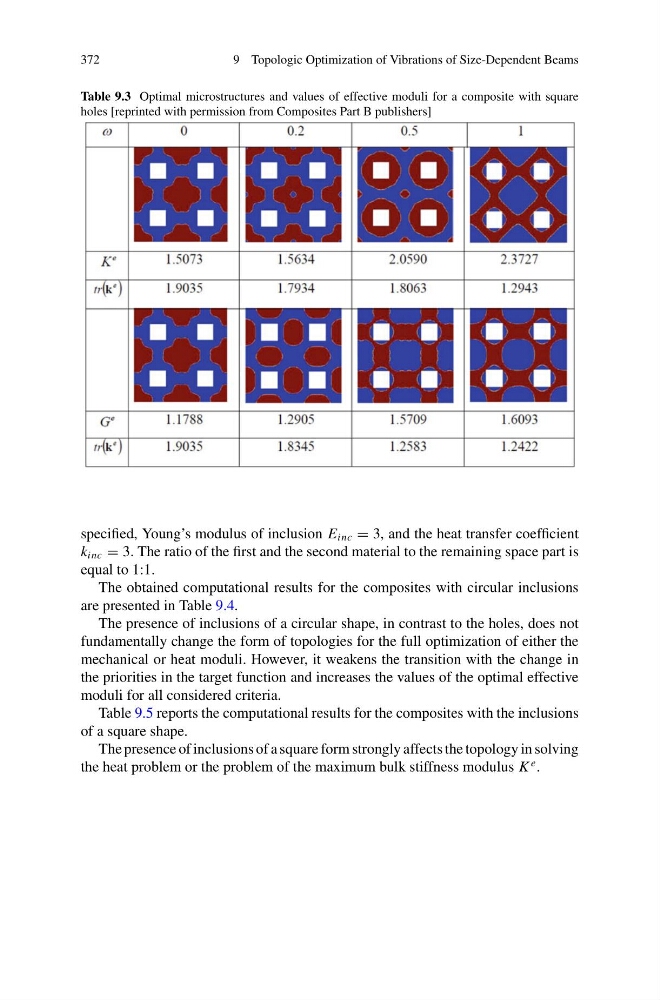
Table 9.3 Optimal microstructures and values of effective moduli for a composite with square
holes [reprinted with permission from Composites Part B publishers]
specified, Young’s modulus of inclusion E inc = 3, and the heat transfer coefficient
k inc = 3. The ratio of the first and the second material to the remaining space part is
equal to 1:1.
The obtained computational results for the composites with circular inclusions
are presented in Table 9.4.
The presence of inclusions of a circular shape, in contrast to the holes, does not
fundamentally change the form of topologies for the full optimization of either the
mechanical or heat moduli. However, it weakens the transition with the change in
the priorities in the target function and increases the values of the optimal effective
moduli for all considered criteria.
Table 9.5 reports the computational results for the composites with the inclusions
of a square shape.
The presence of inclusions of a square form strongly affects the topology in solving
the heat problem or the problem of the maximum bulk stiffness modulus K
e .
9 Topologic Optimization of Vibrations of Size-Dependent Beams
Table 9.3 Optimal microstructures and values of effective moduli for a composite with square
holes [reprinted with permission from Composites Part B publishers]
specified, Young’s modulus of inclusion E inc = 3, and the heat transfer coefficient
k inc = 3. The ratio of the first and the second material to the remaining space part is
equal to 1:1.
The obtained computational results for the composites with circular inclusions
are presented in Table 9.4.
The presence of inclusions of a circular shape, in contrast to the holes, does not
fundamentally change the form of topologies for the full optimization of either the
mechanical or heat moduli. However, it weakens the transition with the change in
the priorities in the target function and increases the values of the optimal effective
moduli for all considered criteria.
Table 9.5 reports the computational results for the composites with the inclusions
of a square shape.
The presence of inclusions of a square form strongly affects the topology in solving
the heat problem or the problem of the maximum bulk stiffness modulus K
e .