

9.6 Topological Optimization with Maximized Stiffness and Heat Transfer
371
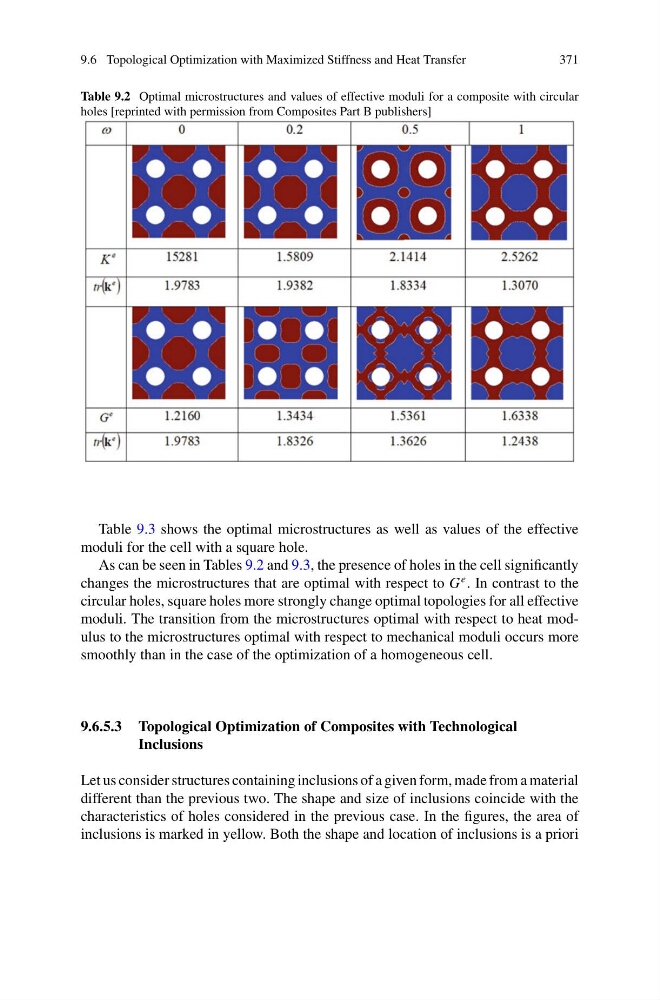
Table 9.2 Optimal microstructures and values of effective moduli for a composite with circular
holes [reprinted with permission from Composites Part B publishers]
Table 9.3 shows the optimal microstructures as well as values of the effective
moduli for the cell with a square hole.
As can be seen in Tables 9.2 and 9.3, the presence of holes in the cell significantly
changes the microstructures that are optimal with respect to G
e . In contrast to the
circular holes, square holes more strongly change optimal topologies for all effective
moduli. The transition from the microstructures optimal with respect to heat modulus to the microstructures optimal with respect to mechanical moduli occurs more
smoothly than in the case of the optimization of a homogeneous cell.
9.6.5.3 Topological Optimization of Composites with Technological
Inclusions
Let us consider structures containing inclusions of a given form, made from a material
different than the previous two. The shape and size of inclusions coincide with the
characteristics of holes considered in the previous case. In the figures, the area of
inclusions is marked in yellow. Both the shape and location of inclusions is a priori
371
Table 9.2 Optimal microstructures and values of effective moduli for a composite with circular
holes [reprinted with permission from Composites Part B publishers]
Table 9.3 shows the optimal microstructures as well as values of the effective
moduli for the cell with a square hole.
As can be seen in Tables 9.2 and 9.3, the presence of holes in the cell significantly
changes the microstructures that are optimal with respect to G
e . In contrast to the
circular holes, square holes more strongly change optimal topologies for all effective
moduli. The transition from the microstructures optimal with respect to heat modulus to the microstructures optimal with respect to mechanical moduli occurs more
smoothly than in the case of the optimization of a homogeneous cell.
9.6.5.3 Topological Optimization of Composites with Technological
Inclusions
Let us consider structures containing inclusions of a given form, made from a material
different than the previous two. The shape and size of inclusions coincide with the
characteristics of holes considered in the previous case. In the figures, the area of
inclusions is marked in yellow. Both the shape and location of inclusions is a priori