

368
9 Topologic Optimization of Vibrations of Size-Dependent Beams
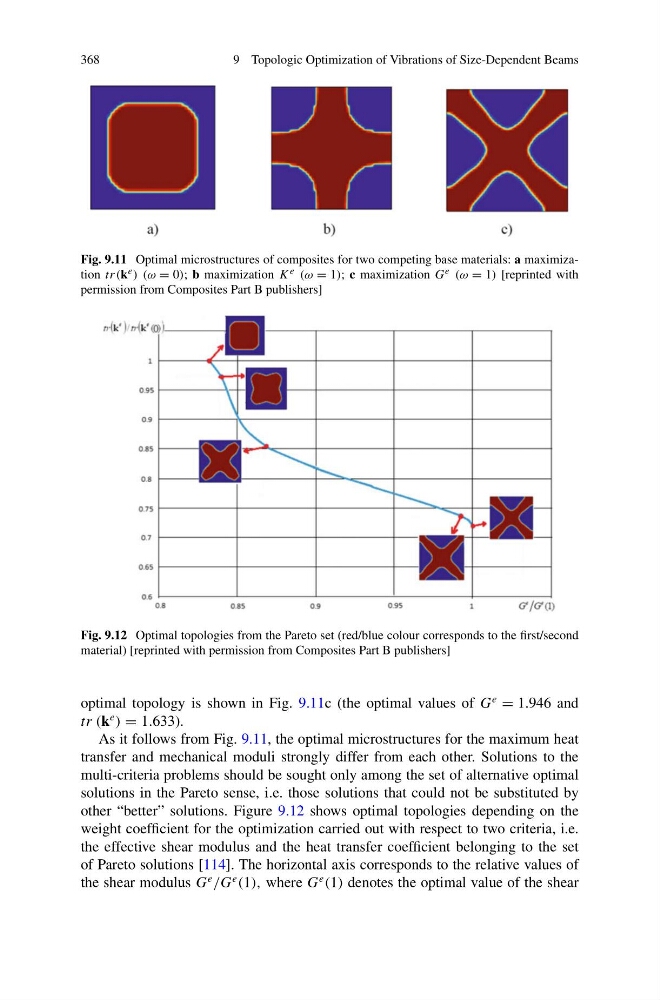
Fig. 9.11 Optimal microstructures of composites for two competing base materials: a maximization tr(k e ) (ω = 0); b maximization K e (ω = 1); c maximization G e (ω = 1) [reprinted with
permission from Composites Part B publishers]
Fig. 9.12 Optimal topologies from the Pareto set (red/blue colour corresponds to the first/second
material) [reprinted with permission from Composites Part B publishers]
optimal topology is shown in Fig. 9.11c (the optimal values of G
e
= 1.946 and
tr (k
e
) = 1.633).
As it follows from Fig. 9.11, the optimal microstructures for the maximum heat
transfer and mechanical moduli strongly differ from each other. Solutions to the
multi-criteria problems should be sought only among the set of alternative optimal
solutions in the Pareto sense, i.e. those solutions that could not be substituted by
other “better” solutions. Figure 9.12 shows optimal topologies depending on the
weight coefficient for the optimization carried out with respect to two criteria, i.e.
the effective shear modulus and the heat transfer coefficient belonging to the set
of Pareto solutions [114]. The horizontal axis corresponds to the relative values of
the shear modulus G
e
/G
e
(1), where G
e
(1) denotes the optimal value of the shear
9 Topologic Optimization of Vibrations of Size-Dependent Beams
Fig. 9.11 Optimal microstructures of composites for two competing base materials: a maximization tr(k e ) (ω = 0); b maximization K e (ω = 1); c maximization G e (ω = 1) [reprinted with
permission from Composites Part B publishers]
Fig. 9.12 Optimal topologies from the Pareto set (red/blue colour corresponds to the first/second
material) [reprinted with permission from Composites Part B publishers]
optimal topology is shown in Fig. 9.11c (the optimal values of G
e
= 1.946 and
tr (k
e
) = 1.633).
As it follows from Fig. 9.11, the optimal microstructures for the maximum heat
transfer and mechanical moduli strongly differ from each other. Solutions to the
multi-criteria problems should be sought only among the set of alternative optimal
solutions in the Pareto sense, i.e. those solutions that could not be substituted by
other “better” solutions. Figure 9.12 shows optimal topologies depending on the
weight coefficient for the optimization carried out with respect to two criteria, i.e.
the effective shear modulus and the heat transfer coefficient belonging to the set
of Pareto solutions [114]. The horizontal axis corresponds to the relative values of
the shear modulus G
e
/G
e
(1), where G
e
(1) denotes the optimal value of the shear